
Most law firm partners think about media relations the moment a reporter calls with an uncomfortable question. That’s the wrong starting point. What is media relations for law firms, at its core, is the practice of proactively managing your firm’s public reputation through earned coverage, journalist relationships, and message-aligned communications — not just responding when things go sideways. Legal media relations work integrates public relations with legal strategy to manage reputational risk at every stage, not just in crisis moments.
Table of Contents
- What media relations means for law firms
- Why law firms rely on earned media rather than paid advertising
- Handling media relations during litigation and legal crises
- Tailoring media relations strategies for different law firm profiles
- Why many law firms underestimate media relations until it’s a crisis
- Strengthen your law firm’s media presence with expert PR support
- Frequently asked questions
Key Takeaways
| Point | Details |
|---|---|
| Strategic reputation management | Media relations for law firms is crucial for managing reputation, especially in high-stakes legal scenarios. |
| Earned media trust | Earned media coverage offers more credibility than paid ads and influences client and referral decisions. |
| Crisis communication alignment | Coordinated messaging during litigation protects a firm’s credibility and helps manage public perception. |
| Tailored media approaches | Media strategies should adapt to a firm’s size, practice areas, and markets for maximum impact. |
| Proactive engagement benefits | Early, integrated PR efforts prevent crises and enhance growth opportunities through trusted visibility. |
What media relations means for law firms
Media relations for law firms is not a press release sent into the void. It is an ongoing discipline built on three pillars: relationship-building with journalists, earning coverage through demonstrated expertise, and controlling your firm’s narrative before someone else does.
At its most practical level, media relations involves identifying reporters who cover the legal sector, courts, business, or regulatory affairs and positioning your attorneys as go-to sources. That means pitching commentary on legal trends, offering client-anonymized case insights, and making your attorneys available for timely expert quotes. PR and media outreach increase visibility, strengthen credibility, and establish a trustworthy reputation — none of which paid advertising achieves at the same depth.
Here is what effective media relations for law firms actually includes:
- Earned media placements: Interviews on television, radio, and in print publications where attorneys appear as credible sources
- Thought leadership: Guest articles and bylined op-eds in legal trade publications or regional business journals
- Media training: Preparing attorneys to speak clearly, on-message, and without legal jargon that loses journalists mid-conversation
- Proactive pitching: Identifying news pegs — court rulings, regulatory changes, landmark verdicts — and connecting your attorneys to the story
- Reputation monitoring: Tracking media coverage and flagging stories that may require a response
Pro Tip: Build a short roster of two or three attorneys per practice area who are media-ready and willing to respond quickly. Reporters work on tight deadlines. The firm that replies first gets quoted. The firm that replies Tuesday gets nothing.
Consistent visibility across law firm PR services channels compounds over time. A partner quoted in The Wall Street Journal today becomes the first call a reporter makes next quarter.
Why law firms rely on earned media rather than paid advertising
Paid advertising tells the world you are good. Earned media shows the world that someone else thinks you are good. That distinction matters enormously in legal markets, where credibility is the product.
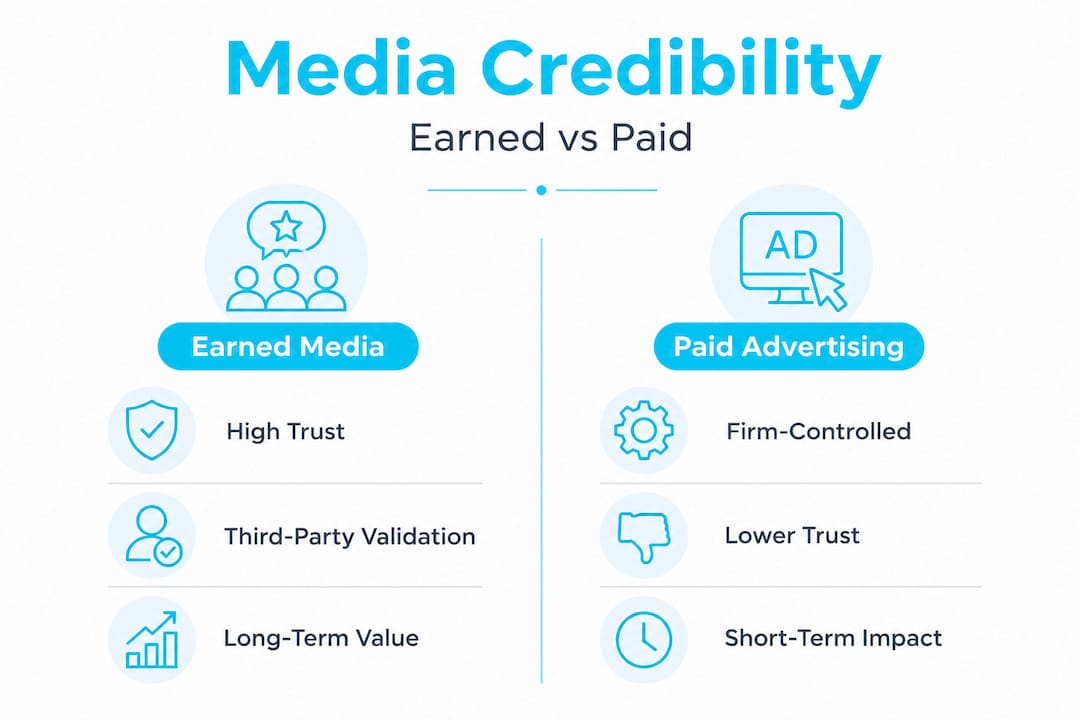
Legal PR earns credibility through third-party validation, which clients, referral sources, and even judges view as far more trustworthy than a display ad or sponsored content. When a reporter at a major outlet quotes your managing partner on a securities fraud ruling, that quote carries weight no ad buy can manufacture.
| Factor | Earned media | Paid advertising |
|---|---|---|
| Source of credibility | Independent journalist | Firm itself |
| Reader trust level | High | Moderate to low |
| Cost over time | Low (relationship-driven) | Ongoing spend required |
| SEO impact | Strong (editorial backlinks) | Minimal |
| Shelf life | Long (articles stay indexed) | Ends when budget ends |
| Influence on referral sources | Significant | Limited |
The practical implication is this: a mid-size litigation firm that builds a year of consistent earned media is easier to find online, easier to refer, and easier to trust than a firm running the same ad in a regional legal directory.
That said, earned media and paid campaigns are not competitors. They work together. Law firm SEO strategies benefit directly from earned editorial links, which signal authority to search engines. Pairing that organic credibility with targeted paid campaigns creates a visibility stack that neither tactic achieves alone. The earned versus paid media decision is not either/or — it is about sequencing them correctly.
Handling media relations during litigation and legal crises
This is where media relations gets genuinely complicated for law firms. A high-profile case or regulatory investigation attracts press attention before your team is ready, and every statement your firm makes carries both reputational and legal consequences.

Law firms engage litigation PR support to align messaging with legal strategy, manage public narratives, and protect reputation during high-profile cases. The PR team does not freelance. They work directly alongside outside or in-house counsel to ensure that nothing said publicly undermines the legal position or creates additional liability.
Here is a step-by-step framework for litigation-era communications:
- Designate a single spokesperson before any media contact occurs — usually a PR counselor or senior partner, not the lead trial attorney
- Align messages with legal strategy by reviewing all public statements with counsel before release
- Establish a rapid response protocol so that media inquiries receive a consistent, pre-approved response within one hour
- Monitor coverage continuously to catch narratives that need correction before they spread
- Prepare a holding statement for scenarios where you cannot comment fully, so reporters receive a professional, non-damaging response
“The goal during litigation is not to win in the press. It is to avoid losing in the press while the actual case is won in the courtroom.” — A principle guiding every effective litigation communications plan.
Integrating public relations with legal strategy helps clients manage risk and maintain credibility when legal issues become public. A well-managed litigation media strategy does not just protect. It can actively shape how a case is perceived by the public, regulators, and future clients watching from the sidelines.
Pro Tip: Never allow a litigating attorney to serve as their own spokesperson during an active case. Their job is to win in court. The moment they improvise with a reporter, they create a quote that may follow the case for years.
Tailoring media relations strategies for different law firm profiles
Not every law firm should pursue the same media mix. A boutique estate planning practice in Charlotte has different media needs than a national white collar defense firm with offices in five cities.
Local and regional press cover firm news and community involvement effectively for smaller practices, legal trade media builds peer credibility, and national outlets suit attorneys with nationally visible cases or regulatory insights.
| Firm profile | Best media targets | Primary goal |
|---|---|---|
| Small or local firm | Regional newspapers, local TV, community business journals | Name recognition, client trust |
| Mid-size regional firm | State bar publications, regional business media | Referral source credibility |
| Specialty practice (e.g., IP, white collar) | Legal trade publications, vertical industry media | Peer authority, client targeting |
| Large or national firm | National outlets, broadcast media, major digital publications | Brand authority, landmark case visibility |
A few observations that most media guides skip:
- Attorneys who avoid jargon get called back. Reporters do not have time to decode legalese. The partner who explains a ruling in plain English becomes a regular source.
- Trade media is underused. Coverage in Law360 or the American Lawyer carries enormous weight with general counsel at corporations who make hiring decisions.
- Community involvement is a media asset. Pro bono work, legal education initiatives, and bar leadership positions generate local press that compounds into reputation over years.
Custom law firm PR programs recognize that firm size, practice area, and geography shape what “good coverage” actually looks like.
Why many law firms underestimate media relations until it’s a crisis
Here is the uncomfortable reality. Most law firms treat media relations the way most people treat estate planning — they know they should do it, they intend to get around to it, and then something forces the issue.
Firms that treat PR as an afterthought pay for that neglect in lost opportunities and crisis mismanagement. When a negative story breaks and you have no existing relationship with the reporter, no standing as a credible source, and no prepared message, you are managing a wildfire with a garden hose.
The firms that handle media crises well did not get lucky. They built journalist relationships during calm periods. They had attorneys who had done interviews before. They had holding statements drafted and approved. When the call came, they were ready because they had been doing the work all along.
There is also a compounding digital benefit that most partners miss entirely. An integrated PR strategy that produces consistent earned media creates a trail of indexed editorial coverage that strengthens search visibility, builds your attorneys’ Google presence, and makes your firm far more discoverable to clients who research before they call. PR and SEO are not separate functions. Done correctly, they reinforce each other at every level.
The firms winning client acquisition battles in 2026 are not necessarily the ones with the largest advertising budgets. They are the ones that show up in trusted editorial contexts when a potential client searches for expertise, asks a peer for a referral, or sees a name quoted in a publication they respect.
Strengthen your law firm’s media presence with expert PR support
Your firm has expertise worth communicating. The gap between firms that grow and firms that plateau is often not the quality of their legal work — it is whether the right people ever hear about it.

Goldman McCormick Public Relations, named by Forbes Magazine as one of America’s Best PR Firms and recognized by the New York Observer as a top five agency specializing in legal PR, works directly with law firms to build media visibility that converts into real client opportunities. From television and radio placements to print and podcast media, we know how to position attorneys as credible, quotable authorities. Our law firm media relations services are built for firms ready to move from reactive to recognized.
Frequently asked questions
What exactly does media relations involve for law firms?
Media relations for law firms includes building relationships with journalists, securing earned media like interviews and articles, and managing public communications that boost visibility and credibility. PR services help firms earn positive media exposure and position attorneys as respected voices in their practice areas.
Why is earned media more effective than paid advertising in legal marketing?
Because earned media is validated by independent third parties, it carries more trust and credibility than paid ads, influencing clients, referral sources, and peers far more effectively. Legal PR’s third-party validation is precisely what makes it more persuasive in legal markets where credibility is everything.
When should a law firm engage media relations during litigation?
Firms should engage media relations early, when anticipating high-profile lawsuits or regulatory investigations, to align messaging with legal strategy before reporters start calling. Litigation PR support is most effective when activated before a story breaks, not after.
How does media relations integrate with digital marketing for law firms?
Earned media coverage creates editorial backlinks and indexed content that directly improves search visibility, making your firm easier to find and harder to ignore online. Authoritative earned media and PR content together build a more resilient search presence than either tactic achieves alone.