
Most law firms think of publicists as press release distributors. Someone who sends announcements to journalists and waits for coverage. That misunderstanding is exactly why so many firms struggle with their public image when it matters most. Understanding what does publicist do for lawyers reveals a far more demanding and strategic function, one that sits at the intersection of legal strategy, media management, and reputation protection.
Table of Contents
- Understanding the publicist’s role in legal representation
- How publicists balance legal strategy and media narratives
- Key publicist services for law firms: From crisis to credibility
- Navigating ethical and compliance challenges in legal publicity
- Measuring the impact: How publicists boost law firm reputation and client acquisition
- Our perspective: The firms that wait until a crisis are already behind
- Work with a legal PR firm that knows your world
- Frequently asked questions
Key Takeaways
| Point | Details |
|---|---|
| Strategic messaging | Publicists translate complex legal strategies into clear, compelling narratives aligned with firm objectives. |
| Crisis management | They manage media and public perception during sensitive legal and reputational crises to protect credibility. |
| Ethical compliance | Publicists operate within strict legal ethics and confidentiality rules to ensure communications are risk-managed. |
| Media impact | Earned media placements boost a law firm’s visibility and credibility, accelerating client acquisition. |
| Integrated collaboration | Effective publicity requires close coordination between legal and PR teams to maintain message consistency. |
Understanding the publicist’s role in legal representation
When a law firm hires a publicist, they are not just buying media contacts. They are hiring someone to manage how the firm and its clients are perceived by judges, juries, regulators, and the general public, often simultaneously. That is a different job entirely from standard corporate PR.
Publicist support for lawyers begins well before any camera turns on or reporter calls. A legal publicist develops messaging frameworks that align with active litigation strategy. Every public statement, every interview, every social media post gets filtered through the question: does this help or hurt our legal position? That discipline is what separates a legal publicist from a general communications professional.
The role of a publicist lawyer includes several specific responsibilities that most firms underestimate:
- Litigation communications: Crafting statements and narratives during active cases that protect the client without prejudicing proceedings
- Media monitoring: Tracking coverage in real time to identify damaging narratives before they gain traction
- Attorney preparation: Coaching lawyers on how to speak to journalists without making inadvertent disclosures
- Stakeholder communications: Managing messaging to investors, employees, and community members during high-profile matters
- Reputation defense: Responding to negative coverage quickly and on the record when silence would be worse
Legal PR/publicity includes advising on messaging during active litigation, regulatory investigations, and reputational crises, with a sharp focus on protecting credibility and managing risk from every public statement. That is not press release work. That is risk management with a media component.
Understanding media and communications tactics in legal crises is essential for any firm that handles high-profile matters, class actions, regulatory investigations, or cases with significant public interest.
How publicists balance legal strategy and media narratives
Here is where the job gets genuinely difficult. Legal strategy and media strategy often pull in opposite directions. Lawyers want to say as little as possible. Journalists want as much as possible. A publicist’s job is to find the narrow corridor between those two forces and hold the firm there under pressure.
The alignment problem is real and consequential. Law and PR teams must coordinate so the public-facing narrative matches legal realities, because conflicting messages can worsen reputational outcomes during crises. A firm that says one thing in court and another thing on television creates a credibility problem that is very hard to undo.

Publicists solve this by functioning as translators. They take complex legal positions and convert them into plain language that does not create new legal exposure. They also work in reverse, explaining to attorneys why certain legally defensible statements are PR disasters waiting to happen.
Key practices that define this balancing act include:
- Message discipline: Every spokesperson uses the same approved language, every time
- Proactive narrative setting: Getting the firm’s version of events into the public record before opposing narratives take hold
- Triage communications: Deciding quickly what needs a response and what is better left unanswered
- Crisis scenario planning: Preparing response frameworks before a crisis hits, not during it
Pro Tip: The best time to develop your crisis messaging framework is six months before you need it. Firms that build these protocols in calm periods respond far more effectively when a high-stakes matter breaks publicly.
Understanding communications tactics during legal crises is not optional for firms handling complex litigation. It is a core operational competency.
Key publicist services for law firms: From crisis to credibility
The concrete deliverables a publicist provides to a law firm span a wider range than most managing partners realize. Here is what the work actually looks like in practice:
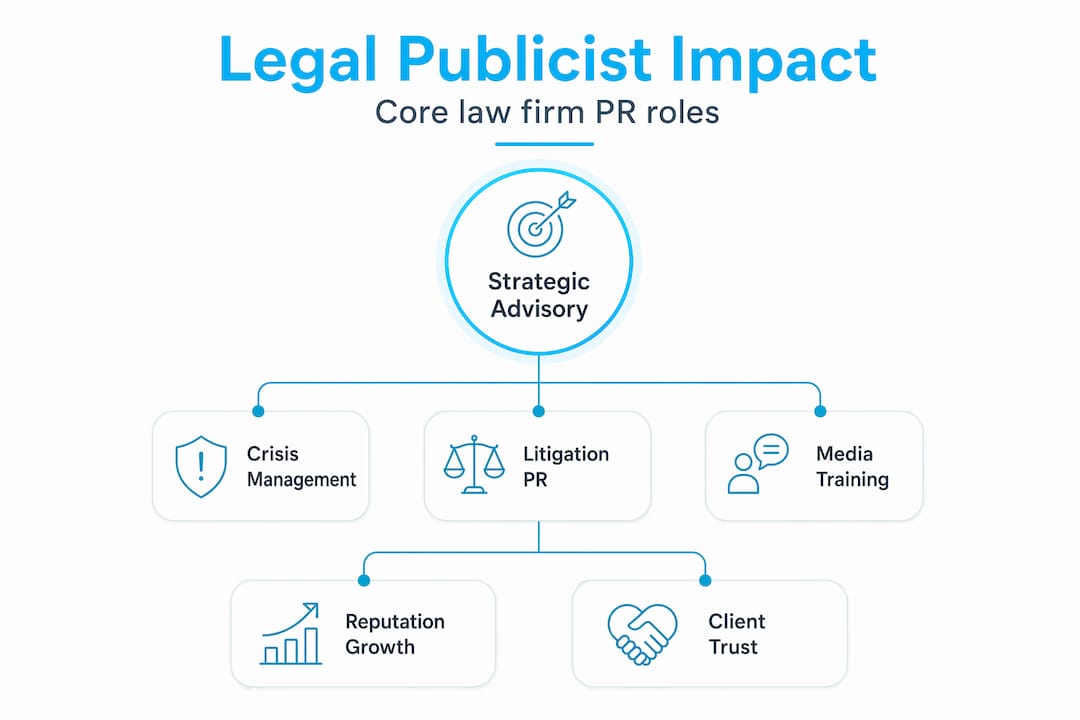
- Crisis communications: Rapid response messaging when a case, verdict, or attorney conduct becomes a news story
- Trial publicity: Managing media coverage during active trials to influence public perception without interfering with proceedings
- Strategic messaging advisory: Ongoing counsel on how the firm positions itself across all public channels
- Media training for attorneys: Formal coaching sessions that prepare lawyers for television, radio, and print interviews
- Risk advisories: Pre-publication review of statements to identify potential legal or ethical exposure before anything goes public
Litigation communications, crisis management, trial publicity, strategic advisory, and attorney media training represent the full spectrum of publicist services for law firms. Each service addresses a specific vulnerability that unmanaged firms face regularly.
Here is a comparison of what firms get with versus without a dedicated legal publicist:
| Situation | Without a publicist | With a publicist |
|---|---|---|
| Breaking news involving a client | Reactive, inconsistent statements | Prepared response deployed within hours |
| Attorney interview request | Attorney speaks off the cuff | Attorney delivers approved, risk-reviewed messaging |
| Negative media coverage | No response or defensive reaction | Proactive counter-narrative with media outreach |
| Trial verdict coverage | Firm scrambles for comment | Pre-drafted statements ready for each outcome |
| Regulatory investigation | Silence or damaging disclosures | Coordinated, compliant communications strategy |
Pro Tip: Media training is not just for senior partners. Any attorney who might speak to press, even once, needs at least a basic briefing on approved messages and off-limits topics. One unguarded comment from a junior associate can undo months of careful reputation work.
Explore public relations services for law firms to understand the full scope of what a dedicated legal PR team can provide.
Navigating ethical and compliance challenges in legal publicity
Publicity in law is not like publicity in entertainment or consumer brands. The rules are stricter, the stakes are higher, and the consequences of getting it wrong extend beyond bad press. They can include bar complaints, sanctions, and mistrial motions.
Publicists working with law firms must understand attorney ethics rules, particularly those governing extrajudicial statements. Many state bar rules restrict what attorneys can say publicly about pending cases. A publicist who does not know those rules is a liability, not an asset.
The compliance dimension of the role shapes every aspect of how publicists operate in legal settings:
- Pre-clearance protocols: All media statements reviewed by both the publicist and a supervising attorney before release
- Confidentiality boundaries: Publicists are often brought into attorney-client privilege structures to protect communications
- Advertising rule compliance: Firm-facing publicity must not cross into attorney advertising without following applicable regulations
- Witness and juror protection: Statements during active trials must avoid any content that could be construed as jury tampering or witness intimidation
In litigation and crisis work, publicists must operate within strict limits on disclosures, combining publicity with compliance and risk review at every stage. This is not a burden. It is what makes legal publicists genuinely different from general PR practitioners.
Pro Tip: When vetting a publicist for your firm, ask specifically about their experience with your state’s bar rules on extrajudicial statements. A publicist who cannot answer that question fluently is not ready for legal PR work.
Understanding legal compliance in PR for law firms is the foundation that makes every other publicity effort sustainable and safe.
Measuring the impact: How publicists boost law firm reputation and client acquisition
Reputation is not abstract. It converts directly into client inquiries, referral quality, and the ability to attract top legal talent. A firm that appears regularly in credible media outlets carries authority that no paid advertisement can replicate.
Consistent credible media coverage increases digital credibility and client acquisition quality for attorneys. That finding reflects something experienced legal marketers have known for years: earned press outperforms paid placement in building trust with sophisticated clients.
Here is how media impact translates into measurable firm outcomes:
| Publicity activity | Business impact |
|---|---|
| TV appearance by lead attorney | Immediate credibility signal to prospective clients |
| Feature in national publication | Long-term search visibility and authority signals |
| Podcast interview | Deepens trust with niche audiences and referral sources |
| Crisis communications handled well | Preserves existing client relationships and prevents departures |
| Consistent media presence over 12 months | Compounding reputation effect that paid ads cannot replicate |
The digital dimension matters more than ever. When a prospective client searches for an attorney, the results they see shape their decision before they ever pick up the phone. Publicists who understand both media placement and search visibility give firms a compounding advantage.
Key outcomes that publicist-led work drives for law firms:
- Search engine authority: News coverage generates backlinks and citations that improve organic search rankings
- Referral network credibility: Other attorneys and professionals refer to firms they see as visible authorities
- Talent attraction: Top associates want to work at firms with strong public profiles
- Client retention: Clients who see their firm covered positively feel confident in their choice
Explore media impact on law firm visibility to understand how consistent earned media builds the kind of reputation that generates business over time.
Our perspective: The firms that wait until a crisis are already behind
After working in legal PR for years, the pattern is unmistakable. Firms that engage publicists only when something goes wrong are managing damage. Firms that build ongoing media relationships are building assets.
The conventional wisdom is that law firms need PR when they are in trouble. We think that gets it exactly backward. A firm with no established media presence and no prepared messaging framework is walking into every potential crisis unarmed. The publicist’s most valuable work happens in the quiet periods, building the credibility infrastructure that makes crisis response actually work.
There is also a competitive reality that many firms ignore. The attorneys who appear on television, get quoted in major newspapers, and are featured in legal publications are not necessarily the best lawyers in their markets. They are often simply the ones who invested in visibility. Clients cannot evaluate legal skill directly. They evaluate reputation, presence, and trust signals. Publicists build exactly those things.
The importance of publicists for lawyers goes beyond media placement. It is about building a firm that is known, trusted, and sought out before anyone even needs a lawyer. That is the real return on the investment.
Work with a legal PR firm that knows your world
Goldman McCormick Public Relations has been named by Forbes Magazine as one of America’s Best PR Firms and was cited by the New York Observer as one of the top five public relations agencies specializing in legal PR. We know what it takes to get attorneys seen on television, heard on radio, and featured in the publications that matter to your clients and referral sources.
If your firm is ready to build a media presence that works before, during, and after high-stakes matters, we can help. Our team has the media relationships, the legal industry knowledge, and the track record to deliver results that move the needle. Contact Goldman McCormick PR to start a conversation about what a dedicated legal publicist can do for your firm’s reputation and growth.
Frequently asked questions
What are the main duties of a publicist working with lawyers?
A publicist for lawyers manages media relations, crafts strategic messaging aligned with legal strategy, prepares attorneys for media interactions, and protects firm reputation during sensitive matters. As recognized in litigation communications work, publicists develop messaging that aligns with legal strategy and prepares attorneys for media scrutiny.
How do publicists handle confidentiality and legal restrictions?
They follow attorney ethical rules closely, advising on what can be disclosed without violating confidentiality or bar regulations, and often serve as risk managers during public communications. Publicists in litigation work operate within strict limits on disclosures, combining publicity with compliance review at every stage.
Why is aligning PR and legal messaging important in law firms?
Alignment ensures the public narrative supports legal strategy and prevents contradictory messages that damage the firm’s credibility or litigation outcomes. Conflicting messaging between legal and PR teams can worsen reputational outcomes during crises, making coordination a non-negotiable practice.
Can publicity help law firms attract more clients?
Yes. Credible media coverage and consistent visibility build trust and authority that influence prospective clients and referral sources. Consistent credible media coverage increases client acquisition quality for attorneys by establishing the kind of authority that paid advertising simply cannot replicate.