
New York criminal defense is one of the most competitive legal markets in the country, and winning clients here requires more than a billboard or a Google ad. You need trust, and trust in this field is built through credibility that comes from outside your own marketing. When you use PR to win more clients, you are not shouting about yourself. You are getting respected journalists, broadcasters, and publications to validate your expertise for you. That third-party endorsement changes how prospects perceive you before they ever pick up the phone.
Table of Contents
- Understanding the role of PR in winning clients ethically
- Setting up your practice for PR success: preparation essentials
- Executing PR strategies to build visibility and attract clients
- Turning PR visibility into new client inquiries and growth
- Common pitfalls and best practices for legal PR in New York
- A fresh take on winning clients with PR in criminal defense
- How Goldman McCormick PR can help New York criminal defense attorneys win more clients
- Frequently asked questions
Key Takeaways
| Point | Details |
|---|---|
| Earned media builds trust | PR works by earning third-party validation, which is more trusted by clients than paid ads. |
| Respect legal ethics | All PR communications must be truthful, confidential, and avoid prejudicing legal processes in New York. |
| Prepare educational assets | Use analytical content explaining legal procedures to build authority ethically and effectively. |
| Convert PR into leads | Leverage media coverage in your sales process to turn visibility into client inquiries. |
| Avoid PR mistakes | Manage expectations carefully and monitor narratives to sustain long-term PR success. |
Understanding the role of PR in winning clients ethically
Public relations, at its core, is about earned media and credibility, not paid placement. A potential client who reads a news story quoting you as a criminal defense expert trusts that quote far more than any ad you could run. That distinction matters enormously in criminal defense, where people are often making high-stakes decisions under stress and are naturally skeptical of self-promotion.
For New York attorneys, public relations for client acquisition comes with a specific set of ethical guardrails you cannot ignore. The New York Rules of Professional Conduct require that all attorney communications be truthful, confidential, and non-prejudicial. That means you cannot comment on a pending case in ways that could influence a jury, and you cannot reveal client information even when telling a compelling story.
Ethics Opinion 1294 from the New York State Bar Association specifically addresses solicitation and advertising, drawing a clear line between permissible education-based communication and prohibited direct solicitation. Understanding where that line sits is not optional. It is the foundation of any legal PR strategy.
Here is what ethical, effective PR looks like for criminal defense attorneys:
- Earned media coverage in local news, legal publications, and broadcast outlets that positions you as a knowledgeable voice on criminal law
- Expert commentary on legal developments, court decisions, and legislative changes that affect New Yorkers
- Educational content explaining how the criminal justice system works, what defendants’ rights are, and what to expect during proceedings
- Thought leadership articles in bar journals or legal media that demonstrate depth of knowledge
- Podcast and radio appearances discussing criminal defense topics in accessible, public-interest terms
Notice what is absent from that list. There are no case outcomes, no client testimonials tied to identifiable matters, and no promises of results. Explore more legal PR insights to understand how this framework applies to your specific practice area.
Setting up your practice for PR success: preparation essentials
Before you pitch a single journalist or draft a single op-ed, you need a clear picture of what you want PR to accomplish. Visibility alone is not a goal. Qualified client inquiry growth is. Knowing the difference shapes every decision you make.
Effective legal PR focuses on educating and building thought leadership rather than promoting case results. That framing actually reduces your ethical risk while increasing your credibility. When you explain how bail hearings work in New York, or what “reasonable doubt” actually means in practice, you are serving the public and demonstrating expertise simultaneously.

Your PR assets should be educational and analytical, explaining legal procedures, standards, and client rights in plain language. Think of these as tools that work for you 24 hours a day. A well-written FAQ about what to do when arrested in New York City builds trust with someone who finds it at 2 a.m. after a family member is taken into custody.
Preparation checklist before launching PR activities:
- Define your primary PR goal (visibility, trust-building, or inquiry volume)
- Identify two to three topic areas where you can speak with genuine authority
- Draft a messaging guide that educates without disclosing client matters
- Create a library of PR assets: articles, FAQs, expert commentary pieces, and legal explainers
- Train staff on what can and cannot be shared publicly, particularly regarding active cases
- Establish a clear review process for any statement before it reaches a reporter
Pro Tip: Build a “media-ready” one-pager about yourself that includes your background, areas of focus, and the types of topics you can speak to. Reporters work on tight deadlines. Making their job easier makes you their first call.
| PR asset type | Primary purpose | Ethical risk level |
|---|---|---|
| Legal explainer articles | Education and authority | Low |
| Expert commentary on news | Visibility and credibility | Low to medium |
| Case filing analysis | Public interest storytelling | Medium |
| Client outcome statements | Social proof | High, requires careful review |
| Op-eds on criminal justice policy | Thought leadership | Low |
Preparing PR assets legally is not a one-time task. It is an ongoing discipline that keeps your communications compliant and your reputation intact.
Executing PR strategies to build visibility and attract clients
Preparation gives you the foundation. Execution is where visibility actually happens. The good news is that New York’s media landscape is enormous, and there is consistent demand for credible criminal defense voices who can explain complex legal situations to general audiences.
Here is a step-by-step approach to deploying effective PR tactics for businesses in the legal space:
-
Identify your target media outlets. Local TV news, New York legal publications, criminal justice podcasts, and neighborhood newspapers all need sources. Make a list of 15 to 20 outlets and the reporters who cover courts and criminal justice.
-
Pitch yourself as a source, not a subject. Reporters want expert analysis, not attorney profiles. Offer to explain a recent court ruling, comment on a high-profile case (one you are not involved in), or clarify a legal misconception circulating in the news.
-
Build genuine relationships with reporters. Send a brief, useful note when you see a story that is legally inaccurate. Offer a correction or a follow-up angle. That kind of helpfulness is remembered. Contributing expert analysis to legal news builds your reputation without crossing into self-promotion.
-
Use public court filings as storytelling tools. Public documents are public for a reason. When a filing raises an interesting legal question, you can discuss the legal principle involved without disclosing anything confidential. Managing PR in high-profile litigation means using filings strategically, correcting misinformation quickly, and controlling the narrative before someone else does.
-
Correct misinformation immediately. If a news story gets the law wrong in a way that could harm public understanding, reach out and offer a correction. This positions you as a reliable resource and earns goodwill with reporters.
-
Speak on the record, carefully. Every statement you make publicly is a PR moment. Prepare your talking points in advance, stay within your ethical boundaries, and never speculate about outcomes.
Pro Tip: Set up Google Alerts for terms like “New York criminal defense,” “NYC arrest,” and relevant legal topics. When a story breaks that fits your expertise, you have a narrow window to offer commentary. Speed and relevance are what get you quoted.
Explore how expert PR firm strategies translate these tactics into sustained media presence for attorneys.
Turning PR visibility into new client inquiries and growth
Getting quoted in the New York Times is satisfying. Converting that quote into a client consultation is the actual goal. Many attorneys treat PR as a brand exercise and then wonder why the phone does not ring. The problem is almost always in the conversion layer, not the visibility itself.
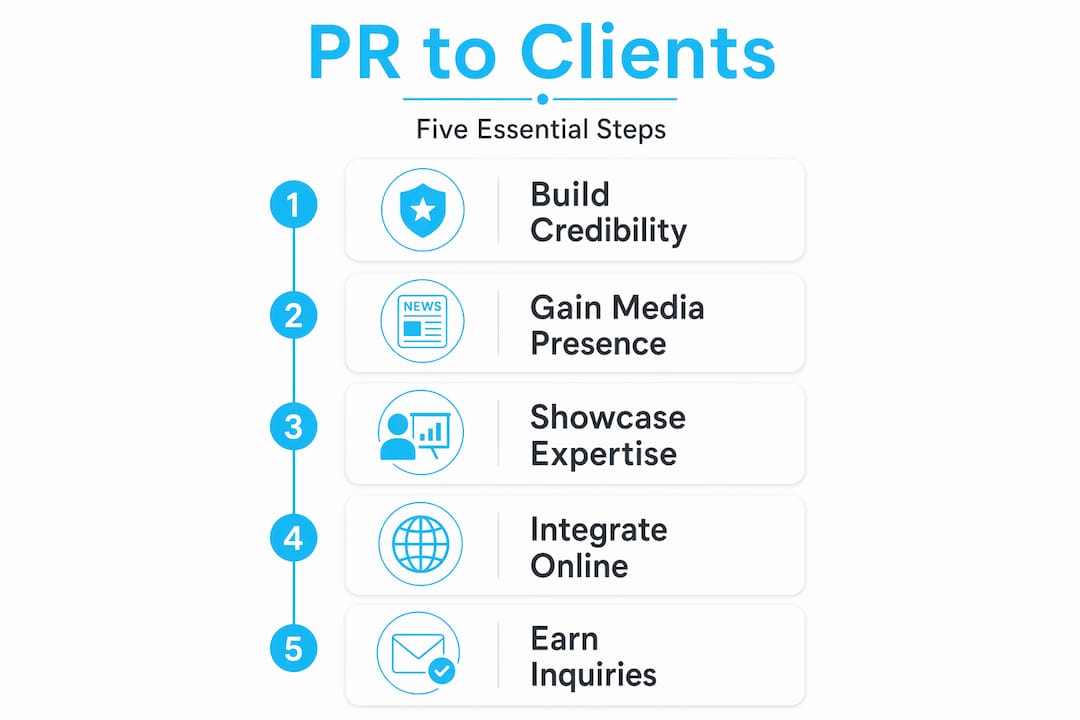
Think of PR as a funnel enabler. It lowers the skepticism a prospect brings to their first contact with you. When someone calls your office because they saw you on the news or read your article in a legal publication, they already believe you know what you are doing. That is a fundamentally different conversation than a cold inquiry from a Google search.
PR functions as assisted growth by lowering friction for prospects and supporting your intake team with third-party validation that clients can see. Here is how to make that work in practice:
- Create a “As seen in” section on your website that displays logos or links to your media coverage. This works as social proof the moment someone lands on your homepage.
- Reference earned media in consultation outreach. When following up with a prospective client, your intake staff can mention relevant coverage naturally. “You may have seen our attorney quoted in the Daily News on this exact issue” is a confidence builder.
- Use coverage in email follow-ups. A link to a relevant article you authored or were featured in adds credibility to any communication.
- Track where inquiries originate. Ask every new caller or contact how they found you. When someone mentions a specific article or broadcast appearance, log it. Over time, this data tells you which PR activities are actually driving client acquisition through PR.
- Respect solicitation rules in follow-up. New York rules prohibit certain forms of direct outreach. Make sure your intake process is reviewed for compliance before you scale it.
| Conversion tactic | Impact on client trust | Implementation effort |
|---|---|---|
| “As seen in” media wall on website | High | Low |
| Coverage references in intake scripts | High | Medium |
| Earned media links in email follow-ups | Medium | Low |
| Tracking PR-sourced inquiries | Medium | Medium |
| Successful conversion via sales scripts | High | Medium |
Common pitfalls and best practices for legal PR in New York
Even well-intentioned PR efforts can backfire. The most common failure mode is not an ethics violation. It is unrealistic expectations combined with poor follow-through.
Clients often erode PR results by mismanaging media expectations and failing to adapt their behavior after coverage runs. An attorney who gets a great segment on a local news channel and then does not update their website, train their intake staff, or follow up on inquiries has wasted the opportunity entirely.
Here are the pitfalls that most frequently undermine legal PR efforts:
- Assuming coverage converts automatically. It does not. You need a system to capture and convert the attention PR generates.
- Ignoring ethics rules under pressure. When a high-profile case generates media interest, the temptation to say more than you should is real. Resist it.
- Mishandling media interactions. Going off the record, speculating, or speaking emotionally can damage your reputation faster than any positive coverage can build it.
- Neglecting narrative management between coverage moments. Even successful legal outcomes may not yield positive public opinion without active narrative management and misinformation correction.
- Treating PR as a one-time campaign rather than an ongoing practice.
Pro Tip: After any significant media appearance, hold a brief internal debrief. What questions came up? What would you answer differently? This kind of reflection sharpens your media skills over time.
“Your reputation in the media is built one interaction at a time. A single careless comment can undo months of careful positioning. Treat every media contact as a long-term relationship, not a transaction.”
A fresh take on winning clients with PR in criminal defense
Here is something most PR guides will not tell you: the ethical constraints New York places on attorney communications are not obstacles to effective PR. They are your competitive advantage.
Most attorneys treat the rules as a cage. The smarter move is to treat them as a filter. When you commit to truthful, educational, non-prejudicial communication, you automatically differentiate yourself from the attorneys who overpromise, sensationalize, and eventually damage their own reputations. Legal PR success comes from respecting ethics boundaries as guardrails that protect credibility and client confidentiality, turning compliance into a competitive strength.
The conventional wisdom in marketing is to move fast, be loud, and claim the space. In criminal defense PR, that approach gets you in trouble. The attorneys who build the most durable client pipelines through PR are the ones who show up consistently, say something genuinely useful, and let the accumulated credibility do the selling.
Treat PR as a long-term engine of credibility that compounds over time. A single media appearance fades. A pattern of expert commentary, educational content, and media relationships builds a reputation that becomes self-reinforcing. Journalists call you because they have called you before. Clients find you because they have read three of your articles and already trust you before they dial.
This mindset also changes how you measure success. Stop counting press hits. Start counting how many consultation calls mention something they read or heard about you. That is the metric that tells you whether your PR is actually working. Explore deep legal PR insights on how this compounding approach plays out in practice.
The attorneys who win the most clients through PR are not the loudest ones. They are the most consistently credible ones.
How Goldman McCormick PR can help New York criminal defense attorneys win more clients
If you are serious about using PR to build your practice, you need a partner who understands both the media landscape and the ethical environment you operate in. Goldman McCormick PR has been named by Forbes Magazine as one of America’s best PR firms and was recognized by the New York Observer as one of the top five agencies specializing in legal PR. That recognition did not come from running generic campaigns.

Our team knows how to get New York criminal defense attorneys seen on television, heard on radio, and read about in the publications your prospective clients actually trust. We build earned media strategies that comply with New York Bar regulations, develop educational content that positions you as the go-to expert in your market, and help you convert that visibility into qualified client inquiries. Every program we build is tailored to your firm’s goals and your ethical obligations.
If you are ready to ethically use PR to attract more clients and build a reputation that compounds over time, explore Goldman McCormick PR services and take the first step toward sustainable practice growth.
Frequently asked questions
How can criminal defense attorneys use PR without violating New York ethics rules?
By focusing on truthful, confidential communications that avoid prejudicial commentary about ongoing cases, attorneys can build credibility and visibility without crossing ethical lines. Educational content and expert commentary on general legal topics are the safest and most effective formats.
What types of PR content are effective for criminal defense lawyers?
Educational and analytical content explaining legal procedures, defendants’ rights, and common questions about the criminal justice system builds authority while keeping confidentiality and ethics intact. Think explainer articles, expert commentary on news events, and public-interest legal analysis.
How does PR convert visibility into actual client inquiries?
PR supports client acquisition by providing third-party validation that lowers prospect skepticism. When attorneys integrate earned media coverage into their websites, intake scripts, and follow-up communications, that credibility actively encourages prospects to reach out.
What common mistakes should attorneys avoid in legal PR?
The biggest mistakes include overpromising results, ignoring ethics rules under media pressure, failing to manage media expectations properly, and treating PR as a one-time event rather than an ongoing discipline. Consistent narrative management is what separates attorneys who benefit from PR and those who do not.