
Instead of “no comment,” say: “I can’t speak to that right now, but here’s what I can tell you.” It acknowledges the question, sets a boundary, and hands the reporter something usable. That matters because Nearly 90% of reporters have heard “no comment” in the last three years, and about 39% of audiences interpret it as a sign someone is hiding something.
TL;DR:
- Using prepared bridging phrases redirects questions to factual or controlled topics without sacrificing credibility or control.
- Rehearsed scripts should include specific timeframes and facts to ensure clear, confident responses under pressure.
- Legal and crisis situations require precise language that acknowledges constraints without inventing or guessing details, reducing legal risk.
- Cross-cultural differences suggest that framing refusals as limits plus alternatives works better internationally than outright “no comment.”
- Consistent media training and rehearsal help spokespeople deliver effective, on-message responses instead of defaulting to unhelpful “no comment” replies.
Table of Contents
- What Are Good No Comment Alternatives?
- How Do You Choose the Right Alternative to No Comment?
- What Is the Bridging Technique and How Does It Work?
- Handling Legal and Crisis Questions Without Saying Too Much
- Scripts for Lawyers and Spokespeople
- How Do You Handle Follow-Up Questions After You’ve Declined to Answer?
- Examples of Effective Responses Under Pressure
- Do Cultures Interpret “No Comment” Differently?
- Training Spokespeople to Use Alternatives Under Pressure
- What Are the Legal Risks of Different Non-Answers?
- Why Disciplined Phrasing Actually Protects You
- Get Media Training Before You Need It
- Sources
What Are Good No Comment Alternatives?
The best no comment alternatives share one trait: they trade a dead end for a bridge. Below are fifteen phrases grouped by the situation that calls for them, each with a quick note on timing and a sample line you can adapt on the spot.
Quick pivots and bridges work when you want to redirect without stonewalling.
- “I can’t speak to that specific point, but what I can tell you is…” Use when the question strays outside your lane. Example: “I can’t speak to the investigation, but I can tell you our safety protocols haven’t changed.”
- “That’s not something I can confirm, but here’s the bigger picture.” Use to reframe toward context you control. Example: “I can’t confirm the settlement figure, but the bigger picture is we’ve resolved the dispute.”
- “Let me address what I do know.” Use to steer toward confirmed facts fast.
Timing and follow-up phrases buy you room without sounding dismissive.
- “We’re still gathering the facts, and I’ll have more for you by [specific time].” Use during a developing story.
- “I don’t have that detail in front of me, but I’ll follow up by end of day.” Use when you genuinely don’t know.
- “That’s under review, and we expect an update this week.” Use for pending decisions.
Confidential or legal refusals protect your position without sounding cagey.
- “I’ve been advised not to discuss the litigation directly, but here’s what’s public record.” Use in active legal matters.
- “That involves proprietary information I’m not able to share.” Use for trade secrets or competitive data.
- “Our legal team is handling that question. I can direct you to them.” Use to redirect appropriately.
Neutral placeholders hold the line when nothing else fits.
- “That’s a fair question, and I want to give you an accurate answer rather than a rushed one.” Use when you need a beat to think.
- “I’ll circle back once I’ve confirmed the details.” Use for verification gaps.
How Do You Choose the Right Alternative to No Comment?
Run through this checklist before you answer, especially live or on camera:
- Is it public information? If yes, share it plainly. If not, say so and explain why in one sentence.
- Is it under litigation or active investigation? If yes, use a legal-safe phrase and refer to counsel.
- Can you promise a follow-up and a real timeframe? Only commit to a date you can actually hit.
- Would answering harm privacy or proprietary interests? If yes, name the boundary instead of dodging it.
Management recommends the same sequence: express willingness to cooperate, give a brief reason, then offer either a safe substitute or a timeframe.
Three scripts to rehearse:
Friendly interview: “Great question. I don’t have that number yet, but I’ll get it to you by tomorrow morning.”
Hostile question: “I understand why you’re asking. I can’t speak to the specifics, but here’s what our records show.”
Live broadcast: “That’s still developing. What I can confirm right now is [one fact].”
Pro Tip: Say your bridge and your follow-up deadline out loud, at normal speaking speed, before you ever face a camera or a phone call. If it sounds stiff in your kitchen, it will sound worse under lights.
What Is the Bridging Technique and How Does It Work?
Bridging means you acknowledge the question, briefly note a limit, then pivot to something you can actually say. PR trainers who track newsroom behavior argue “no comment” cedes control of the story, while a rehearsed bridge lets you keep steering it.
Three templates worth memorizing:
- “I understand the concern. What matters here is [confirmed fact].”
- “That’s outside what I can confirm today. What I can tell you is [message].”
- “Good question. Let me put that in context: [pivot].”
Annotated example, hostile reporter: “Why won’t you release the report?” becomes “I hear the frustration. What I can share is that the findings are under final review and we’re targeting release next week.” That answers the emotion, not the trap.
Annotated example, neutral reporter: “Any update on the merger?” becomes “Nothing final yet, but I can tell you both teams met this morning and expect a statement by Friday.” Short, factual, forward looking.
On broadcast, keep sentences under fifteen words, pause a full beat before answering, and deliver the bridge at a calm, even pace. Rushed answers sound defensive even when the content is fine.
Handling Legal and Crisis Questions Without Saying Too Much
When litigation or an active investigation is involved, precision protects you more than silence does. A lawyer-safe version might sound like: “I’ve been advised not to comment because this matter is subject to litigation, but here’s what I can tell you.” That names the constraint instead of hiding it.
Where possible, offer something concrete in place of raw silence. A press release, a confirmed quote, or a specific follow-up window all beat a flat refusal. Spokesperson training guidance is blunt on one point: never invent a number or a date you haven’t verified. If you don’t have a timeline, say you don’t have one yet rather than guessing.
Scripts for Lawyers and Spokespeople
Lawyers and corporate spokespeople carry different risk than a solo executive, so their language needs tighter guardrails.
- Lawyer phrasing: “I’m not able to discuss pending matters, but I can direct you to our media relations contact for a statement.” This routes the reporter without conceding ground.
- Executive on live TV: “What I can confirm on air right now is [fact]. We’ll issue a full statement once details are finalized.”
- Radio or print spokesperson: “That question touches on information we’re not disclosing yet. Here’s what’s already public.”
One more thing worth flagging for publicly traded companies: any comment that touches material financial information runs into Regulation FD disclosure rules, so route those questions to investor relations or legal before answering on the record.
How Do You Handle Follow-Up Questions After You’ve Declined to Answer?
Reporters rarely stop at one question. Once you’ve used a bridge, expect at least two more attempts to pry open the same door from a different angle.
The move is to repeat your bridge with slightly different wording rather than caving or getting defensive. If a reporter asks “But why can’t you just tell us?” a strong response is: “I know it’s frustrating, but I want to give you accurate information, not a guess. I’ll have that for you by [time].” Repeating the boundary calmly, without irritation, signals discipline rather than evasion.
Watch for the “just between us” trap, where a reporter softens tone to get an off-the-record admission. Treat every follow-up as being on the record, because it usually is. If the questions escalate into speculation (“Is this about the lawsuit?”), correct the premise briefly, then return to your bridge: “That’s not accurate, and here’s what actually happened.”
Keep a mental limit of two bridges per topic. After that, it’s fine to say directly: “I’ve shared what I can on this for now. I’m happy to follow up once I have more.”
Examples of Effective Responses Under Pressure
During a product recall, one consumer brand handled reporter calls with a version of: “We take this seriously. Right now, we’re confirming the scope, and I can tell you every affected unit will be addressed by 2026.” That gave reporters a fact and a deadline instead of silence.
In a workplace controversy, an executive facing a hostile on-air question responded: “I hear you, and I want to be careful not to speculate. What I can confirm is that we’ve launched a review, and we’ll share findings publicly.” Notice the structure: acknowledge, limit, pivot to a controllable fact.
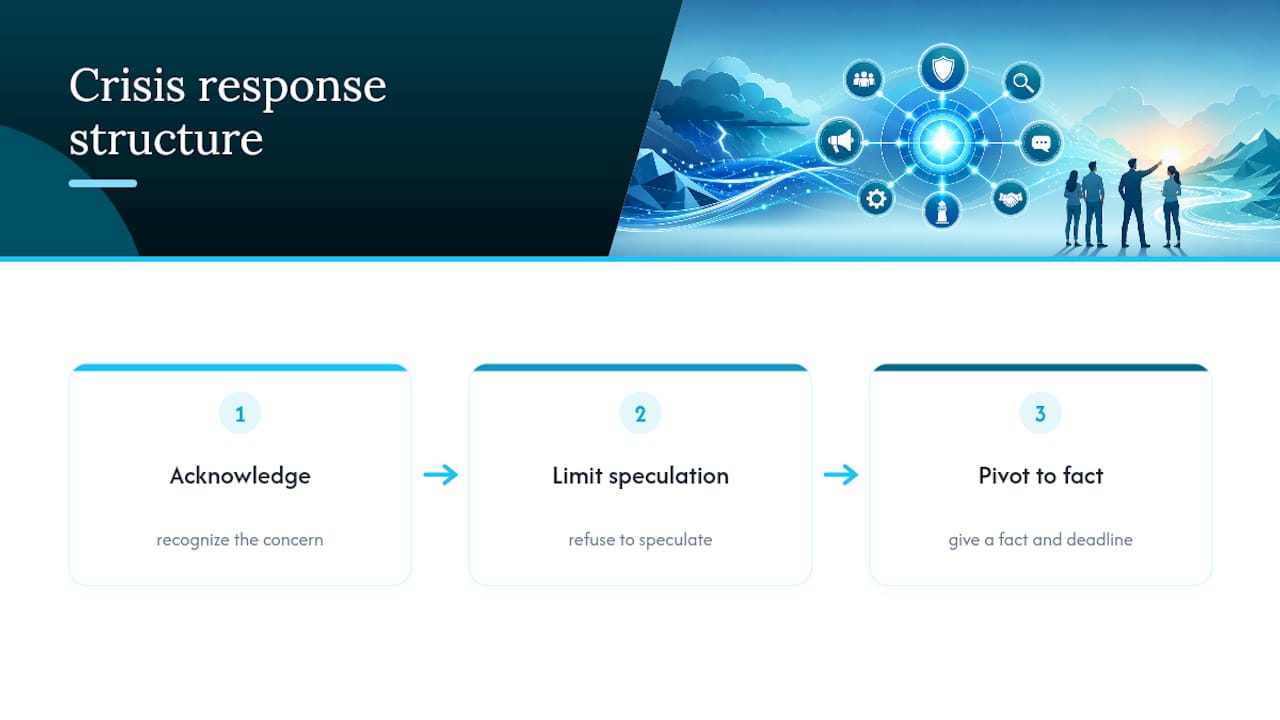
A crisis-tested phrase from Havas Red’s communications team captures the same logic: “I can’t speak to that specific issue, but what I can tell you is…” It works because it never denies the question exists. It just redirects the energy toward something true and sayable.
The common thread across effective crisis responses: short sentences, a real fact, and a specific next step. None of them promise more than the speaker can deliver, and none of them try to out talk the question.
Do Cultures Interpret “No Comment” Differently?
American audiences tend to hear “no comment” as evasive by default, which is part of why PRSA’s research found it damages credibility so consistently. In some European and Asian media markets, a flat refusal carries less stigma and can be read as appropriate restraint rather than concealment, particularly around legal or governmental matters.
That gap matters for any spokesperson working across borders or with international press. A phrase that sounds properly cautious to a Japanese business reporter might sound suspicious to a US cable news audience. The safest approach, regardless of market, is the same underlying structure: acknowledge the question, state a real limit, and offer whatever you can confirm. That formula translates better across cultures than a bare refusal does, because it signals respect for the question rather than dismissal of it.
Training Spokespeople to Use Alternatives Under Pressure
Building this instinct takes repetition, not just a list of phrases. Run mock interviews with genuinely hostile questions, not softballs, and time how long it takes someone to get to their bridge. If it takes more than a few seconds, the phrase isn’t rehearsed enough.

Record the sessions. Most spokespeople are shocked at how often they say “no comment” reflexively before catching themselves. Build a short reference card with three or four bridges specific to your organization’s likely risk areas, and drill until the wording is automatic rather than something the person is composing in real time.
Training guidance built for prepping any interview stresses treating every microphone as live and every conversation as on the record. That mindset alone eliminates most of the “no comment” reflex, because it forces a spokesperson to always have a fallback fact ready instead of a blank refusal.
What Are the Legal Risks of Different Non-Answers?
Not all refusals carry the same risk. A flat “no comment” rarely creates legal exposure by itself, but it can still fuel negative coverage that complicates a legal strategy by shaping public and even juror perception before a case is resolved.
Inventing a reason for silence is riskier than the silence itself. Saying “there’s nothing to this story” when there is something to it can create a false statement that later undermines your credibility or your legal position. Similarly, promising a timeline you can’t meet (“we’ll have an answer tomorrow”) and then missing it repeatedly reads as either incompetence or dishonesty, both of which are harder to walk back than the original question.
The safer legal posture is naming the constraint honestly: “I’ve been advised not to discuss this because it’s part of active litigation.” That’s defensible, accurate, and gives the reporter something real to report instead of a vague refusal they’ll likely characterize unfavorably. When in doubt, run any public statement past legal counsel before it goes out, especially in matters involving securities disclosure, ongoing investigations, or pending litigation.
Why Disciplined Phrasing Actually Protects You
Every crisis case I’ve reviewed points to the same pattern: the organizations that come out ahead are the ones that treat silence as a choice with consequences, not a safe default. Goldman McCormick PR was named one of America’s Best PR Firms for 2021 by Forbes, earned a Gold Award in Bulldog Reporter’s CSR Awards, and was recognized by the New York Observer as a top firm for legal PR. That track record comes from watching clients win or lose the room based on a single sentence. One client facing hostile press during a legal matter avoided “no comment” entirely, used a simple bridge to confirmed facts, and the story died within a news cycle instead of building for a week. Words carry weight. Choose them on purpose.
— Ryan McCormick
Get Media Training Before You Need It
Reading about bridging is one thing. Delivering it calmly with a camera in your face is another. We build media training and crisis coaching specifically around moments like these, working directly with spokespeople so the right phrasing becomes reflex instead of guesswork under pressure.
Sessions cover live interview drills, hostile question rehearsal, and tailored scripts for specific legal or business exposure, whether for a criminal defense attorney managing press or an executive preparing for a first sit-down interview. If your team keeps defaulting to “no comment” and watching coverage turn against them, that’s a fixable habit, not a fixed personality trait. Visit the Goldman McCormick PR media training page to book a session and get your spokespeople ready before the next call comes in.