Aim for a few hundred words, typically between 300 and 500, to best fit editorial needs and reader attention. PR Newswire and PRSA both land on that range for a simple reason: editors triage fast, and anything that spills onto a second page tends to get skipped. Complex legal, financial, or research announcements can be longer but should only use extra words if the detail clearly adds value. Everything else belongs in an attached backgrounder.
TL;DR:
- Most press releases should stay within 300 to 500 words to align with how editors and wire services read and distribute content effectively.
- Writing a release longer than 600 words risks turning it into a white paper rather than a news brief, requiring supplemental background attachments.
- To be concise, remove vague adjectives, cut extra quotes, and move technical details into backgrounders, focusing the main release on the core news.
- The ideal structure includes a six- to twelve-word headline, a brief lead paragraph, supporting body paragraphs, one or two quotes, and a single-paragraph boilerplate.
- Distribute only the main release on one page, attaching backgrounders for additional details, and remember that length constraints are driven by practical platform and reader limitations.
Table of Contents
- Press Release Length by Range: What Fits Where
- Structuring a One-Page Release So It Survives Editorial Triage
- Matching Press Release Length to the Type of News
- How Distribution Platforms Shape Practical Length Choices
- When to Split a Release Into a Short Version Plus a Backgrounder
- The Fast Press Release Length Checklist
- What Fifteen Years of Editing Press Releases Actually Teaches You
- Getting Press Release Length Right When the Stakes Are Real
- Sources
Press Release Length by Range: What Fits Where
The 300 to 500 word range isn’t arbitrary. It maps directly to how much information a journalist can absorb in the time they actually spend on a release, which PBJ Stories pegs at well under a minute for most inbound pitches. Here’s how the ranges break down in practice.
Under 300 words usually signals a release that’s missing context. This length works for a quick personnel announcement or a short event notice, but most news needs more room to answer who, what, when, where, and why without sounding like a tweet stretched into paragraphs.
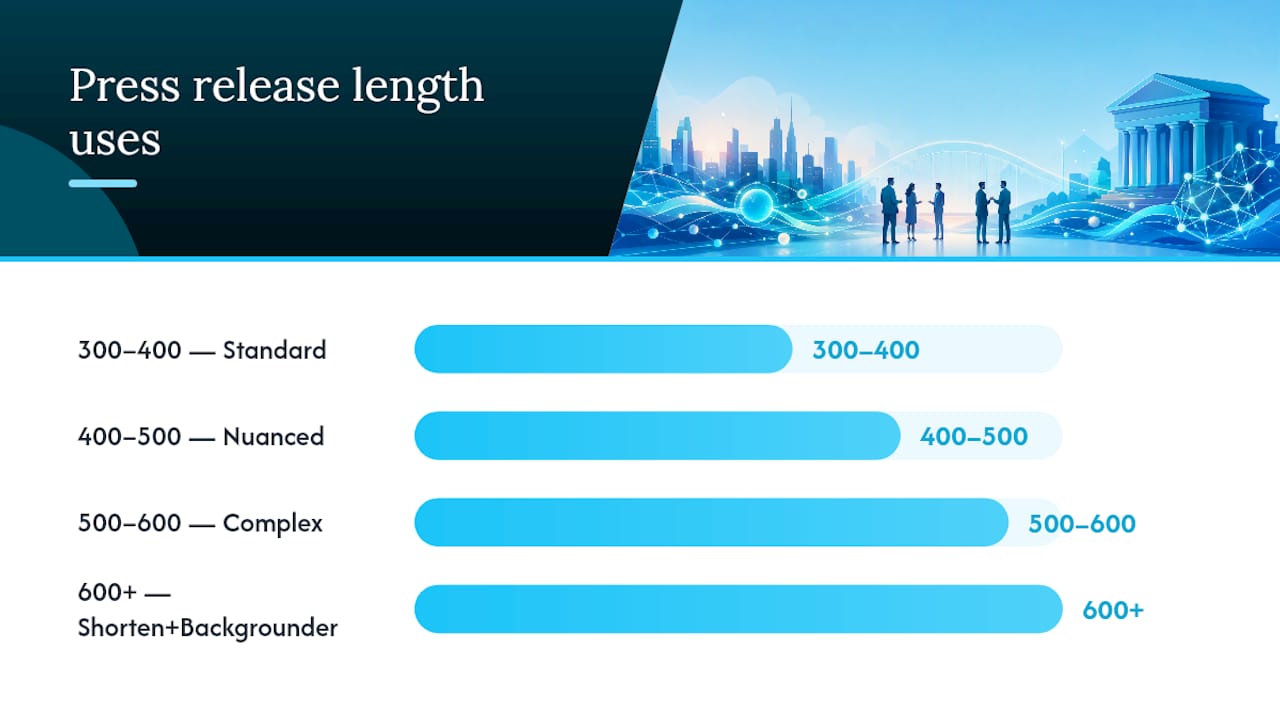
300 to 400 words is the zone for standard announcements: a new hire, a small partnership, a local event, a minor product update. You get one lead paragraph, two or three body paragraphs, a single quote, and a boilerplate, without excess.
400 to 500 words gives you room for a second supporting point or a slightly longer quote, and it’s the range PBJ Stories recommends when there’s more nuance to convey, like a funding round or a notable case outcome.
500 to 600 words is the outer edge, reserved for genuinely complex stories. A merger, a regulatory filing, a scientific finding. Push past 600 and you’re no longer writing a press release. You’re writing a white paper that happens to have a dateline.
600-plus words should almost never be the main release. If your draft is too long, it’s better to shorten the main release and provide supplemental backgrounders. It’s a shorter release plus an attached backgrounder that carries the technical weight.
Releases that are too short often lack context, reducing newsworthiness, while overly long ones risk losing reader interest early on, with later content ignored.
To condense a bloated draft, cut in this order:
- Remove adjectives and adverbs that describe rather than inform (“innovative,” “state-of-the-art,” “game-changing”).
- Cut the second and third quotes; keep only the one that adds a fact, not a feeling.
- Move background, methodology, or history into a linked backgrounder.
- Trim the boilerplate to a single paragraph, no matter how many awards the company wants listed.
- Read the release aloud. Any sentence you’d naturally skip when reading it out loud gets deleted.
Structuring a One-Page Release So It Survives Editorial Triage
A release that fits on one page isn’t just a formatting nicety. It’s a signal to editors that the writer respects their time, and PRSA’s guidance is blunt about the alternative: releases running past one page often get treated as a sign of sloppy editing, not thoroughness.
Here’s how the page breaks down, element by element:
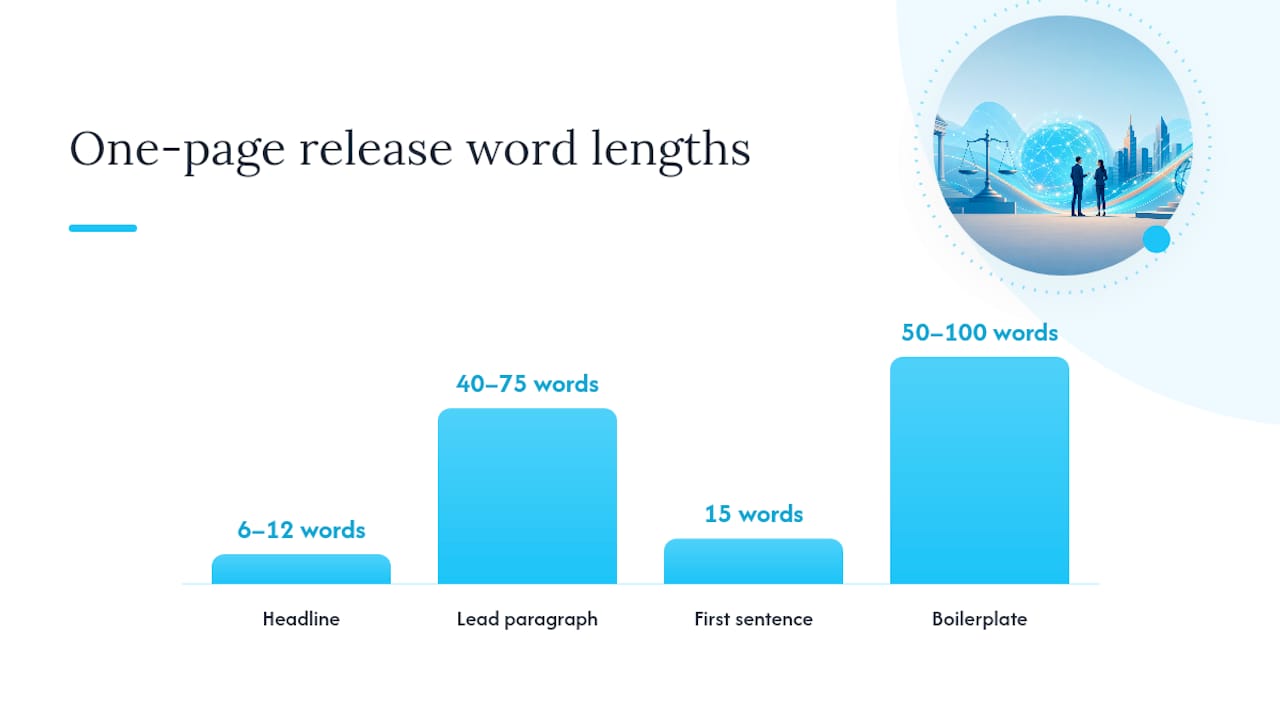
- Headline. Six to twelve words, roughly 60 to 80 characters. Long enough to carry a verb and a fact, short enough to read in one glance, per TypeCount’s format guide. Add a subheadline only when the headline alone can’t carry the “why now.”
- Lead paragraph. Forty to seventy-five words that answer the five W’s: who, what, when, where, and why. The first sentence should hit “why now” inside fifteen words, because that’s often all an editor reads before deciding whether to continue.
- Body paragraphs. Two to four sentences each, arranged in an inverted pyramid so the most newsworthy fact leads and supporting detail follows in descending order of importance.
- Quotes. One or two, each a single concise line. A quote should state a reaction or a forward-looking claim a reporter couldn’t easily restate themselves, not a summary of the release they just read.
- Boilerplate. Fifty to one hundred words, per TypeCount. One paragraph, company description, no history lesson.
- End mark. A centered
###or-30-below the boilerplate, telling the editor there’s nothing more.
Journalists field a high volume of releases daily, and AP-style formatting, standard fonts, and normal margins are the visual shorthand that says “this was written by someone who knows the format,” according to Nieman Lab’s coverage of newsroom habits around press release intake. Skip the exotic fonts and the centered body text. It reads as amateur before the editor even gets to your lead.
Pro Tip: Write your headline last. Once the release is done, you’ll know the one fact that actually matters, and that’s the fact your headline should carry, not the one you assumed mattered when you started drafting.
Matching Press Release Length to the Type of News
Not every announcement carries the same weight, and the ideal press release length should flex with the story, not a fixed template.
Simple announcements and events (300 to 400 words). New hires, small partnerships, local events, minor product updates. Lead with the fact, one quote from a decision maker, basic details (date, location, availability), and a short boilerplate. Nothing here needs more room.
Funding, research, and product launches (400 to 600 words). These carry more legitimate complexity: funding amount and use of proceeds, research methodology, or product specs and pricing. Put the headline number in the lead. Push methodology, technical specs, or investor lists into a linked backgrounder rather than cramming them into the main narrative.
Crisis and legal announcements. Length discipline matters more here, not less. Coordinate the main release with counsel, keep it tight (often under 400 words), state facts without speculation, and attach a legal backgrounder or fact sheet for detail that reporters may need but that doesn’t belong in the primary statement. A crisis release that reads like a legal brief loses the room before the first paragraph ends.
The pattern across all three types: the master release stays short, and complexity gets absorbed by attachments, never by inflating the word count on page one.
How Distribution Platforms Shape Practical Length Choices
Wire services build pricing tiers around length, which quietly pushes most PR teams toward brevity whether they planned on it or not. PBJ Stories notes that display and character limits on major wire platforms, along with cost thresholds tied to word count, reward releases that stay lean.
A few practical constraints worth building into your draft before you hit send:
- Email previews typically show 40 to 90 characters of a subject line before truncating, so your headline needs to make its point well inside that window.
- Mobile readers on wire service apps or aggregator feeds often see only the headline and lead paragraph before deciding to tap through, which makes those first 75 words do more work than the rest of the release combined.
- Social distribution rewards a shorter companion version, not a copy-paste of the full release; a two-sentence summary with a link back to the master release usually outperforms a truncated wall of text.
- When a release needs both a media version and a social version, treat the wire release as the canonical source and build shorter derivatives from it rather than editing two documents in parallel. A platform built for content distribution across formats can help here if you’re managing several channels at once.
None of these constraints change the writing, exactly. They just confirm that the 300 to 500 word range wasn’t picked for aesthetic reasons. It’s the range that survives contact with how releases actually get read.
When to Split a Release Into a Short Version Plus a Backgrounder
The workflow that solves most length arguments is simple: write a concise master release, then attach a backgrounder for anything that doesn’t clear the “does this add news value for an editor” bar. That question, straight from PR Newswire’s own editing guidance, is the fastest filter for deciding what stays and what moves.
Backgrounders preserve journalist goodwill because they let the reporter choose their own depth. A busy editor reads the 400 word release and moves on. A reporter writing a feature opens the attachment and gets the methodology, the full executive bios, or the technical appendix they actually need.
Name attachments clearly: “Backgrounder: [Company] Series B Funding Details” reads better than “Attachment 1.” Reference it in the release itself with a single line, something like “Additional financial detail is available in the attached backgrounder.” Legal and technical appendices follow the same rule: they exist so the main release never has to justify a claim it doesn’t have room to explain. Wire services typically don’t index attachments the way they index the release body, so treat the backgrounder as a resource for direct outreach and reporter follow-up, not as content bound for syndication.
The Fast Press Release Length Checklist
Run any draft against this before distribution:
- Headline: 6 to 12 words, 60 to 80 characters.
- Lead paragraph: 40 to 75 words, answers the five W’s, “why now” inside the first 15 words.
- Total word count: 300 to 500 words for standard news; up to 600 only for genuinely complex stories.
- Quotes: one or two, each a single line.
- Boilerplate: 50 to 100 words, one paragraph.
- End mark present (
###or-30-). - If it spills to page two, move the excess into a backgrounder instead of trimming randomly.
What Fifteen Years of Editing Press Releases Actually Teaches You
The conventional wisdom on press release length treats word count like a compliance checkbox: hit 400, ship it. That’s backward. Word count is a symptom, not a target. The real skill is deciding, sentence by sentence, whether a line earns its place in front of an editor who’s already decided whether to keep reading by the end of your lead paragraph.
I once took a 900-word draft down to 380 words for a client announcing a settlement outcome, and the version that survived wasn’t the one with the fewest words removed. It was the one where every remaining sentence answered a question a reporter would actually ask. The three paragraphs of case background went into a backgrounder. Two of the three quotes went with them. What stayed was the outcome, one quote with a forward-looking statement, and the boilerplate. The story didn’t lose anything. It lost weight.
The harder part isn’t editing the draft. It’s the internal meeting afterward, when a stakeholder wants a fourth quote or a paragraph of company history reinstated because it “feels important.” The only argument that works is the editor’s argument: does this line give a journalist a reason to keep reading, or does it give the company a reason to feel good about itself? Those are different questions, and only one of them belongs in a press release.
— Ryan McCormick
Getting Press Release Length Right When the Stakes Are Real
Editing your own release down from 900 words to 400 is a skill you can learn. Doing it under deadline, for a client whose case or reputation is on the line, is a different job entirely, and it’s the job this team was built around. This team writes and distributes releases sized the way editors actually want them, and pairs that with direct media outreach to media contacts who decide whether a story runs at all.
Attorneys, psychologists, and other professionals who need coverage without guesswork tend to be the clients who benefit most, since a release that’s the wrong length rarely gets a second look no matter how strong the story is underneath it. Goldman McCormick PR was named one of America’s best PR firms for 2021 by Forbes, and earned a Gold Award in Bulldog Reporter’s CSR Awards in 2016. If your next announcement needs to land on an editor’s desk at the right length and actually get read, start a conversation with Goldman McCormick PR about writing and distributing it.