
Yes, if the news is genuinely worth covering. Specialized legal PR handles the reporter relationships, ethical guardrails, and distribution mechanics that most firms lack in-house, and the investment tracks a predictable range: boutique legal PR retainers typically run $4,000 to $12,000 per month, with wire fees layered on top depending on reach.
TL;DR:
- Legal PR retainers typically cost between $4,000 and $12,000 per month, with additional wire fees depending on reach and scope.
- Press releases are only worth the cost if they highlight genuinely newsworthy events like verdicts, major hires, awards, or significant office expansions.
- Effective releases focus on clear facts and usable quotes, avoiding promotional language and confidential information, and should be tailored to targeted reporters.
- Combining broadcast via wire services, direct outreach to relevant reporters, and owned channels maximizes distribution and SEO benefits.
- Agencies are most effective when they understand legal ethics, have proven media relationships, and establish clear workflows for approvals and follow-up.
Table of Contents
- What Makes a Law Firm Press Release Worth Sending?
- How Do You Write a Release Journalists Will Actually Use?
- Wire Service, Direct Pitch, or Owned Channel: Which Wins?
- What Does a Law Firm Press Release Actually Cost?
- How Do You Vet a Legal PR Agency Before Signing?
- What Should You Expect From the Agency Relationship?
- What Legal PR Agencies Wish Every Law Firm Knew
- Ready to Get Your Firm’s News in Front of Reporters?
- Sources
What Makes a Law Firm Press Release Worth Sending?
A press release earns its cost only when the news actually qualifies as news. Reporters and editors ignore routine updates dressed up as headlines, so run your announcement through a quick filter before looping in an agency.
Send a release for:
- A verdict or settlement with genuine public interest or precedent value
- A senior partner hire or departure that shifts the firm’s practice focus
- National or regional awards, rankings, or bar association honors
- Office expansions into new markets or practice areas
- A significant pro bono win, especially one tied to a public issue
Skip the release for:
- A single attorney speaking at a regional conference
- Routine associate promotions with no broader relevance
- Minor administrative changes (new office manager, updated hours)
If you can’t answer “why would a stranger care?” in one sentence, hold off. A targeted pitch to a handful of relevant reporters often outperforms a mass wire release for stories that fall into a gray area.
How Do You Write a Release Journalists Will Actually Use?
Editors want facts and quotable material first, not marketing language. A release that reads like a brochure gets deleted in seconds; one that leads with the news and hands a reporter a ready quote gets used almost as written.
- Lead with the news. Your headline and lede should answer who, what, when, where, and why in the first two sentences, no throat-clearing.
- Give reporters a real quote. A managing partner saying “This ruling changes how contractors in this state can structure liability waivers” is usable. A quote calling the firm “thrilled and honored” is not.
- Protect privilege and confidentiality. Route every draft through the attorney of record before it leaves the building, and strip anything that touches client confidences, even indirectly.
- Set clear approval and embargo terms. Decide who signs off and by when, and tell reporters explicitly if information is embargoed until a set date.
Journalists consistently favor releases with usable quotes over promotional copy, which is the single biggest difference between a release that gets picked up and one that gets buried.
Pro Tip: Keep a rolling file of pre-cleared quotes from your named partners. When news breaks fast, you’ll have language ready instead of chasing sign-offs at midnight.
Wire Service, Direct Pitch, or Owned Channel: Which Wins?
Each distribution method solves a different problem, and the smartest campaigns usually combine two or three rather than picking one.
- Wire services buy broad reach and searchable syndication, useful for building SEO and backlink value, but the sheer volume of daily wire traffic means individual releases get lost easily.
- Targeted reporter outreach works best when timing, exclusivity, or a specific beat matters. A pitch sent to three reporters who actually cover your practice area often lands better than a release blasted to thousands of inboxes.
- Legal trade media and specialist outlets, including industry-specific legal news publications, reach the audience that matters most for reputation building within the profession.
- Owned channels, meaning your firm’s website, LinkedIn, and email newsletter, guarantee delivery regardless of pickup and double as a permanent record for future SEO and reputation searches.
The strongest campaigns layer these: a wire for footprint, direct pitches for pickup, and owned channels for permanence.
What Does a Law Firm Press Release Actually Cost?
Budget expectations vary widely depending on scope and ambition, but the ranges are more consistent than most firms expect.
Boutique legal PR retainers run $4,000 to $12,000 per month, while national agencies commonly start above $15,000 monthly. Wire distribution fees range from a few hundred dollars to several thousand depending on reach, according to industry cost benchmarks.
A boutique retainer typically covers ongoing media relationships, release writing, and pitching. National agencies charge more because they add larger teams, broader trade contacts, and often crisis capacity. Add-ons like media training, formal award submissions, or crisis support usually carry separate project fees. If your need is a single, well-timed release with no ongoing relationship building, a project fee rather than a retainer often makes more sense.
How Do You Vet a Legal PR Agency Before Signing?
Not every PR shop understands the constraints attorneys operate under, so the vetting conversation should go deeper than a standard marketing pitch.
Look for:
- Demonstrated legal PR experience, not just general business PR
- Existing relationships with reporters who cover your practice areas or region
- Fluency in attorney ethics rules around client confidentiality and advertising
- A clear measurement framework tied to pickups and coverage quality, not vanity metrics
Ask directly:
- “Which reporters on this beat have you placed stories with in the past year?”
- “How do you handle embargoes and last-minute legal holds?”
- “What does your approval workflow look like before anything goes out?”
Red flags: vague answers about past placements, no mention of legal ethics constraints, and reporting built entirely around impressions rather than actual pickups or backlinks.
Pro Tip: Ask for two or three sample releases the agency wrote for other law firms. If every one reads like a press-release template with the names swapped, keep looking.
What Should You Expect From the Agency Relationship?
A press release campaign typically moves through intake, drafting, approvals, distribution, and follow-up over one to three weeks, faster for breaking news.
- Firm responsibilities: supply accurate facts fast, designate one approver, and make spokespeople available for follow-up interviews.
- Agency deliverables: a media list matched to your story, a drafted release with quotable language, targeted pitches, and clip reporting after distribution.
- Embargo handling: targeted pre-briefs to key reporters ahead of a public release often beat a mass wire drop, since it gives reporters lead time to build a fuller story.
- Realistic KPIs: track actual pickups, estimated impressions, backlink and SEO value, and whether new reporter relationships formed, not just the number of outlets the release was “sent to.”
A disciplined approvals workflow with scheduled updates is what separates a smooth campaign from one built on last-minute scrambling. Without it, agencies default to ad-hoc outreach that misses nuance and risks factual errors.
What Legal PR Agencies Wish Every Law Firm Knew
Goldman McCormick PR was founded in 2010 by working and former members of the media, and Forbes named the firm one of America’s Best PR Firms for 2021. In 2016, the agency won a Gold Award in Bulldog Reporter’s CSR Awards for Best Cause/Advocacy Campaign, and the New York Observer named it one of the top five agencies specializing in legal PR back in 2014.
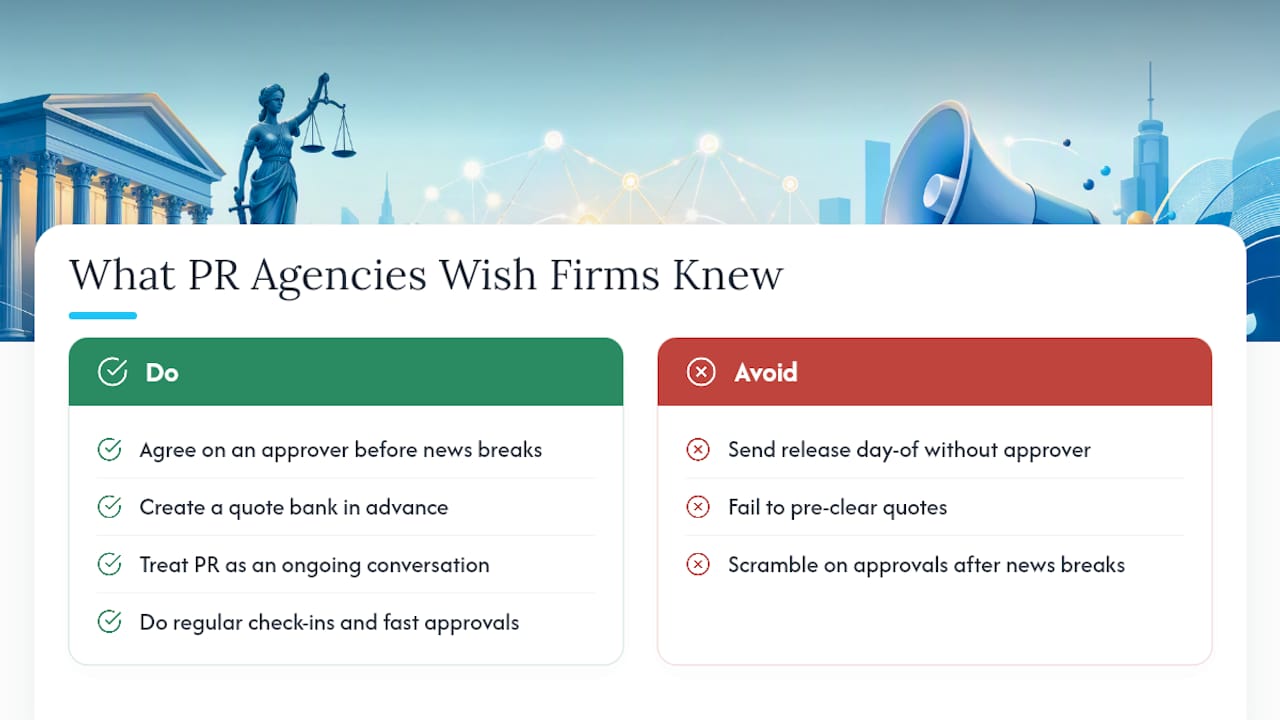
The most common mistake we see is a firm sending a release the day something happens, with no pre-cleared quote and no designated approver. That forces a scramble, and reporters move on before the quote clears. The fix is simple: agree on an approver and a quote bank before news breaks, not after.
The firms that get consistent coverage treat PR as an ongoing conversation, not a one-off request. That means regular check-ins, fast responses on approvals, and trust that the agency understands both the story and the ethics constraints around it.
— Ryan McCormick
Ready to Get Your Firm’s News in Front of Reporters?
A specialized legal PR firm writes, distributes, and places law firm press releases directly, avoiding long buildup and generic templates swapped with your firm’s name. Such firms often handle media outreach, media training for spokespeople, and crisis communications when a story needs careful handling quickly.
What sets a specialized legal PR firm apart is knowing which quotes are usable and which cross ethical boundaries before a reporter sees the draft. That’s built from years of actual newsroom experience, not a marketing checklist. If your firm has a verdict, a hire, an award, or an expansion worth telling reporters about, reach out to Goldman McCormick PR to talk through what a release and distribution plan would look like for your specific announcement.
Sources
For readers who want to go deeper on budgeting and tactics, these sources back the figures and guidance above: