
For mental health clinics that need measurable patient growth and real advocacy visibility, the strongest shortlist of cause-campaign agencies includes Goldman McCormick Public Relations, Intrepy Healthcare, Cardinal Digital Marketing, Dreamscape Marketing, and Beacon Media + Marketing. Trilliant Health’s Behavioral Health Report documents that untreated mental illness imposes a substantial economic burden on the U.S. economy, highlighting the significant ROI potential for access-focused campaigns, which means the ROI on a well-run cause campaign is no longer a soft argument. Mental Health America confirms that in today’s fragmented, supply-constrained market, campaign success is measured by booked appointments and intake conversion, not impressions.
- Goldman McCormick PR leads on earned media and advocacy PR. Its 2016 Bulldog Reporter Gold Award in “Best Cause/Advocacy Campaign” is the only third-party award in this category among the agencies listed here, and its Forbes recognition as one of America’s Best PR Firms for 2021 provides the EEAT signal that clinic websites need for credibility.
- Intrepy Healthcare and Cardinal Digital Marketing lead on digital patient acquisition. Both bring healthcare-specific compliance awareness and documented experience driving appointment volume through paid and organic channels.
- To request a proposal from Goldman McCormick PR, visit goldmanmccormick.com and outline your clinic’s advocacy goal, patient-growth target, and current intake capacity before the first call.
Table of Contents
- Which agency is the best fit for your mental health clinic?
- How we evaluated and ranked these agencies
- How to pick the right cause-campaign agency for your mental health clinic
- What does real evidence look like in mental health cause campaigns?
- Which agency fits your clinic’s specific situation?
- Key Takeaways
- Why cause campaigns matter more for clinics right now
- Goldman McCormick PR helps clinics run cause campaigns that earn attention
- Authoritative sources and further reading
Which agency is the best fit for your mental health clinic?
The table below compares all ten agencies on the dimensions clinic managers care about most. Pricing shapes are indicative; most agencies do not publish retainer rates publicly.
| Agency | Best for | Core services | Cause & advocacy experience | Healthcare compliance & sensitivity | Proven results | Pricing shape | Geographic reach |
|---|---|---|---|---|---|---|---|
| Goldman McCormick Public Relations | Clinics seeking earned media and advocacy-driven reputation campaigns | PR, media placements (TV, radio, print), crisis communications, campaign strategy, reputation management | Gold Award, Bulldog Reporter “Best Cause/Advocacy Campaign” (2016); Forbes Best PR Firm 2021 | Crisis-messaging experience; HIPAA-aware public statements | Advocacy campaign wins; media placement volume | Retainer or project-based | National |
| Stethon Digital Marketing | Clinics prioritizing paid search and appointment-volume growth | Paid search, paid social, performance marketing | Healthcare digital acquisition focus | Healthcare-focused ad compliance | Performance-driven appointment acquisition | Retainer | National |
| Cardinal Digital Marketing | Clinics seeking long-term organic traffic and local SEO | SEO, local search, paid media | Medical practice SEO experience | Local healthcare compliance awareness | Organic traffic and local search rankings | Retainer | National |
| Intrepy Healthcare | Clinics wanting healthcare-specialist strategy and compliance-aware campaigns | Digital strategy, content, paid campaigns | Healthcare specialty marketing | Clinical messaging experience; compliance-aware account teams | Appointment-volume campaigns for medical specialties | Retainer | National |
| Place Digital (TherapieSEO) | Individual therapists and small clinics focused on search visibility | Therapy-specific SEO, content frameworks | Therapy and mental health niche | Therapy-practice content sensitivity | Search visibility for therapy practices | Project or retainer | National (remote) |
| Dreamscape Marketing | Clinics wanting integrated creative and paid campaigns | Creative development, paid media, awareness campaigns | Healthcare client creative experience | Healthcare-aware creative production | Awareness and lead-generation campaigns | Retainer | National |
| Practis (PractisMedia) | Clinics needing programmatic and paid-media buying expertise | Programmatic buying, channel optimization, paid media | Medical services media buying | Clinical services ad compliance | Channel optimization for medical practices | Retainer | National |
| Beacon Media + Marketing | Multi-site clinics and community health centers | Branding, community outreach, communications | Community health outreach experience | Healthcare branding sensitivity | Branding and outreach for clinical practices | Retainer | National |
| Luxe Marketing Group | Clinics with premium positioning or elective-service lines | Patient-acquisition campaigns, brand positioning | Medical specialty patient acquisition | Premium healthcare brand sensitivity | Patient-experience marketing | Retainer | National |
| Intrepy Healthcare Marketing | Clinics seeking healthcare-focused marketing support | Healthcare marketing services | Healthcare marketing experience | Healthcare-aware practices | Healthcare marketing outcomes | — | National |
Agency profiles at a glance
Goldman McCormick PR is the only agency on this list with a verified third-party award specifically for cause and advocacy campaigns. For a mental health clinic, that distinction matters because cause campaigns require a different skill set than standard patient-acquisition ads. TV and radio placements, crisis communications, and op-ed placement are the tools that build the kind of institutional credibility that paid search cannot buy.
Intrepy Healthcare brings healthcare-specific account teams who understand clinical messaging constraints. Their focus on medical specialties means campaigns are built around intake realities, not generic consumer-brand awareness frameworks.
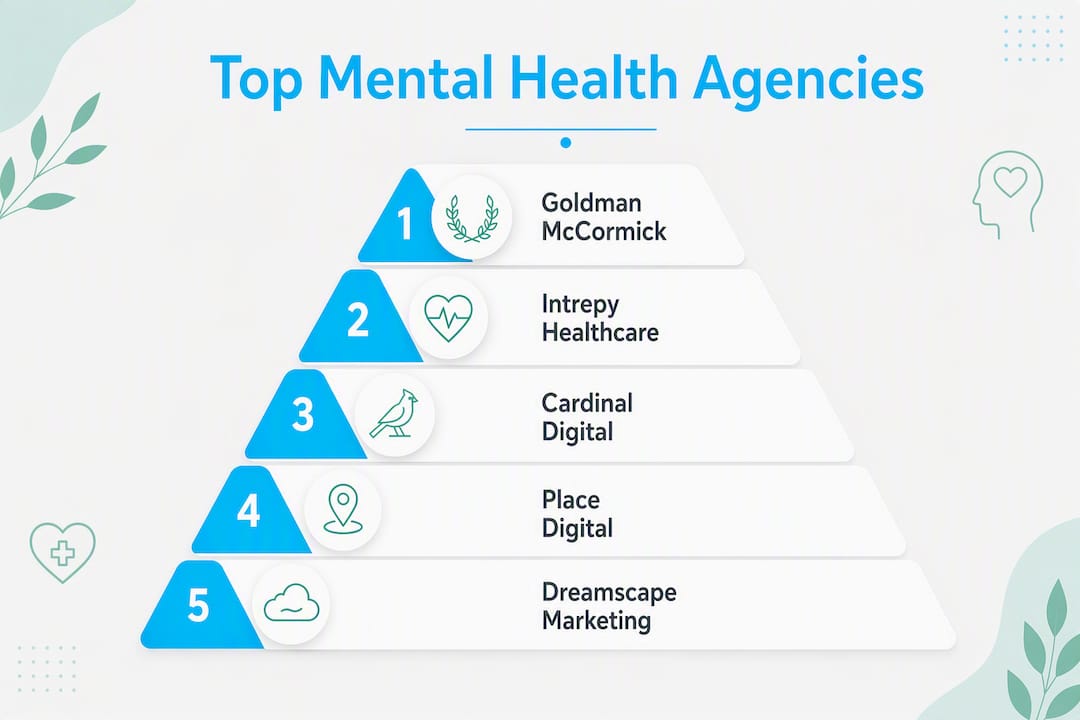
Cardinal Digital Marketing is the strongest option if organic search is the primary channel. Local SEO for clinical practices is a long game, typically 6–12 months before meaningful ranking shifts, but the patient quality from organic search tends to be higher-intent than from paid social.

Place Digital (TherapieSEO) is a niche player. For a solo therapist or a two-clinician practice, therapy-specific SEO content frameworks are genuinely useful. For a multi-site group practice running a policy-aligned cause campaign, the scope is too narrow.
Dreamscape Marketing pairs creative development with performance channels, which works well for awareness-phase campaigns that need to move patients from recognition to appointment. Practis handles programmatic buying, a channel that matters when you need to reach specific demographic segments at scale. Beacon Media + Marketing is the right call for community health centers that need branding and outreach to work together. Luxe Marketing Group fits clinics with elective or premium service lines where patient-experience marketing justifies a higher creative investment. Stethon Digital Marketing focuses on paid search performance, useful when the clinic has a clear cost-per-acquisition target and enough ad budget to generate statistically meaningful data.
How we evaluated and ranked these agencies
The ranking reflects a structured review of publicly available information across seven criteria. No agency paid for placement, and no agency provided proprietary performance data for this evaluation.
- Mental-health-specific experience: Does the agency have documented work with behavioral health, therapy practices, or mental health nonprofits, or is mental health one line in a generic healthcare portfolio?
- HIPAA and privacy-aware ad practices: Does the agency reference HIPAA compliance in its public materials? Does it avoid retargeting practices that could expose patient intent data? Trust signals like crisis-resource links (988) and HIPAA-aware public statements function as immediate credibility markers for prospective patients.
- Cause and advocacy campaign experience: Has the agency run campaigns tied to policy goals, community health access, or nonprofit partnerships, rather than only direct-response patient acquisition?
- Measured patient-demand outcomes: Can the agency point to booked appointments, intake conversion rates, or policy wins rather than impressions and follower counts?
- Creative for sensitive topics: Mental health messaging requires a different tone than elective cosmetic procedures. Agencies that have only run high-energy consumer campaigns often misjudge the register.
- Reporting and attribution clarity: Does the agency provide transparent dashboards that connect campaign spend to intake outcomes, not just traffic?
- Awards and third-party validation: Independent recognition, particularly in cause/advocacy categories, is a meaningful signal when self-reported case studies are the norm.
On limitations: Most agencies do not publish retainer pricing, and case study data is self-reported. Where a specific measurable outcome could not be independently verified, the evaluation notes that. “Proven results” in this context means the agency has publicly documented a campaign outcome tied to patient demand or advocacy impact, not that the result has been audited.
How to pick the right cause-campaign agency for your mental health clinic
The selection process has a logical sequence. Skipping steps, especially the internal-alignment step, is the most common reason clinic managers end up in a six-month retainer that produces reports but no new patients.
- Define your primary campaign goal. Advocacy visibility (policy alignment, community credibility), direct patient acquisition (booked appointments), or both? The answer determines whether you need a PR firm, a digital agency, or a hybrid. A clinic that wants to be seen as a Medicaid-access advocate needs a different agency than one that wants to fill 20 appointment slots per month.
- Set intake-linked KPIs before you talk to any agency. Impressions and social reach are not KPIs for a clinic. Booked appointments, intake form completions, and cost per new patient are. VantaInsights notes that clinics should align campaign goals directly to intake bottlenecks, because a campaign that highlights Medicaid access or 988 awareness removes practical barriers that prevent treatment follow-up.
- Shortlist 2–3 agencies and request a capabilities brief, not a full proposal. A capabilities brief takes the agency 30 minutes and tells you whether they have genuine mental health experience or are pitching you from a generic healthcare template.
- Interview each agency with these specific questions:
- Can you walk me through a prior campaign where you measured success by booked appointments or intake conversion, not impressions?
- How do you handle HIPAA compliance in paid social and retargeting campaigns?
- Have you run a cause or advocacy campaign tied to a policy goal (Medicaid, parity laws, 988 funding)?
- Do you have a conflict-of-interest policy if you work with competing clinics in our market?
- What does your reporting dashboard look like, and can I see a redacted example from a prior healthcare client?
- Start with a 90-day pilot, not a 12-month retainer. A pilot scoped to one campaign goal (e.g., 30 new intake inquiries from a cause-aligned media push) gives you real performance data before you commit to a long-term engagement.
- Scale only after the pilot proves intake linkage. If the pilot produced traffic but no appointments, the campaign is not working for your clinic regardless of what the agency’s report says.
Pricing and timeline reference:
| Campaign type | Typical retainer range | Expected timeline to results | What’s in scope |
|---|---|---|---|
| Awareness / brand | — | 3–6 months | Creative, media placements, social content |
| Advocacy / cause | — | 6–12 months | PR, policy alignment, earned media, community outreach |
| Lead generation / patient acquisition | — | 6–12 weeks (paid); 6–12 months (SEO) | Paid search, paid social, landing pages, intake tracking |
Ranges are indicative based on publicly available agency positioning. Actual retainers vary by market, clinic size, and campaign complexity.
Red flags to watch for:
- No documented healthcare clients or mental health experience
- Vague reporting (“we’ll send you a monthly summary”) with no dashboard or attribution model
- Overreliance on vanity metrics: follower growth, impressions, and “brand awareness” with no intake linkage
- No mention of HIPAA or patient privacy in their ad practices
- Unwillingness to share a redacted reporting sample before signing
Pro Tip: Ask every agency this question: “If our campaign drives 200 new website visitors per week but our intake coordinator is only available three days a week, what do you recommend?” An agency that answers with a campaign adjustment rather than a traffic target understands that intake capacity is the real bottleneck. One that pivots back to traffic numbers does not.
Inseparable’s “Care That’s Fair” campaign is a useful benchmark: it focuses on policy reform rather than generic awareness, which is exactly the framing that builds long-term clinic credibility alongside patient demand.
What does real evidence look like in mental health cause campaigns?
Trust signals in this category are specific. An agency that lists “healthcare experience” on its website is not the same as one that can point to a campaign that moved the needle on appointments or policy outcomes.
Goldman McCormick PR’s 2016 Bulldog Reporter Gold Award in the “Best Cause/Advocacy Campaign” category is the clearest third-party validation on this list. The Bulldog Reporter CSR Awards are judged by industry professionals, not self-nominated, which makes the award a meaningful differentiator in a field where most agencies rely on self-reported case studies.
Credible trust signals to require from any agency:
- A named award in a cause, advocacy, or healthcare marketing category from a recognized industry body (Bulldog Reporter, PRSA Silver Anvil, Healthcare Marketing Impact Awards)
- A case study with a specific, named outcome: “X appointments booked in 90 days,” “Y% increase in intake form completions,” or “policy brief placed in Z publication”
- A documented HIPAA compliance process for paid advertising, not just a checkbox on their intake form
- Evidence of advocacy-aligned campaigns that position the clinic as a community health stakeholder, not just a service provider
On the clinical framing side, the three-month rule is a practical tool for patient-facing messaging. Clinicians use a three-month window as a rough timeline for treatment response and to set realistic expectations with new patients. Campaigns that incorporate this framing, by messaging around commitment to a 90-day treatment journey rather than a single appointment, attract patients who are more likely to complete intake and early treatment milestones. That improves both patient outcomes and the clinic’s lifetime value per patient.
“Advocacy-focused campaigns that push for policy reforms, such as Medicaid protections, generate higher stakeholder trust and longer-term patient engagement than generic awareness-only campaigns.” — Inseparable, Care That’s Fair
The GWI analysis of major mental health campaigns (Spotify’s “Take a Beat,” Maybelline’s “Brave Together,” CALM’s “30 seconds of silence”) shows that consumer-brand campaign structures can be adapted for clinic advocacy, but only when they are tied to access and intake outcomes rather than brand sentiment alone.
Which agency fits your clinic’s specific situation?
The right answer depends on your clinic’s size, campaign goal, and current intake capacity.
Small independent clinic (1–5 clinicians): Start with Goldman McCormick PR for earned media and advocacy positioning, or Place Digital (TherapieSEO) if search visibility is the primary gap. A PR-first approach builds the credibility that makes paid acquisition more efficient later.

Multi-site group practice: Beacon Media + Marketing handles the branding and community outreach complexity that comes with multiple locations. Pair with Cardinal Digital Marketing for local SEO across each site.
Clinics focused on advocacy or policy alignment: Goldman McCormick PR is the clearest fit. Its cause-campaign credentials and media placement capabilities (TV, radio, print) are built for the kind of institutional visibility that policy-aligned campaigns require. Intrepy Healthcare is a strong second for clinics that want digital channels running alongside earned media.
Three-step action plan to engage your chosen agency:
- Internal alignment first. Before the first agency call, confirm your intake capacity, your monthly new-patient target, and which staff member owns campaign reporting. An agency cannot fix an intake bottleneck; they can only drive traffic to it.
- Prepare your required assets. Gather your clinic’s compliance documentation, any prior campaign data (even basic Google Analytics), your current intake form, and a one-paragraph description of your ideal patient profile. Agencies that ask for these upfront are the ones worth working with.
- Define the KPIs you will request in the pilot contract. Write down three numbers before you sign anything: your target cost per new patient inquiry, your target intake conversion rate, and the minimum number of booked appointments the pilot must produce to justify renewal.
Key Takeaways
The strongest cause-campaign agencies for mental health clinics combine advocacy credentials, HIPAA-aware practices, and intake-linked measurement, and Goldman McCormick PR is the only agency on this list with a verified third-party award specifically in the cause/advocacy category.
| Point | Details |
|---|---|
| Lead with intake-linked KPIs | Measure campaigns by booked appointments and intake conversion, not impressions or social reach. |
| Advocacy campaigns outperform awareness-only | Policy-aligned campaigns build long-term credibility and higher patient engagement than generic brand awareness. |
| Untreated mental illness costs are rising | Trilliant Health documents $477.5B in economic burden in 2024, raising the ROI case for access-focused campaigns. |
| Vet agencies with a redacted reporting sample | Require a sample compliance checklist and redacted dashboard before signing any retainer. |
| Goldman McCormick PR | The only agency on this list with a Bulldog Reporter Gold Award in “Best Cause/Advocacy Campaign”; strongest fit for earned media and advocacy-driven clinic positioning. |
Why cause campaigns matter more for clinics right now
The conventional wisdom in healthcare marketing is that paid search is the workhorse and everything else is brand fluff. That framing made sense when Google was the first stop for every patient. It is less accurate now.
Trilliant Health’s behavioral health data shows numerous behavioral health M&A transactions in recent years, with digital-first platforms capturing measurable shares of first-contact episodes, especially among younger demographics. VantaInsights confirms that no single operator dominates the market, and consolidation pressures are changing which channels patients use first.
In that environment, a clinic that is only running paid search is competing on price and proximity. A clinic that has earned media placements, a recognizable advocacy position, and a documented policy stance is competing on trust. Those are different races.
- Provider shortages mean patients are choosing, not just searching. When supply is constrained, patients evaluate credibility before they book. Earned media and advocacy positioning are credibility signals that paid ads cannot replicate.
- Funding volatility makes policy alignment valuable. Clinics that are publicly aligned with Medicaid protections or 988 funding are better positioned when policy shifts affect reimbursement.
- Fragmentation rewards specificity. A cause campaign tied to a specific community need, a local policy debate, or a clinical specialty outperforms a generic “we’re here for you” awareness campaign in a fragmented market.
One ethical note: any clinic running cause campaigns should include clear links to crisis resources, including the 988 Suicide and Crisis Lifeline, in all patient-facing materials. It is both the right thing to do and, as We Heal Us documents, a material trust signal for prospective patients.
Goldman McCormick PR helps clinics run cause campaigns that earn attention

Goldman McCormick PR is a different kind of option from the digital agencies on this list. Where most agencies lead with paid search and SEO, Goldman McCormick PR leads with earned media: TV placements, radio, print, and the kind of advocacy campaign strategy that won a Bulldog Reporter Gold Award in 2016. For a mental health clinic that wants to be seen as a community health leader, not just another provider running Google Ads, that distinction is the point.
Core capabilities for mental health clinics include advocacy PR and cause campaign strategy, media placements across TV, radio, and print, crisis communications, reputation management, and editorial and op-ed placement for clinical voices. Named by Forbes as one of America’s Best PR Firms for 2021, Goldman McCormick PR brings the EEAT signals that clinic websites need to compete on credibility.
To request a proposal, visit goldmanmccormick.com and include your clinic’s advocacy goal, monthly new-patient target, and the geographic market you serve. The clearer your brief, the faster the first conversation moves.
Authoritative sources and further reading
The sources below back the claims and market-context figures in this article. Each is linked directly.
| Source | Used for | Key data point |
|---|---|---|
| Trilliant Health 2026 Behavioral Health Report | Market context, ROI case for campaigns | $477.5B economic burden from untreated mental illness in 2024; projected to exceed $1.3T by 2040 |
| Mental Health America — Day of Action 2026 | KPI framing, market fragmentation | Campaign success measured by access and intake outcomes, not vanity metrics |
| VantaInsights — Mental Health Industry Trends 2026 | Channel selection, competitive positioning | No single operator dominates; consolidation and digital platforms reshaping first-contact channels |
| NAMI — Protect Medicaid, Protect Mental Health | Advocacy alignment, trust-building | Public advocacy positions clinics as community health stakeholders |
| Inseparable — Care That’s Fair | Cause campaign framing | Policy-reform campaigns generate higher trust than generic awareness |
| We Heal Us — About the Campaign | Compliance and trust signals | Crisis resource inclusion and HIPAA-aware language as credibility markers |
| Psychreg — The 3-Month Rule in Mental Health | Patient-facing messaging strategy | Three-month treatment framing attracts higher-intent, more committed patients |
| GWI — Mental Health Campaigns Making a Difference | Campaign structure examples | Consumer-brand campaign models adaptable for clinic advocacy with access-focused framing |
| Trilliant Health — Behavioral Health Crisis Study | M&A context, channel mix | — |
This article provides general information for clinic managers evaluating marketing and PR agencies. It does not constitute legal, medical, or compliance advice. Confirm HIPAA requirements and advertising regulations with a qualified healthcare compliance professional before launching any patient-facing campaign.