
Public relations is the most direct path to grow your private practice with PR, turning your clinical or legal expertise into a recognized public authority that attracts clients without paid advertising. Practices with documented marketing strategies grow 2–3 times faster than those without one. Earned media coverage, directory authority, and a tight intake process work together to produce that growth. This guide gives criminal defense attorneys and psychologists a clear, step-by-step framework to build visibility, earn media placements, and convert that attention into a full caseload or client roster.
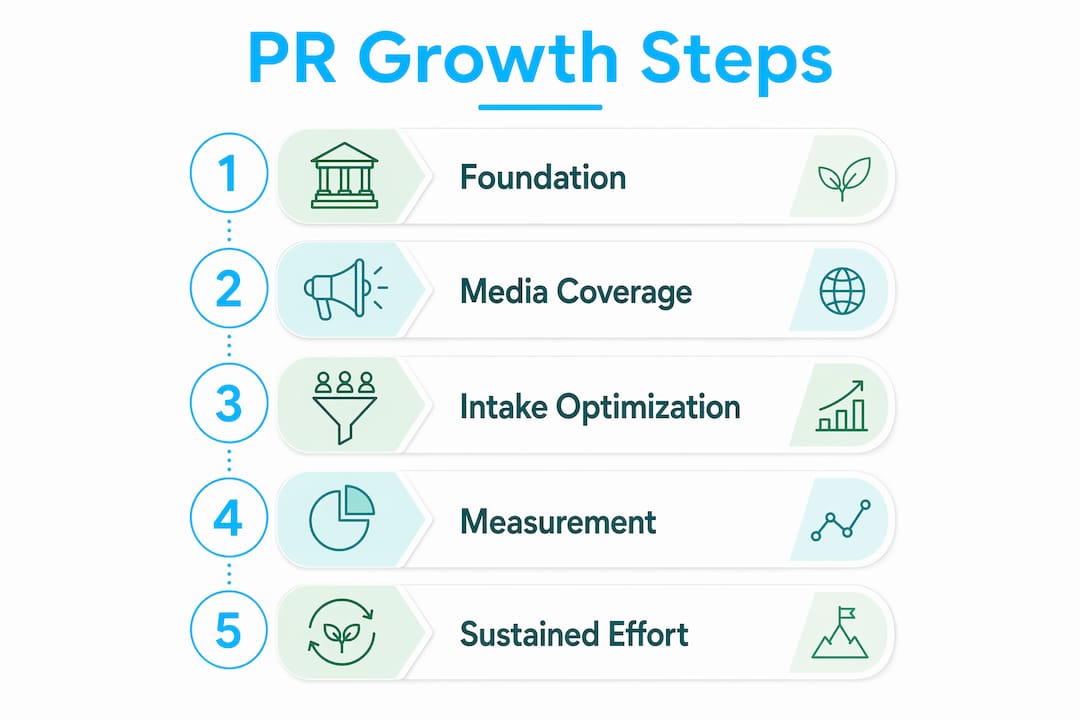
How to grow your private practice with PR: the foundation
Before pitching a single journalist, your practice needs a clear base. Reporters and potential clients both do the same thing first: they search online. 77% of prospective therapy clients begin their search online. That number applies equally to people looking for a criminal defense attorney in their area.
What your foundation must include
- Defined ideal client. Know exactly who you serve. A psychologist specializing in trauma and a general therapist need different messages, different media targets, and different referral networks.
- Complete Google Business Profile. Accurate hours, services, photos, and responses to reviews signal credibility to both Google and prospective clients.
- Directory citations. Psychology Today, Avvo, Justia, and Healthgrades each carry domain authority that feeds into your local search ranking.
- Clear website. Your homepage must answer three questions in under five seconds: Who do you help? What do you do? How do they contact you?
- Online self-scheduling. Booking friction kills conversions. A calendar tool that lets a visitor book a consultation at 11 p.m. on a Sunday captures clients your competitors miss.
Pro Tip: Track where every new inquiry comes from before you launch any PR campaign. That baseline makes it possible to measure exactly what media coverage adds later.
Successful practices allocate 5%–10% of annual revenue to marketing, with the bulk going to foundational work like citation cleanup and local SEO rather than untested paid ads. That allocation discipline separates practices that grow steadily from those that spend heavily and plateau.
How do you build a PR strategy that earns real media coverage?
Public relations, in the industry sense, means earned media: coverage a journalist or editor chooses to publish because your story is genuinely newsworthy. That is different from sponsored content or paid placements, which carry no editorial credibility and produce weak trust signals.
The most effective PR strategy for a private practice follows these steps:
- Identify your newsworthy moments. A new specialty service, a research collaboration, a milestone case outcome, or a published article in a peer-reviewed journal all qualify. Routine announcements do not.
- Build a targeted media list. For psychologists, that means mental health editors at regional newspapers, health reporters at local TV stations, and producers of health-focused podcasts. For criminal defense attorneys, it means legal affairs journalists, court reporters, and law-focused radio programs.
- Craft a pitch with quantified impact. Specific, quantifiable client impact stories attract media attention far better than vague claims. “My client avoided a wrongful conviction” is weaker than “My client was exonerated after 14 months using forensic evidence the prosecution overlooked.”
- Pursue digital PR for backlinks. Digital PR generates high-authority backlinks that boost your site’s SEO ranking. A feature in a regional newspaper’s online edition carries more ranking power than a dozen directory listings.
- Combine local and national media. Local TV and radio build community trust fast. National outlets like Forbes, Psychology Today’s editorial section, or legal publications build the kind of authority that shows up in Google’s E-E-A-T signals.
Pro Tip: Avoid any placement that requires you to pay for editorial coverage. Google’s quality guidelines treat paid placements as advertising, not authority. Earned coverage is the only kind that builds lasting search credibility.
Practices with diverse visibility channels maintain more stable client flow than those relying on a single tactic. A mix of referral networks, earned media, and local search produces the most reliable growth over time.

How does intake optimization turn PR leads into paying clients?
PR drives attention. Your intake process determines whether that attention becomes revenue. This is the step most practitioners underestimate, and it is where growth stalls.
Ignoring intake friction can lose up to 75% of leads even when PR efforts are strong. A prospective client who calls and reaches voicemail, or fills out a contact form and waits three days for a reply, will book with someone else. The lead is gone before you know it existed.
Practices that fix this problem see dramatic results. Optimizing the intake funnel increases inquiry-to-booking conversion from 5%–10% up to 25%–35%. That improvement alone can double the number of new clients from the same volume of PR-generated traffic.
The core fixes are straightforward:
- Respond to every inquiry within one business hour during working hours.
- Use automated email or text confirmations the moment a booking is made.
- Send reminders 48 hours and 24 hours before a first appointment.
- Track the source of every new inquiry, whether it came from a media mention, a Google search, or a referral.
That last point matters for measuring PR return on investment. Without source tracking, you cannot know which media placements drove actual bookings.
How do you measure whether your PR efforts are working?
PR is not instant. Revenue impacts from PR efforts typically appear between months 3 and 6 of sustained activity. Practitioners who quit after six weeks never see the return.
The metrics worth tracking are concrete and specific. Branded search volume, meaning how often people search your name directly, rises when media coverage is working. Website traffic from earned media sources, tracked through Google Analytics with UTM parameters on press links, shows which placements drive real visits. Inbound inquiries from non-referral sources reveal whether your public profile is generating new interest.
| Metric | What it tells you |
|---|---|
| Branded search volume | Whether media mentions are building name recognition |
| Earned media traffic | Which placements send actual visitors to your site |
| Inquiry-to-booking rate | Whether your intake process converts PR-driven leads |
| Non-referral inbound leads | Whether your public profile is generating new interest |
| Media placements per quarter | Whether your pitch cadence is producing consistent coverage |
Pro Tip: Set a monthly comparison against your pre-PR baseline for each metric. A 20% rise in branded searches after a TV segment is a concrete result. Without the baseline, you cannot see it.
Earned media coverage also feeds Google’s E-E-A-T framework, which stands for Experience, Expertise, Authoritativeness, and Trustworthiness. Google’s AI-driven search results and tools like ChatGPT increasingly favor practitioners with reputable media citations over those with generic web content. That means PR investment compounds over time.
Key takeaways
Effective PR for private practices requires a documented strategy, earned media placements, and a tight intake process working together to produce measurable, sustained growth.
| Point | Details |
|---|---|
| Foundation before outreach | Complete your Google Business Profile, directory citations, and website before pitching any media. |
| Earned media over paid placements | Editorial coverage builds E-E-A-T signals; paid placements do not. |
| Intake optimization is non-negotiable | Fixing intake friction can raise conversion rates from 5%–10% up to 25%–35%. |
| Measure against a baseline | Track branded search volume, earned traffic, and inquiry sources monthly from day one. |
| Expect results in 3–6 months | Sustained PR effort produces revenue impact within a 3–6 month window, not weeks. |
Why most private practices get PR wrong
I have worked with attorneys and psychologists who spent real money on PR and saw nothing. In almost every case, the problem was not the media coverage. The coverage landed. The problem was everything that happened after.
A criminal defense attorney gets featured on a local news segment. His phone rings twice that week. Both callers hit voicemail. Neither got a callback until the next day. Both had already hired someone else. That is not a PR failure. That is an intake failure wearing a PR mask.
The second mistake I see constantly is chasing visibility without building authority. Getting quoted once in a local paper is not a PR strategy. It is a single data point. What builds a practice is consistent PR insight applied over months: regular media placements, a recognizable point of view, and a name that journalists call when they need an expert source.
The practitioners who grow fastest treat PR the way they treat clinical or legal work. They show up consistently, they measure results, and they refine their approach based on what the data tells them. Patience is not passive. It is the discipline to keep executing when results are not yet visible.
— Ryan McCormick
Goldman McCormick PR works with private practice professionals
Goldman McCormick PR has built media authority for healthcare providers and legal professionals since 2010. Named by Forbes Magazine as one of America’s Best PR Firms for 2021, the firm specializes in TV, radio, and print placements that generate the kind of earned coverage that builds lasting credibility.
For criminal defense attorneys and psychologists ready to expand their client base, Goldman McCormick PR offers tailored PR strategies built around your specialty, your market, and your growth goals. The firm’s track record in legal PR, recognized by the New York Observer as a top five agency in the field, means your practice gets positioned in front of the right audiences through the right channels. Contact Goldman McCormick PR to schedule a discovery call and build a media strategy that produces real results.
FAQ
How long does PR take to grow a private practice?
Revenue impacts from PR typically appear between months 3 and 6 of sustained effort. Practitioners who maintain consistent outreach see compounding results over time.
What is the difference between PR and paid advertising for private practices?
PR refers to earned media coverage that journalists and editors choose to publish. Paid advertising is purchased placement. Earned coverage builds Google’s E-E-A-T authority signals; paid placements do not.
How much should a private practice spend on marketing and PR?
Successful practices allocate 5%–10% of annual revenue to marketing, prioritizing foundational work like local SEO and citation cleanup before investing in broader campaigns.
Why do PR-generated leads fail to convert into clients?
Intake friction is the leading cause of lead loss, with poor follow-up and slow response times responsible for losing up to 75% of inquiries. Fixing scheduling and response protocols resolves most conversion problems.
Do psychologists and attorneys need different PR strategies?
The core approach is the same: earned media, authority building, and intake optimization. The media targets differ. Psychologists pitch health editors and mental health publications; criminal defense attorneys target legal affairs journalists and court reporters.