
A press release for a criminal case is an official, structured statement designed to communicate verified legal facts clearly and responsibly to the media and public. Done right, it controls the narrative before speculation fills the void. Done wrong, it exposes attorneys, PR specialists, and their clients to legal liability and newsroom rejection. Effective press releases in 2026 follow strict formatting: a headline under 15 words, a lead paragraph of 40–60 words answering the 5 Ws, and a total length of 300–1,000 words ending with ###. This guide covers every component legal professionals, journalists, and PR specialists need to write press release criminal case documents that hold up under scrutiny.
What are the essential components when you write a press release for a criminal case?
The standard press release format includes a headline, dateline, inverted pyramid body, boilerplate paragraph, and contact information ending with three hash marks (###). Each element serves a specific function. Remove one and you signal to editors that the release was not prepared by a professional.
The headline carries the most weight. It must state the newsworthy fact in plain language, under 15 words, without editorializing. Legal press releases that perform well highlight judicial outcomes upfront. For example, Herman Law’s $18 million verdict against New York City Public Schools appeared in the headline and lead paragraph. That placement establishes immediate news value and gives editors a reason to keep reading.
The lead paragraph answers who, what, when, where, and why in 40–60 words. The body follows the inverted pyramid: most important facts first, supporting details second, background last. Every criminal case release must include the official case number, court jurisdiction, and complaint number. Omitting verified documentation leads directly to rejection by news desks.
| Format component | Typical word count |
|---|---|
| Headline | 10–15 words |
| Lead paragraph | 40–60 words |
| Body (2–3 paragraphs) | 200–700 words |
| Boilerplate | 50–100 words |
| Contact information | 20–30 words |
- Write the headline as a declarative statement of fact, not a question or teaser.
- Place the dateline (city, state, date) at the start of the first body sentence.
- Include the official case number and court name in the first or second paragraph.
- Close with a boilerplate describing the firm or organization, then contact details.
- End every release with ### on its own line.
Pro Tip: For criminal cases involving ongoing proceedings, add a one-line disclaimer stating that the release reflects facts as of the filing date and does not constitute legal advice. This protects the issuing party and signals professionalism to editors.
How do you write a legally sound criminal case press statement?
Legal accuracy is the single non-negotiable standard in a criminal case media release. Verified documentation such as case numbers, court jurisdictions, and complaint numbers is not optional. It is the foundation that separates a credible release from one that gets discarded.

Staying strictly on the record prevents legal exposure. Speculation in ongoing or unsolved cases risks liability and destroys credibility with journalists who cover courts regularly. Write only what appears in filed documents or official statements. If a fact is not confirmed in writing, it does not belong in the release.
Tone must be objective and third-person throughout. Avoid adjectives that characterize the defendant or victim beyond what the court record states. Controlled, official statements limit misrepresentation and reduce journalistic speculation by providing a clear, authoritative narrative.
- State only facts confirmed by court filings, official records, or authorized spokespersons.
- Write in third person throughout. Never use “we believe” or “allegedly” without attribution.
- Designate a single media contact. Contradictory statements from multiple sources undermine credibility immediately.
- Clearly define what information is available for public release versus background only.
- Separate on-record statements from off-record context before drafting.
Pro Tip: For victim-related releases, include a privacy statement that specifies what topics the designated contact will and will not address. This limits aggressive media inquiries and protects sensitive parties from unwanted intrusion.
What steps should you follow to draft and distribute a criminal case press release?
Preparation comes before writing. Gather all verified documents: court filings, case numbers, jurisdiction details, and any official statements from attorneys or law enforcement. Confirm every fact against primary sources before a single sentence is drafted.
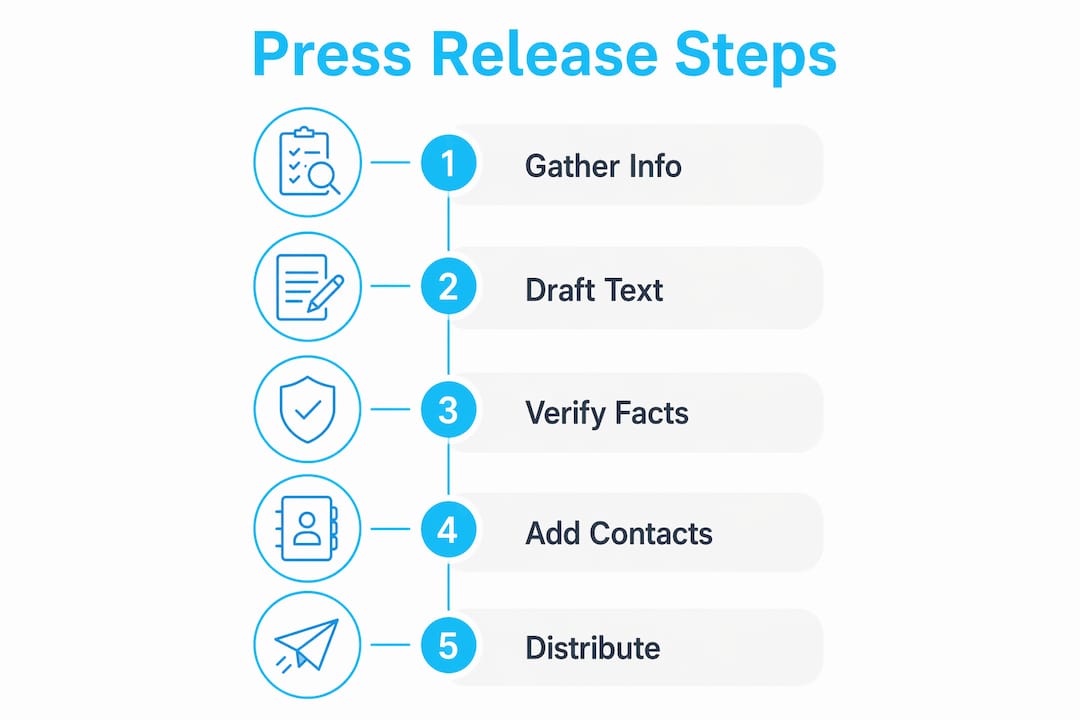
Write the headline and lead paragraph first. Both must stand alone as a complete summary of the news. Quotes from key stakeholders add credibility and perspective without repeating the headline. A quote from the lead attorney, a law enforcement official, or an authorized spokesperson gives journalists a ready-made sound bite and adds dimension to the release.
Distribution requires the same discipline as writing. Targeted media emails to relevant outlets outperform mass blasts every time. Research the specific reporters who cover courts and criminal justice at your target outlets. Send once. Follow up once. Multiple messages signal desperation and damage the relationship.
- Gather all verified documents and confirm case numbers, court names, and dates.
- Write the headline as a factual, newsworthy statement under 15 words.
- Draft the lead paragraph answering who, what, when, where, and why in 40–60 words.
- Build the body using the inverted pyramid: key facts, supporting details, background.
- Insert one or two quotes from authorized sources. Attribute every quote by full name and title.
- Add the boilerplate, contact information, and close with ###.
- Mark the release “FOR IMMEDIATE RELEASE” or set an embargo date and time at the top.
- Send to targeted journalists covering courts and criminal justice. Follow up once after 48 hours.
What common mistakes occur in criminal case press releases, and how do you avoid them?
Speculation is the most damaging mistake in a criminal case press release. A single unverified claim can expose the issuing party to defamation liability and permanently damage relationships with journalists. The rule is simple: if it is not in a court document or official statement, it does not appear in the release.
Tone errors come second. Releases that read as advocacy documents rather than factual statements lose credibility with editors immediately. Journalists covering criminal cases are experienced readers. They recognize promotional language and treat it as a red flag. Write as a reporter would write, not as a defense attorney or prosecutor arguing a position.
- Never include speculation about motive, guilt, or outcome in an active case.
- Avoid adjectives that editorialize: “shocking,” “devastating,” or “outrageous” have no place in a press release.
- Do not omit the designated media contact. Editors need a clear path to follow-up questions.
- Never ignore criminal news reporting standards around dateline placement and news value emphasis.
- Failing to define communication boundaries leads to uncontrolled media access and contradictory public statements.
Pro Tip: For high-profile or sensitive cases, prepare a short Q&A document for your designated media contact before the release goes out. Anticipate the five most likely follow-up questions and agree on approved answers in advance. This prevents off-script responses under pressure.
Key takeaways
A legally sound criminal case press release requires verified documentation, a single designated media contact, and strict adherence to the inverted pyramid format to maintain credibility and control the public narrative.
| Point | Details |
|---|---|
| Format is non-negotiable | Follow the headline, dateline, inverted pyramid, boilerplate, and ### structure every time. |
| Verified facts only | Include case numbers, court jurisdictions, and complaint numbers. Omitting them causes rejection. |
| One media contact | Designate a single spokesperson to prevent contradictory statements and protect credibility. |
| Stay on the record | Never include speculation. Write only what appears in filed documents or official statements. |
| Target your distribution | Send to specific court and criminal justice reporters. One targeted email outperforms a mass blast. |
Why precision beats storytelling in criminal case PR
The biggest mistake I see from attorneys and PR teams entering legal communications is treating a criminal case press release like a narrative pitch. They want to tell a story. Editors want facts they can verify in 90 seconds.
Working on high-profile criminal cases has taught me that the releases which generate the most media pickup are the ones that read like court documents, not press kits. The headline states the verdict or charge. The lead answers the 5 Ws. The body adds context without editorializing. That discipline is harder than it sounds, especially when a client is emotionally invested in the outcome.
Relationship-building with journalists matters as much as the writing itself. Reporters who cover courts know when a release is credible and when it is spin. Sending them accurate, well-formatted releases consistently builds trust over time. That trust pays off when you need coverage on a tight deadline or a sensitive development that requires careful handling.
The releases that fail are almost always the ones that try too hard. They editorialize, they speculate, and they bury the news value under background paragraphs. Write the facts. Attribute the quotes. End with ###. The story takes care of itself.
— Ryan McCormick
How Goldman McCormick PR helps with legal case media releases
Goldman McCormick PR has specialized in legal PR services since 2010, and the New York Observer named it one of the top five public relations agencies specializing in legal PR as early as 2014. Forbes Magazine recognized Goldman McCormick PR as one of America’s Best PR Firms for 2021. The firm works directly with legal professionals and their teams to draft, review, and distribute criminal case press releases that meet journalistic standards and protect client interests. From identifying the right media contacts to controlling the message across TV, radio, and print, Goldman McCormick PR delivers results that attorneys and PR specialists can rely on.
The firm also produces nationally syndicated radio programs heard on the Genesis Communications Network and Starcom Radio Network, giving legal clients direct access to broadcast audiences that print alone cannot reach.
FAQ
What is a press release for a criminal case?
A criminal case press release is an official, structured statement that communicates verified legal facts to journalists and the public. It follows standard press release format and includes case numbers, court jurisdiction, and a designated media contact.
How long should a criminal case press release be?
A criminal case press release should be 300–1,000 words. The lead paragraph runs 40–60 words, and the full release ends with ### to signal completion to editors.
What information must you include for legal credibility?
Every criminal case release must include the official case number, court jurisdiction, and complaint number. Omitting these details leads to rejection by news desks and undermines credibility.
How do you avoid legal liability in a criminal case press statement?
Stay strictly on the record. Write only facts confirmed in court filings or official statements, and never speculate about motive, guilt, or outcome in an active case.
Who should be the media contact in a criminal case press release?
Designate a single, authorized spokesperson as the media contact. Multiple contacts create contradictory statements and damage the credibility of the release and the issuing party.