
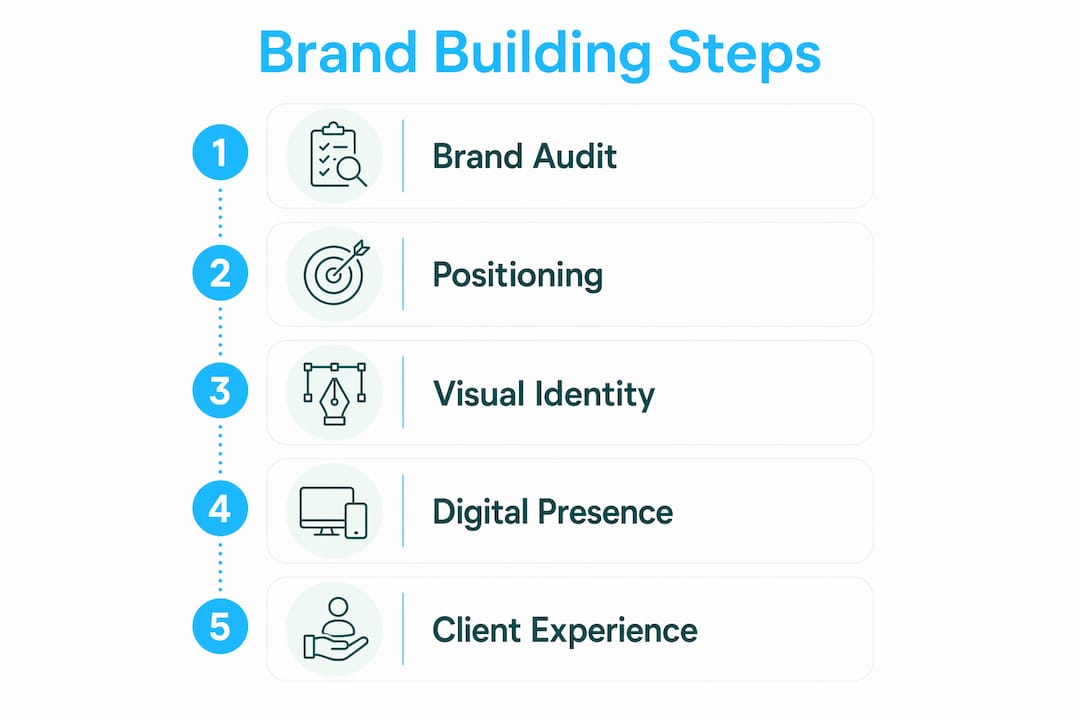
Building a law firm brand in NYC is the strategic process of defining how your firm is perceived locally, encompassing positioning, messaging, visual identity, digital presence, and client experience. New York’s legal market is among the most saturated in the world, where a firm’s online reputation is its most valuable digital asset and requires continuous cultivation. The New York State Bar Association’s Ethics Opinion 1294 governs advertising, solicitation, and lead generators, making compliance a non-negotiable foundation for any branding effort. Firms that treat brand strategy as a structured discipline, rather than a cosmetic exercise, consistently outperform competitors on trust, referrals, and search visibility.
How to build a law firm brand in NYC: start with a brand audit
Before you redesign a logo or rewrite your website copy, you need a clear picture of what your brand currently communicates. A brand audit inventories every client-facing asset: your website, social media profiles, Google Business Profile listing, Avvo and Yelp reviews, email signatures, and printed collateral. The goal is to identify gaps between how your firm presents itself and how clients actually perceive it.
Audit your online reputation with the same rigor you apply to case preparation. Search your firm name in Google and note what appears in the first ten results, including review scores, directory listings, and any press coverage. Survey five to ten current or former clients and three to five referral sources with a short questionnaire asking what words they associate with your firm and why they chose you.
- Check logo and color consistency across your website, LinkedIn, and any physical signage
- Review all practice area pages for outdated information or inconsistent tone
- Score your Google Business Profile completeness and review response rate
- Assess page load speed, since mobile load time under three seconds is a retention threshold, not a luxury
- Note any awards, peer recognitions, or media mentions that are not prominently displayed
Pro Tip: Internal discovery, meaning structured interviews with your own attorneys and staff about firm values and client experience, consistently produces more authentic brand strategy than any external survey alone.
How do you develop positioning and messaging for the NYC legal market?
Positioning is the single sentence that explains why a client in New York should choose your firm over every other option. Brand development in NYC requires articulating your value proposition with clarity, confidence, and cultural awareness, because Manhattan clients, Brooklyn small business owners, and Queens families each respond to different language and proof points.
Follow this sequence to build a messaging framework that holds up under scrutiny:
- Define your ideal client with specificity. A Midtown employment attorney’s ideal client is not “anyone with a workplace dispute.” It is a senior manager at a financial services firm facing wrongful termination.
- Identify your competitive category. Are you the boutique specialist, the full-service firm, or the community-focused practice? Your category shapes every word you write.
- Write a brand promise in one sentence. It must be specific enough to be falsifiable. “We fight hard for clients” is not a promise. “We resolve commercial lease disputes for NYC restaurant owners within 90 days” is.
- Develop practice area narratives that connect legal outcomes to client life outcomes. Clients do not buy legal services. They buy certainty, protection, and resolution.
- Review all messaging against NYSBA Opinion 1294 before publishing, particularly any use of endorsements, testimonials, or technology-assisted lead generation.
Pro Tip: Geo-fenced Google Ads and hyperlocal SEO campaigns targeting specific NYC boroughs or micro-neighborhoods consistently deliver better conversion rates and lower cost per click than citywide campaigns.
What does a cohesive digital presence look like for NYC law firms?
Visual identity and digital presence are where your positioning becomes tangible. Brief your designer with your completed positioning statement and messaging framework before any creative work begins. This prevents the most common and expensive mistake in legal branding: a polished website that communicates nothing distinctive.

| Element | Weak execution | Strong execution |
|---|---|---|
| Website homepage | Generic hero image, vague tagline | Clear value proposition above the fold, client-outcome focused |
| Google Business Profile | Incomplete, no responses to reviews | Fully optimized, consistent review responses, updated photos |
| Social media | Sporadic posts, no consistent voice | Scheduled content tied to practice areas and local news |
| Trust signals | No awards or recognition displayed | Bar association honors, media mentions, and peer ratings visible |
Trust signals deserve particular attention. Awards from recognized bodies, media coverage in outlets like the New York Law Journal, and client testimonials (structured to comply with ethics rules) all function as third-party validation. Strategic philanthropy and coherent community storytelling also reinforce brand credibility in ways that paid advertising cannot replicate.
Pro Tip: Integrate local statutes, court names, and borough-specific legal references into your website content. This approach directly strengthens your E-E-A-T signals in Google’s quality assessment and reinforces your authority as a New York practitioner.
How client experience and firm culture reinforce your legal brand
A firm’s brand is ultimately the sum of every interaction a client has with it, not just the visual identity. Culture and responsible business practices must be embedded into daily firm operations to build credible brand trust. A beautifully designed website that leads to a slow intake process or inconsistent communication destroys the brand promise before the engagement begins.
Map your client journey from first contact through matter resolution and post-matter follow-up. At each touchpoint, ask whether the experience matches the promise your marketing makes. Specific areas to address include:
- Intake call scripts that reflect your firm’s tone and values, not just information gathering
- Response time standards for emails and calls, communicated clearly to clients at the start
- Regular case status updates that demonstrate proactive communication
- Post-matter surveys that gather feedback and, where appropriate, invite reviews in compliance with ethics guidelines
- Community involvement and pro bono work that aligns with your stated firm values
Brand authenticity built from the inside out produces referrals and loyalty that no advertising budget can manufacture. Clients who feel genuinely served become the most credible brand ambassadors your firm has.
How do you manage reputation and stay compliant in NYC?
Law firm reputation management is a growth engine, not a damage control function. Proactive reputation building enhances perceived trustworthiness and amplifies the effectiveness of every other marketing channel you use. Firms that monitor and respond consistently outperform those that treat reviews as an afterthought.
- Set up Google Alerts and review monitoring tools for your firm name, key attorneys, and practice area terms specific to your NYC market.
- Respond to every Google, Avvo, and Yelp review within 48 hours. Responses to negative reviews must be professional, non-specific about case details, and reviewed against NYSBA ethics guidelines before posting.
- Integrate reputation signals into your SEO content strategy. Positive review volume and recency directly influence local search rankings.
- Conduct a formal brand and messaging review every 12 months. Adjust positioning based on analytics, client feedback, and competitive shifts in your practice area.
- Build structured compliance workflows for review requests and testimonial collection so every team member follows the same ethics-approved process.
Pro Tip: Set up a shared internal document where every review response is drafted and reviewed before posting. This single workflow prevents ethics violations and ensures brand voice consistency across all platforms.
Key takeaways
Building a law firm brand in NYC requires a structured sequence: audit first, define positioning second, build visual identity and digital presence third, and sustain it through client experience and proactive reputation management.
| Point | Details |
|---|---|
| Audit before redesigning | Inventory all brand assets and survey clients before spending on creative work. |
| Positioning drives everything | A specific, falsifiable brand promise outperforms generic taglines in every NYC market segment. |
| Ethics compliance is a brand asset | NYSBA Opinion 1294 governs advertising and testimonials; compliance builds trust, not just legal protection. |
| Client experience is the brand | Intake protocols, response times, and post-matter follow-up must match your marketing promise. |
| Reputation management drives growth | Proactive review monitoring and response directly improve local SEO rankings and lead quality. |
What I’ve learned about building law firm brands in New York
After years of working in legal PR and media in New York, the pattern I see most often is firms that invest heavily in visual identity before they have done the internal discovery work. The result is a beautiful website that says nothing a competitor’s site does not also say. The firms that build lasting brands in this city start with hard questions: What do our best clients actually value? Why do referral sources send work to us specifically? What do we do operationally that no one else does?
The second lesson is that ethics compliance is not a constraint on creativity. It is a differentiator. In a market where some firms cut corners on advertising disclosures or testimonial language, a firm that operates with visible integrity stands out. Clients notice. Judges notice. Referral sources notice.
The third lesson is that culture cannot be faked at scale. I have seen firms launch culture-driven campaigns that collapsed within a year because the internal reality did not match the external message. The firms that sustain strong brands in NYC are the ones where the managing partner and the receptionist describe the firm’s values in the same language. That alignment is the real brand.
— Ryan McCormick
How Goldman McCormick PR helps NYC law firms build their brand
Goldman McCormick PR has specialized in legal public relations since 2014, when the New York Observer named it one of the top five PR agencies in legal PR. Named by Forbes Magazine as one of America’s Best PR Firms for 2021, Goldman McCormick PR brings media relationships, compliance-aware messaging, and integrated reputation strategy to NYC law firms that need more than a new logo. The firm’s work spans television placement, radio, nationally syndicated programs, and print coverage, all coordinated to reinforce a single, consistent brand message. If you are ready to build a legal brand in NYC that generates real visibility and client trust, Goldman McCormick PR delivers the results your firm deserves.
FAQ
What is the first step to build a law firm brand in NYC?
Conduct a brand audit before any creative work begins. Inventory your existing assets, review your online reputation across Google, Avvo, and Yelp, and survey clients for perception feedback.
How does NYSBA Opinion 1294 affect NYC legal marketing?
NYSBA Opinion 1294, issued in March 2026, governs advertising, solicitation, endorsements, and lead generators. Every review request, testimonial, and paid campaign must be structured to comply with its requirements.
What makes NYC law firm branding different from other markets?
NYC requires hyperlocal SEO targeting specific boroughs, cultural awareness in messaging tone, and stricter ethics compliance than many other jurisdictions. Brand consistency across digital and physical touchpoints also matters more in a market where clients have more choices.
How often should a law firm review its brand strategy?
A formal brand and messaging review should occur annually. Firms in fast-moving practice areas, such as employment law or real estate, may benefit from a mid-year check against competitive and regulatory changes.
Is reputation management the same as law firm branding?
Reputation management is one component of a broader branding strategy. It focuses specifically on monitoring and responding to reviews, managing search results, and maintaining public trust, all of which reinforce the larger brand identity.