
Attorney crisis communications is the coordinated practice of managing messaging, media relations, and legal privilege protection during high-stakes events that threaten a client’s or firm’s reputation. According to Venable, the most common and costly mistake law firms make is assuming PR consultants and other third parties can be freely included in crisis response without proper legal structures in place. The standard industry term for this discipline is legal crisis management, and it sits at the intersection of attorney public relations and litigation strategy. Get the structure wrong from the start, and you risk waiving attorney-client privilege before a single reporter files a story.
How can law firms protect attorney-client privilege during crisis communications?
Attorney-client privilege does not automatically extend to crisis communications consultants. Privilege extends to PR consultants only when their involvement is demonstrably necessary for the attorney to comprehend and respond to the legal situation. That is a high bar, and courts apply it strictly.

The common interest doctrine offers one path forward, but it requires active collaboration on shared legal issues among parties with aligned legal interests. It is not a blanket shield for anyone copied on a strategy email. Two additional legal standards from case law define the boundaries: the functional equivalence standard, which asks whether the consultant performs a role equivalent to an employee, and the active involvement standard, which requires counsel to remain genuinely engaged in the communications work rather than serving as a pass-through.
To reduce privilege waiver risks, retain consultants through counsel with a documented legal purpose, and mark all relevant communications accordingly. Retaining a crisis communications consultant outside your usual PR firm and doing so in anticipation of litigation also increases the likelihood of maintaining privilege. Structure, independence, and document markings are not administrative details. They are the legal architecture that keeps your communications protected.
Practical steps to protect privilege when engaging crisis consultants:
- Retain the consultant directly through outside counsel, not through the client’s marketing department
- Document the consultant’s role as necessary to assist legal strategy comprehension
- Mark all communications “Privileged and Confidential: Attorney-Client Communication”
- Keep counsel actively involved in reviewing and directing communications work
- Avoid copying the consultant on communications unrelated to the legal strategy
Pro Tip: Draft a formal engagement letter for every crisis communications consultant that explicitly states their role is to assist counsel in formulating legal strategy. This single document is often the difference between protected and discoverable communications.
What are the essential crisis communication strategies for attorneys?
Speed and transparency are the two variables that most directly determine whether a legal crisis escalates or stabilizes. Effective crisis communication requires risk assessments to prioritize scenarios, pre-drafted messaging templates, rapid initial responses, and a commitment to transparency, particularly in the early phases when public narratives form fastest. Reporters and social media audiences do not wait for a firm to get comfortable. They begin constructing the story with whatever information is available.
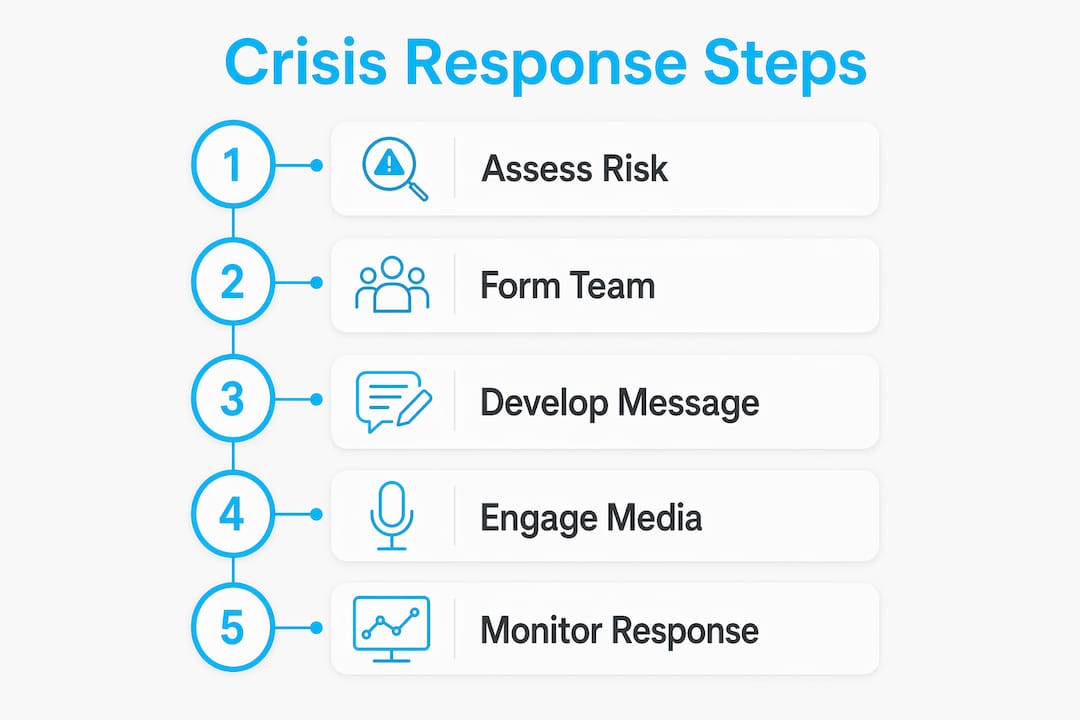
The instinct to say “no comment” is one of the most damaging reflexes in legal crisis management. Lawyers often err with the ‘no comment’ reflex, when the more effective approach is to coordinate messaging and control who speaks. A prepared, limited statement that acknowledges the situation without prejudicing legal proceedings is almost always better than silence.
Here is a numbered framework for building attorney crisis communication strategies:
- Conduct a scenario risk assessment. Identify the five to ten crisis scenarios most likely to affect your practice area or client base. Rank them by probability and reputational impact.
- Draft messaging templates in advance. Prepare holding statements, media inquiry responses, and client notification templates before a crisis occurs. Approval workflows should be built into each template.
- Designate a communications lead. This person prepares initial reactive media statements, nominates spokespersons, and coordinates all internal and external messaging.
- Coordinate across legal, PR, IT, and leadership. Crisis response is not a solo function. Each team has a distinct role, and gaps between them create the inconsistencies reporters exploit.
- Apply ABA Model Rule 7.1 to every public statement. Attorney messages on social media must avoid false or misleading claims about legal services. This rule applies with equal force during a crisis, when the temptation to over-reassure is highest.
Pro Tip: Build your messaging templates around what you can say, not what you cannot. Courts and bar associations scrutinize what attorneys say publicly during active matters. A template that passes ethics review in advance is far safer than an improvised statement under pressure.
What steps should legal teams take to prepare for and respond to crises?
Preparation is the only variable in crisis response that you fully control. Law firms that conduct crisis tabletop exercises simulating media inquiries and stakeholder reactions, involving legal, PR, IT, HR, and leadership teams, consistently outperform firms that rely on ad hoc responses. These exercises test timing, message consistency, and chain-of-command clarity before the pressure is real.
The formation of a crisis management team with defined roles is the structural prerequisite for everything else. Each member needs a written role description, a backup contact, and a clear escalation path. Without this, the first crisis meeting becomes a debate about who is in charge rather than a coordinated response.
Over-communication is preferable to silence during an active crisis, even when the facts have not changed. Internal synchronization and pre-approved messaging templates allow teams to communicate frequently without creating new legal exposure. The table below maps the key preparation steps against their primary purpose and responsible party.
| Preparation step | Purpose | Responsible party |
|---|---|---|
| Scenario risk assessment | Identifies likely crises and prioritizes response resources | General counsel + communications lead |
| Crisis team formation | Assigns roles and escalation paths before a crisis occurs | Managing partner or COO |
| Tabletop exercises | Tests message consistency, timing, and chain of command | All core team members |
| Messaging template library | Enables rapid, pre-approved responses under pressure | Communications lead + outside counsel |
| Internal sync protocol | Prevents information gaps and contradictory statements | Communications lead |
Pro Tip: Include a media role-play segment in every tabletop exercise. Have one team member play an aggressive reporter. The discomfort of that simulation is far less costly than the discomfort of the real thing.
What common pitfalls do lawyers face in crisis communications?
The most structurally dangerous pitfall is retaining crisis PR consultants without routing the engagement through counsel and without clear records of the legal purpose. Missteps in retaining crisis PR consultants outside counsel and lacking clear legal purpose documentation can lead directly to privilege waivers. Once privilege is waived, communications that were intended to be strategic become discoverable evidence.
Beyond privilege, inconsistent messaging is the most visible failure mode. When different attorneys, partners, or spokespersons say different things to different audiences, the inconsistency becomes the story. Reporters actively compare statements across sources. A single contradictory quote from a junior partner can undermine a carefully prepared response from the communications lead.
Social media amplifies every gap. Misinformation spreads faster than corrections, and a single post from a firm employee that contradicts the official statement can reset the entire narrative. ABA Model Rule 7.1 governs what attorneys can say publicly, but the rule does not prevent well-meaning people from saying the wrong thing without realizing it.
“Reporters begin forming narratives early. The firm that controls the first credible statement controls the frame of the story. Silence is not neutral. It is an invitation for someone else to fill the gap.”
Practical remedies for the most common pitfalls:
- Establish a single approved spokesperson and enforce the rule that no one else speaks to media
- Brief all attorneys and staff on the approved messaging before any public statement is released
- Monitor social media in real time during an active crisis and have a designated responder for misinformation
- Review all public statements against ABA Model Rule 7.1 before release
- Document every decision made during the crisis response for potential future legal review
Key takeaways
Effective legal crisis management requires integrating privilege protection, pre-built communication infrastructure, and message discipline before a crisis occurs, not during it.
| Point | Details |
|---|---|
| Privilege protection is structural | Retain crisis consultants through counsel with documented legal purpose to avoid waiver. |
| Templates beat improvisation | Pre-approved messaging templates allow rapid, ethics-compliant responses under pressure. |
| Tabletop exercises build readiness | Simulations involving legal, PR, IT, and HR teams test chain-of-command clarity before a real crisis. |
| “No comment” damages more than it protects | A prepared limited statement almost always outperforms silence in controlling the narrative. |
| ABA Model Rule 7.1 applies in crises | Every public statement, including social media, must meet the truthfulness standard without exception. |
Why the “hunker down” instinct fails law firms in a crisis
I have worked alongside legal teams long enough to recognize a pattern: the instinct to go quiet, close ranks, and wait for the crisis to pass. It feels like discipline. It is actually abdication. The narrative does not pause while your team deliberates. It moves forward with or without you.
What I have seen work consistently is the opposite approach. Firms that invest in tabletop exercises, build their messaging templates before they need them, and establish clear roles for their communications lead walk into a crisis with something most firms lack: confidence in the process. That confidence is not arrogance. It is the product of preparation, and it shows in every interaction with media, clients, and opposing counsel.
The other lesson I keep returning to is this: find crisis communications consultants who understand the legal privilege architecture, not just the PR mechanics. A consultant who has never worked inside a privilege framework will inadvertently create discoverable communications. The legal and communications functions are not separate tracks. They are one integrated strategy, and the firms that treat them that way protect their clients far more effectively.
— Ryan McCormick
How Goldman McCormick PR supports law firms in crisis
Goldman McCormick PR has specialized in legal public relations since 2014, when the New York Observer named the firm one of the top five PR agencies in legal PR. Named by Forbes Magazine as one of America’s Best PR Firms for 2021, Goldman McCormick PR brings direct media experience to every crisis engagement, including attorney media relations, privilege-sensitive communications strategy, and rapid response support.
For law firms managing active crises or building proactive communication plans, Goldman McCormick PR offers tailored support that accounts for the legal privilege constraints attorneys face. The firm’s team can assist with tabletop exercise facilitation, spokesperson preparation, and media statement development, all structured to protect the attorney-client relationship. Contact Goldman McCormick PR directly to discuss a crisis communications plan built for your firm’s specific risk profile.
FAQ
What is attorney crisis communications?
Attorney crisis communications is the coordinated practice of managing media relations, public messaging, and legal privilege protection during events that threaten a client’s or firm’s reputation. It combines legal crisis management with attorney public relations to protect both legal interests and public standing.
How do you protect attorney-client privilege when using a PR consultant?
Retain the PR consultant through outside counsel with a documented legal purpose, mark all communications as privileged, and keep counsel actively involved in directing the communications work. Privilege extends to consultants only when their role is necessary for legal strategy comprehension.
What is the biggest mistake lawyers make in a crisis?
The most common mistake is defaulting to “no comment,” which cedes narrative control to reporters who will fill the gap with available information. The second most costly mistake is retaining crisis consultants without routing the engagement through counsel, which risks privilege waiver.
How often should law firms conduct crisis tabletop exercises?
Law firms should conduct tabletop exercises at least annually, with additional sessions after significant changes in practice area, client base, or firm structure. Exercises should include media role-play scenarios to test spokesperson readiness and message consistency under pressure.
Does ABA Model Rule 7.1 apply to crisis communications?
Yes. ABA Model Rule 7.1 governs all public attorney communications, including statements made during a crisis. Every public statement, social media post, and media response must avoid false or misleading claims about legal services, regardless of the pressure to reassure clients or the public.