
When a crisis hits, your words carry weight that most professionals never face. Whether you’re managing a client in acute distress or responding to a public mental health emergency, the stakes of poor communication are measurable and real. This psychologist crisis communication guide draws on authoritative frameworks including the CDC CERC Manual and guidance from the American Counseling Association to give you practical, ethics-grounded strategies. You’ll find preparation checklists, step-by-step communication techniques, social media guidance, and self-care protocols built specifically for mental health professionals.
Table of Contents
- Key Takeaways
- Your psychologist crisis communication guide starts here
- Step-by-step crisis communication techniques
- Managing social media and public platforms
- Monitoring outcomes and protecting your resilience
- My perspective on what nobody tells you
- How Goldmanmccormick helps mental health professionals
- FAQ
Key Takeaways
| Point | Details |
|---|---|
| Prepare before the crisis | Build a crisis communication plan with de-escalation scripts and designated team roles before emergencies occur. |
| Ethics come first | Never publicly diagnose individuals or share confidential client information, even under media or public pressure. |
| Balance facts with empathy | Credible information delivered without emotional attunement often fails to reach people under stress. |
| Social media has hard limits | Clarify that online posts are education, not therapy, and always direct followers to offline professional support. |
| Protect yourself too | Secondary trauma is an occupational reality in crisis work. Structured self-care is professional responsibility, not optional. |
Your psychologist crisis communication guide starts here
Effective crisis communication for psychologists is not a single skill. It is a system of interconnected competencies that must be prepared, tested, and sustained over time. The CDC CERC framework organizes crisis communication into distinct phases, each requiring a different emphasis. Early phases demand rapid, empathetic fact-sharing. Later phases require consistent updates, misinformation correction, and trust maintenance. Understanding where you are in that arc shapes every message you send.
Before you communicate a single word during a crisis, you need three things in place.
- A written crisis communication plan with clearly defined roles and escalation paths
- Pre-approved de-escalation scripts for phone-based and in-person distress interactions
- A short list of verified referral resources you can provide immediately
The ethical dimension is non-negotiable. The American Counseling Association explicitly states that publicly diagnosing the mental state of an individual without consent violates professional ethics codes. This applies in media interviews, social media posts, and public statements. You can speak about patterns, populations, and evidence without labeling specific individuals.
Clinician self-protection belongs in the preparation phase too, not as an afterthought. The British Psychological Society identifies secondary trauma as a significant occupational hazard in crisis work, requiring structured awareness, containment strategies, and self-care protocols built directly into crisis plans. If your crisis plan doesn’t include you, revise it now.
| Tool or requirement | Purpose |
|---|---|
| Crisis communication plan | Defines roles, escalation paths, and messaging approval process |
| De-escalation scripts | Provides calm, consistent language for distressed callers or clients |
| Ethical guidelines checklist | Prevents diagnostic labeling and confidentiality breaches under pressure |
| Referral resource list | Gives clients immediate pathways to appropriate support |
| Self-care protocol | Protects clinician well-being throughout the crisis period |
Pro Tip: Review and practice your de-escalation scripts at least twice a year with your team. Scripted language feels unnatural until it doesn’t. In a real crisis, that rehearsal is what keeps your voice steady.
Step-by-step crisis communication techniques
The technical side of crisis communication gets far less attention than it deserves. Most clinicians receive training in clinical empathy, not structured crisis messaging. These two things are related but not the same.
The Law Society Crisis Communication Guide underscores that de-escalation scripts for emotionally distressed callers are not just helpful; they are foundational tools. Here is a stepwise framework you can apply in real-time client or public interactions:
-
Establish safety and acknowledgment first. Begin by naming what you observe. “I can hear that you’re in a lot of distress right now. I’m here with you.” This signals presence without making promises you can’t keep.
-
Slow the pace deliberately. Speak at roughly 70% of your normal conversational speed. Research on first responder communication shows that calmness, clarity, and trust-building directly improve crisis outcomes. Your tone regulates theirs.
-
Offer one piece of information at a time. Under acute stress, people process less. Overloading a distressed client with options or details actively reduces comprehension. State one fact. Pause. Confirm understanding. Then continue.
-
Use positive framing. Instead of “Don’t panic,” say “Let’s focus on one thing right now.” Instead of “I can’t give you advice,” say “What I can do is help you find the right support.” Language that points toward action reduces perceived threat.
-
Acknowledge resistance without arguing. When someone pushes back on your guidance, validate the emotion behind the resistance: “It makes sense that this feels overwhelming.” Then redirect toward a concrete next step.
-
Close with a clear, specific next step. Never end a crisis interaction with vagueness. “I’d like you to call this number within the next hour” is far more effective than “You should probably reach out to someone.”
The CDC CERC guidance on crisis psychology reinforces that emotional engagement and credible facts must coexist in effective messaging. Facts without empathy get rejected. Empathy without facts leaves people without direction. You need both, in the right sequence.
Pro Tip: After every significant crisis interaction, write three sentences about what worked, what you’d change, and how you’re feeling. This practice builds your skills faster than any training program and catches secondary trauma early.
Managing social media and public platforms
Social media gives psychologists a reach that was impossible a decade ago. It also creates pressures and ethical gray areas that formal training rarely addresses directly.

Research published in PMC on psychologist Instagram use found that psychologists acting as mental health influencers must consistently clarify that their content is education, not therapy, and should actively direct followers to offline individualized support. During a crisis, this distinction becomes even more critical. Followers in distress may interpret general posts as personal guidance. The line blurs fast.
Here is what responsible social media crisis communication looks like in practice:
- Post a clear disclaimer at the start of any crisis-related content: “This is general education. If you are in distress, please contact [crisis line] immediately.”
- Share only evidence-based information from verified sources. Link to the original source, not to summaries.
- Use content warnings before discussing triggering subjects such as suicide, trauma, or violence.
- Avoid real-time, reactionary posting during breaking events. Wait until you have verified facts.
- Set firm time boundaries on your social media engagement. Responding to comments from distressed followers at midnight is neither effective nor sustainable.
- Seek supervision specifically around your public communications, not just your clinical work.
Managing emotional labor online is genuinely difficult. The volume and intensity of responses during a public crisis can wear you down faster than a full clinical caseload. Recognizing that boundary is not weakness. It is professional judgment.
Monitoring outcomes and protecting your resilience
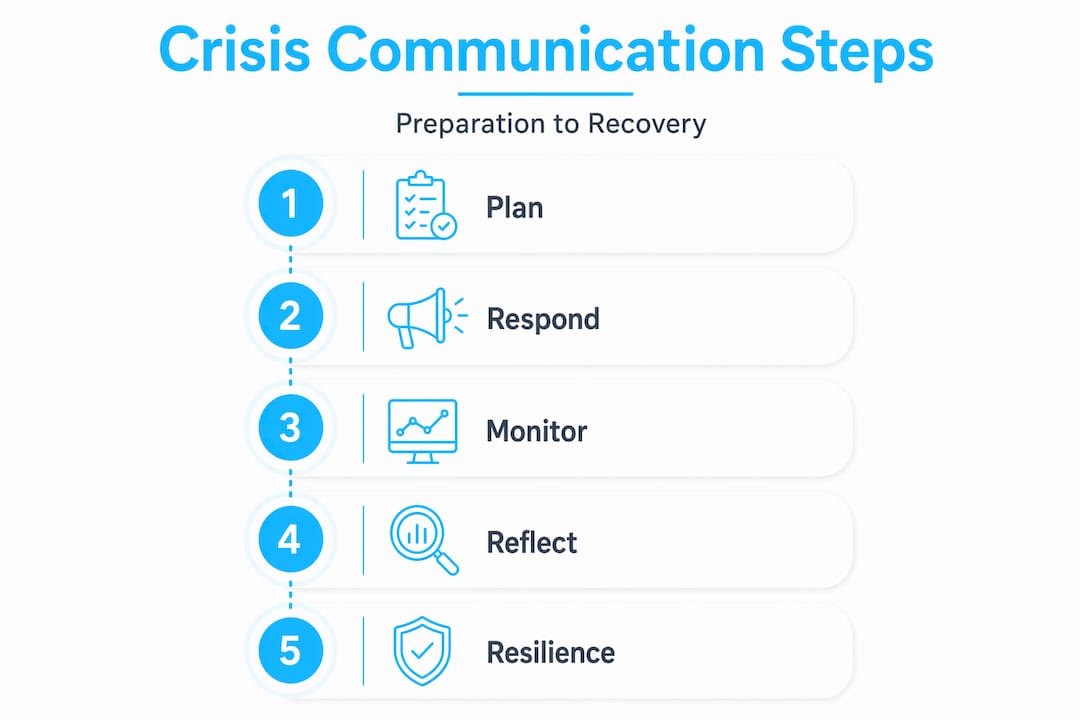
Effective crisis communication doesn’t stop when the acute phase ends. Misinformation spreads fastest in the recovery phase, when public attention drifts but vulnerability remains. The CDC CERC framework emphasizes consistent updates and misinformation correction as critical to sustaining the trust you built early.
| Monitoring activity | How to implement it |
|---|---|
| Client feedback loops | Brief check-ins after crisis interactions to assess comprehension and emotional state |
| Team debriefs | Structured after-action reviews within 48 hours of major crisis communications |
| Misinformation scanning | Regular review of public channels where your name or practice appears |
| Self-monitoring for secondary trauma | Weekly self-assessment using validated tools such as the ProQOL scale |
| Supervision | Scheduled consultation focused on crisis communication impacts, not just clinical outcomes |
Pro Tip: Set a calendar reminder one week after any significant public crisis communication to review what you said, what circulated, and whether corrections are needed. Most professionals skip this step. It’s where reputations are either solidified or quietly eroded.
My perspective on what nobody tells you
I’ve spent years watching skilled clinicians stumble in crisis communication not because they lack empathy, but because they underestimate how different communicating under pressure is from standard therapeutic conversation. The skills transfer, but the conditions don’t.
The hardest part, in my experience, is holding professional clarity when everyone around you is expecting you to perform emotional rescue. People want certainty from a psychologist during a crisis. You can offer presence, process, and direction. You cannot offer certainty. Learning to say that calmly, and mean it, is one of the more difficult things in this work.
Social media during a crisis is genuinely a double-edged situation. I’ve seen it amplify exactly the right message to exactly the right person at 2 a.m. I’ve also seen well-intentioned posts misread catastrophically. The safest posture is consistency: say what you’d say in a professional publication, not what you’d say to a close colleague.
Secondary trauma doesn’t announce itself. It accumulates. If your crisis communication plan doesn’t include deliberate recovery protocols for you and your team, it is incomplete. Build that in now, before you need it.
— Jack
How Goldmanmccormick helps mental health professionals
Goldmanmccormick, named by Forbes as one of America’s best PR firms, works with mental health professionals who need to communicate credibly under pressure. Whether you’re managing a practice’s public profile during a community crisis or preparing for media coverage of a sensitive mental health issue, having a communications partner with deep media experience makes a measurable difference. The team at Goldmanmccormick understands the ethical boundaries that govern your work and builds messaging strategies that respect those boundaries while amplifying your authority. If you’re ready to approach crisis communication proactively rather than reactively, this is where that work starts.
FAQ
What is a psychologist crisis communication guide?
A psychologist crisis communication guide is a structured framework covering preparation, ethical boundaries, communication techniques, and self-care strategies to help mental health professionals manage client and public interactions during crises.
How should psychologists handle de-escalation during crisis calls?
Use pre-written scripts with calm, containment-focused language. Slow your speech, acknowledge distress directly, and offer one clear next step at a time, as supported by the Law Society Crisis Communication Guide.
Can psychologists publicly comment on someone’s mental state during a crisis?
No. The ACA ethics guidelines prohibit publicly diagnosing an individual’s mental state without consent, even in crisis contexts or media settings.
What is secondary trauma and why does it matter in crisis work?
Secondary trauma is psychological distress acquired through exposure to others’ traumatic experiences. The BPS identifies it as a significant occupational risk for psychologists in crisis roles, requiring structured self-care protocols.
How should psychologists use social media during a mental health crisis?
Post general, evidence-based education only. Always include crisis line referrals, use content warnings, and clarify that online content does not constitute therapy, per PMC research on psychologist social media conduct.