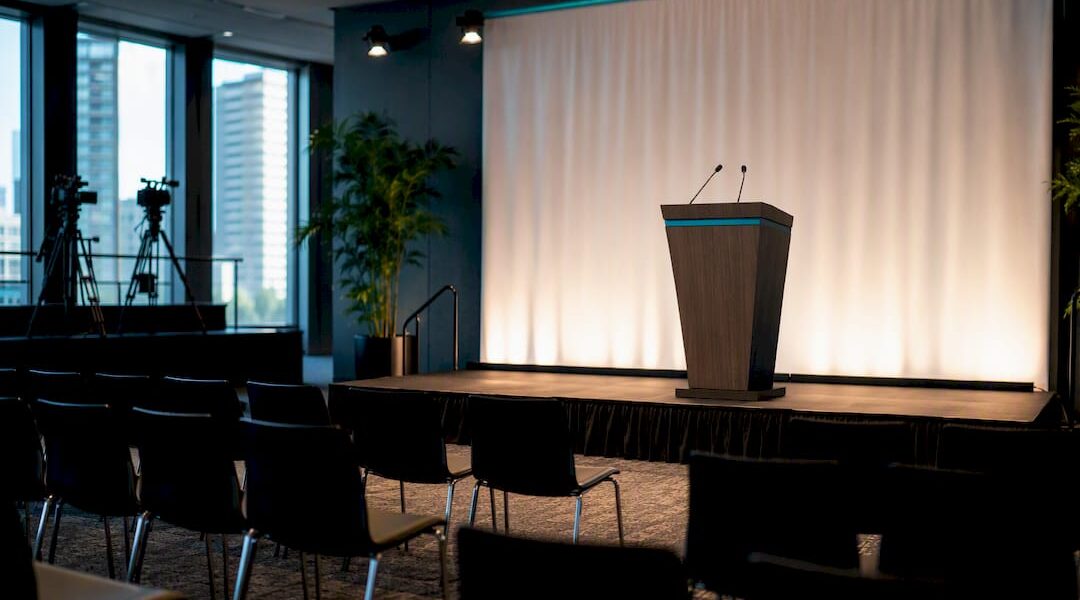
A press conference backdrop has one job: make the branding read clearly on camera while everything around it stays out of the story. That means clean sightlines, a logo scaled for broadcast, and remarks tight enough to hold a room. Schedule the event mid-week (Tuesday through Thursday) and mid-morning as recommended by industry best practices, and keep it under 30 minutes to protect journalist turnout. Some firms, founded by former broadcast producers, build this staging discipline into every scope of work.
TL;DR:
- Keep the press conference duration under 30 minutes and schedule mid-week mornings to maximize journalist attendance and coverage quality.
- Use one major logo on the backdrop placed at least 10 feet behind the speaker, with minimal supporting marks and plenty of margin to ensure broadcast readability.
- Assign clear roles for messaging, media outreach, staging, and AV setup, with strict responsibility outlines to prevent last-minute improvisation.
- Deliver final photos, videos, and transcripts to media on the same day to support timely news coverage and follow-up interviews.
- Build detailed timelines into the scope of work, including milestones for approval, rehearsal, and asset delivery, with contingency plans for low RSVP scenarios.
Table of Contents
- What Should Be In A PR Firm’s Press Conference Proposal?
- How Should You Place The Backdrop And Logo?
- How Do You Lock The Message And Manage Q&A Risk?
- What AV And Sightline Specs Should You Require?
- What Belongs In The Media Advisory And Press Kit?
- What Milestone Timeline Should Go In The Scope Of Work?
- Why Clean Staging Beats Spectacle In Legal PR
- Hire Goldman McCormick PR To Run Your Press Conference
- Sources
- FAQ
What Should Be In A PR Firm’s Press Conference Proposal?
Before you sign anything, the proposal should read like a punch list, not a mood board. If a firm can’t name who owns each deliverable, that’s a scope gap you’ll pay for later.
A workable scope of work should include:
- Backdrop placement and podium branding specs
- A camera sightline plan with riser and aisle measurements
- A press kit (bios, fact sheet, high-res logos, b-roll links)
- A media advisory drafted and scheduled for distribution
- RSVP tracking and a day-of media list
- A moderated Q&A structure with time limits
- One named on-site media contact for follow-up
Timing matters just as much as content. Insist on a mid-week, mid-morning slot and a hard stop under 30 minutes; both recommendations come from decades of press conference planning practice.
Responsibility should be spelled out by role, not left implied:
- The PR firm owns messaging, media outreach, and staging design.
- The client approver signs off on the primary message and speaker list.
- The venue confirms room access, power, and AV hookups.
- The AV vendor tests audio and lighting during rehearsal, not on arrival.
How Should You Place The Backdrop And Logo?
Distance and restraint matter more than size. Experienced planners set the backdrop at least 10 feet behind the primary speaker whenever the room allows it, which cuts shadow interference and gives cameras enough depth to frame the shot without cropping the branding.
Logo strategy is where most events go wrong. A backdrop crowded with a dozen sponsor marks reads as noise on a 24-inch television screen. One dominant logo, repeated two or three times at a consistent height, with generous margin around each mark, holds up far better than a busy pattern crammed edge to edge.
- Keep one primary logo dominant; treat supporting marks as secondary and smaller
- Leave margin around every logo so nothing touches the frame edge
- Avoid tight patterns, gradients, or fine text that blur at broadcast resolution
- Test the layout on a phone screen before the event; if it’s unreadable there, it’s unreadable on TV
Pro Tip: Stage one strong visual moment, a signing, a check presentation, a document handoff, near the podium. A single memorable image does more for coverage pickup than adding another logo ever will, since visual storytelling drives pickup far more reliably than branding density.
How Do You Lock The Message And Manage Q&A Risk?
One primary message wins the headline. Two or three supporting points back it up. Anything beyond that dilutes the soundbite reporters actually use, and any topic that could derail the message belongs on a red-line list the spokesperson reviews before walking out.
Speaker roles should be assigned, not improvised:
- Lead spokesperson delivers the primary message in 3 to 5 minutes, a length practitioners consistently recommend to keep remarks usable for broadcast.
- Technical or subject expert stands ready for detail questions the lead shouldn’t field alone.
- Backup speaker covers scheduling risk if the lead is delayed or unavailable.
Q&A needs its own rules. A moderator selects questions, enforces a time limit per response, and closes the floor before energy drops. Reserve one-on-one interview windows immediately after the formal session, since reporters value efficient access to follow-up quotes almost as much as the main event itself.
What AV And Sightline Specs Should You Require?
Broadcast-usable footage depends on specs, not luck. Require lapel mics on every speaker plus a backup handheld mic on standby, since a single mic failure can end a segment’s usability. Camera risers belong at the back of the room, elevated enough to shoot over standing attendees.
Room layout affects coverage more than most planners assume. A center aisle of roughly 6 feet gives photographers a clean walking lane, and a front row set about 8 feet from the stage keeps still photography and video both in frame without crowding the speaker.
Lighting deserves the same attention as sound. Even light across the speaker’s face prevents the washed-out or shadowed look that makes clips unusable, and strong backlight from windows should be blocked or countered before doors open.
Build redundancy into the SOW itself:
- A spare wireless mic, charged and tested
- A second recorder or laptop backing up any livestream feed
- A tested livestream path with confirmed bandwidth, not an assumption
- A backup power source for anything running on a single outlet
Pro Tip: Run every camera angle during rehearsal, not just the audio check. A sightline that looks fine standing at the podium can still put a support column directly behind the lead speaker’s head on camera.
What Belongs In The Media Advisory And Press Kit?
Reporters don’t want a press release. They want the who, what, where, when, and why in a format they can scan in under a minute.
- Send the media advisory 7 to 10 days before the event, the window most PR practitioners recommend for securing calendar space on assignment desks.
- Send a reminder 24 hours prior, confirming logistics and any changes.
- Build the press kit around a one-page fact sheet, speaker bios, high-res logos and photos, b-roll links, and a plan for transcript delivery.
- Name a single media contact for one-on-one interview requests, so follow-up doesn’t stall in an inbox nobody checks.
- Deliver final assets, photos, video, transcript, the same day the event happens, while the story is still being written.
A platform built for organizing and distributing event assets, like the workflow tools on the content publishing platform, can keep b-roll and press kit files in one place reporters can reach without a chain of email attachments.
What Milestone Timeline Should Go In The Scope Of Work?
A press conference lives or dies on deadlines nobody wrote down. Build the timeline into the contract itself:
- 2 to 3 weeks out: news hook and speaker lineup approved by the client
- 7 to 10 days out: media advisory distributed to the target list
- 2 to 3 days out: full rehearsal, including camera angle checks
- 48 to 72 hours out: RSVP count confirmed and press kit assets QA’d
- Event day: staging, AV checks, and moderated Q&A execution
- Same day: final assets delivered to attending media
Assign an owner to each milestone so “done” has a clear definition. If RSVPs run low 48 hours out, the contingency should already be written, either reschedule or pivot to an embargoed exclusive with one trusted outlet rather than running a press conference to an empty room.
Why Clean Staging Beats Spectacle In Legal PR
Ryan McCormick has spent years watching press conferences succeed or fail on details nobody notices until they’re missing, a lesson reflected in the firm’s Forbes recognition as one of America’s best PR firms, its Bulldog Reporter Gold Award for advocacy campaign work, and its New York Observer mention among top legal PR agencies.
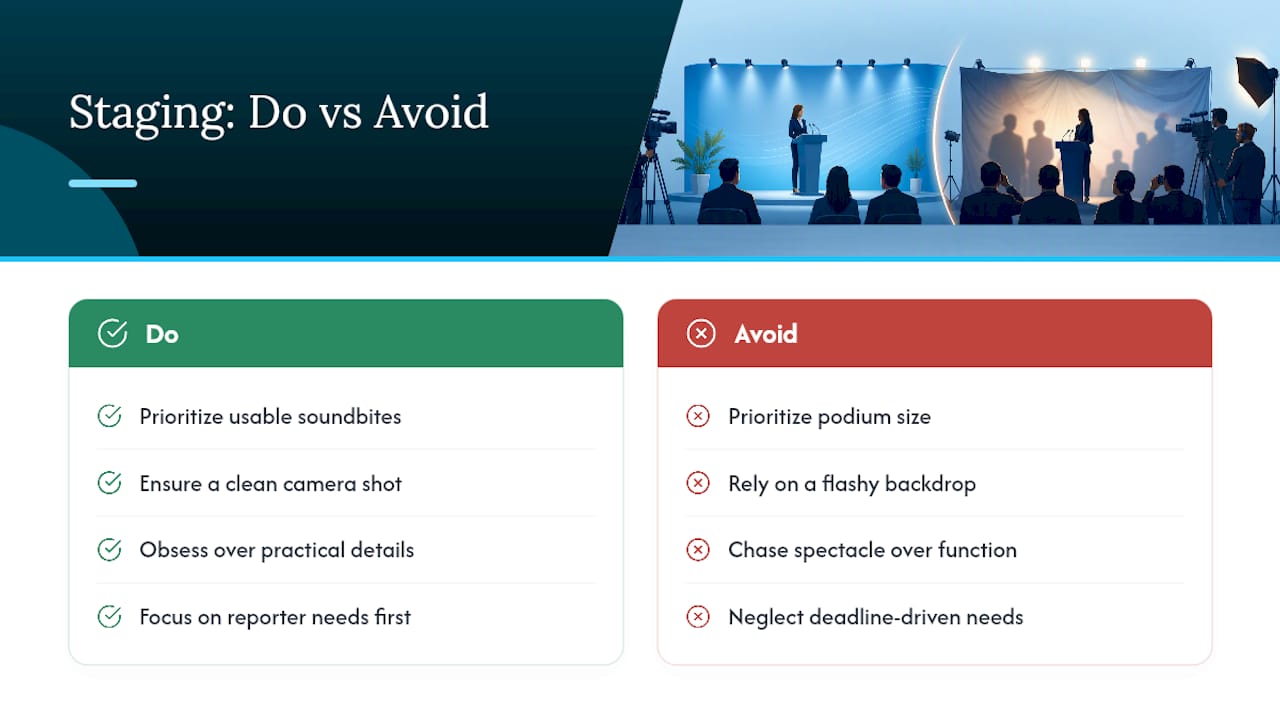
The pattern holds across cases: attorneys who obsess over podium size lose the plot. Reporters don’t remember a flashy backdrop. They remember whether they got a usable soundbite and a clean shot before their deadline. Prioritize that over spectacle every time.
— Ryan McCormick
Hire Goldman McCormick PR To Run Your Press Conference
Most law firms don’t have a staging plan sitting in a drawer, which means the backdrop, the sightlines, and the timeline all get improvised the week of the event. Goldman McCormick PR replaces that scramble with a firm built by former TV and radio producers who have run press conferences from the reporter’s side of the camera.
Our Press Conferences service covers staging and backdrop design, media advisory distribution, press kit creation, AV coordination, media training for your spokesperson, and full day-of execution. This disciplined approach has earned recognition within the legal public relations field. If your case, cause, or client needs a press conference that reporters actually cover, start with a discovery call: bring your target message, your ideal date window, and your spokesperson list, and we’ll build the scope of work from there.
Sources
Scheduling and duration guidance comes from the Community Tool Box press conference planning guide. Media list and RSVP timing draws on Forbes’ checklist for media briefings. Staging and press kit advice comes from PR Daily’s guide to winning press conferences.
- Community Tool Box — Press conference planning (CTB)
- Checklist for successful media briefings — Forbes (2025)
- Set the stage for a winning press conference that doesn’t bore — PR Daily
FAQ
How Long Should A Press Conference Last?
Keep it under 30 minutes, scheduled mid-week (Tuesday through Thursday) and mid-morning as recommended by industry best practice to maximize journalist attendance. Shorter events with tighter remarks consistently produce more usable coverage than longer ones.
How Many Logos Should Appear On A Press Conference Backdrop?
One dominant logo repeated two or three times reads best on camera. Crowding a backdrop with multiple sponsor marks creates visual clutter that dilutes broadcast readability.
Who Pays For AV Equipment At A Press Conference?
That’s typically negotiated in the scope of work between the PR firm, the venue, and any outside AV vendor, and it should be spelled out before signing. A clear proposal names who supplies mics, risers, and lighting so nothing gets assumed on event day.
When Should Final Photos And Video Reach The Media?
Same-day delivery is standard practice. Reporters working same-day stories need transcripts, b-roll, and high-res photos while the news is still fresh, not the following morning.
Does Goldman McCormick PR Handle The Entire Press Conference, Including Staging?
Yes. The Press Conferences service covers backdrop and staging design, media advisory distribution, press kit creation, AV coordination, and day-of execution as a single engagement.