
Public relations can materially affect acquittal probability, and defense counsel who treat it as an afterthought are ceding ground to the prosecution before opening statements. Research on courtroom media coverage shows that excessive media exposure alters perceptions of guilt and biases jury deliberation. A randomized experiment with 330 participants found that pretrial publicity exposure increased conviction rates and that a brief educational video failed to remove that bias. ABA Model Rule 3.6 constrains what counsel can say publicly, but it does not prohibit a coordinated, disciplined communications strategy.
The practical implication: designate press counsel at intake, begin documenting media exposure immediately, and treat every public filing as a narrative instrument.
- PR can shift the story jurors carry into the courtroom before a single witness testifies.
- Documented media exposure becomes evidentiary support for change-of-venue and continuance motions.
- IADC guidance recommends appointing press counsel and establishing intake safeguards as early as possible.
Key Takeaways
Pretrial publicity measurably increases conviction rates, and no courtroom remedy reliably reverses that bias once a narrative is established, making early, disciplined PR a core component of defense strategy.
| Point | Details |
|---|---|
| Designate press counsel at intake | Appoint a single approver before any media contact to prevent fragmented messaging. |
| Document media exposure immediately | Timestamped press logs support change-of-venue motions and voir dire strategy. |
| Use filings as narrative tools | Draft motions with press-readability in mind to seed defense framing through the public docket. |
| Silence requires a plan | Disciplined silence is a strategy; document why you chose not to respond and what you monitored. |
| Goldman McCormick PR | A Forbes-recognized legal PR firm offering press counsel, monitoring, and media training for defense matters. |
Table of Contents
- How does media exposure change the way jurors make decisions?
- What are the U.S. legal constraints on defense PR?
- When should defense teams speak, and when should they stay silent?
- What PR tactics give defense teams the most leverage?
- How does PR work interlock with courtroom remedies?
- How do you measure PR impact and document it for legal use?
- U.S. case examples that show PR’s role in trial outcomes
- What ethical pitfalls should defense teams avoid?
- How do you select the right legal PR firm for a defense matter?
- How does acquittal-related PR affect public trust and victim families?
- How do social media narratives shape public opinion after acquittal?
- What ethical obligations apply to PR communications after an acquittal?
- How should legal counsel and PR professionals coordinate during the acquittal phase?
- What the conventional wisdom on trial PR gets wrong
- Goldman McCormick PR supports defense teams from intake through verdict
- Sources
How does media exposure change the way jurors make decisions?
Jurors do not weigh evidence in a vacuum. According to the story model of juror decision-making, jurors construct a narrative from all available information, including media coverage, and then fit trial evidence into that pre-existing story. Judicial admonitions to “disregard what you’ve heard” rarely erase a narrative already embedded through weeks of news coverage.
Several cognitive mechanisms amplify that effect:
- Availability bias: Vivid media accounts make guilt feel more probable simply because the story is easy to recall.
- Confirmation bias: Once a juror has absorbed a prosecution-friendly narrative, contradictory evidence tends to be discounted.
- Memory distortion: Repeated exposure to media framing can cause jurors to misattribute media-sourced “facts” to trial testimony.
- Motivated reasoning: Jurors who have formed a strong prior opinion often rationalize rather than deliberate.
Cross-national experiments confirm that continuous media presence alters credibility judgments and courtroom behavior. The SAGE randomized trial noted above found that even a purpose-built debiasing intervention left conviction-rate differences intact, which tells defense counsel something important: you cannot rely on the judge’s instruction to fix a narrative problem. You have to address the narrative itself.
What are the U.S. legal constraints on defense PR?
The First and Sixth Amendments pull in opposite directions. Press freedom supports open reporting on criminal proceedings; the right to a fair trial demands an impartial jury. Courts have generally tolerated media coverage while placing the burden on counsel to avoid statements that create a “substantial likelihood of material prejudice,” the standard embedded in ABA Model Rule 3.6.
Local rules tighten that standard further. The Southern and Eastern Districts of New York’s Local Criminal Rule 23.1 and New York Rule of Professional Conduct 3.6 both restrict extrajudicial statements about evidence, witness credibility, and anticipated testimony. Before any public statement, counsel must map the applicable district rule.
| PR Action | Rule Implication |
|---|---|
| On-the-record statement about evidence | High risk under Rule 3.6; requires careful scoping |
| Holding statement (no comment on merits) | Generally permissible; safest default |
| Third-party spokesperson (non-attorney) | Permissible if counsel does not direct content that would violate Rule 3.6 |
| Filing-as-press-release | Permissible; public record protects the statement |
Pro Tip: Use public filings as de facto press releases. A well-drafted motion to dismiss or bail memorandum is on the public docket, ethically protected, and readable by any journalist. Draft it with that audience in mind.
When should defense teams speak, and when should they stay silent?
Timing is the variable most defense teams get wrong. Practitioners warn that reflexive rebuttals create persistent soundbites, and that disciplined silence is sometimes the safer option. Here is a stage-by-stage framework:
Pre-indictment (days 1–30, cost: low)
Move fast. The prosecution’s initial narrative, if unchallenged, becomes the default. A single, carefully worded holding statement and a designated spokesperson can prevent the worst framing from hardening.
Pretrial and motions (weeks 4–16, cost: medium)
This is where filings-as-press-releases pay off. Draft motions with press-readability in mind. Seed journalists with defense themes through the docket. Media monitoring begins here and runs continuously.
Trial (duration of proceedings, cost: high)
Silence on merits is the default. Corrective factual statements about procedural matters are permissible. No spokesperson discusses evidence or witnesses.
Post-verdict (days 1–14, cost: medium)
An acquittal does not end the PR work. Immediate, measured statements that contextualize the verdict prevent the prosecution’s post-trial narrative from dominating.
- Designate one spokesperson before any media contact occurs.
- Draft a holding statement on day one of representation.
- Establish a media monitoring service within the first week.
- Review all public statements against the applicable district rule before release.
- Reassess the silence-vs.-speak decision at each litigation milestone.
What PR tactics give defense teams the most leverage?
Litigation communications operates as a parallel discipline to trial advocacy. The tactics below are the ones that move the needle.
Holding statements are the foundation. A holding statement acknowledges the situation, states that the matter is being handled through proper legal channels, and commits to nothing else. It is ethics-compliant and prevents the “no comment” vacuum that journalists fill with prosecution sources.
Sample holding statement template: “Our client [Name] maintains their complete innocence. We are confident the facts, when fully presented, will demonstrate that. We will address this matter in the appropriate legal forum and have no further comment at this time.”
Designated spokesperson. One person speaks. IADC guidance is explicit: appoint a single approver, typically lead counsel or press counsel, to prevent fragmented messaging. Off-the-cuff remarks from co-counsel or family members have derailed otherwise solid defense strategies.
Media monitoring. Daily tracking of coverage tone, reach, and framing is not optional in a high-profile matter. It feeds both the PR response and the legal record.
Corrective action sequence: (1) Identify the factual error in coverage. (2) Confirm it is materially prejudicial. (3) Draft a short, factual correction. (4) Obtain counsel sign-off. (5) Distribute through a single channel.
Media training checklist for counsel and clients:
- Practice the three-point message before any interview.
- Never speculate about what evidence will show.
- Redirect questions about witnesses to “that will be addressed at trial.”
- Treat every off-the-record conversation as on the record.
Pro Tip: Build a PR campaign structure that separates the “accuracy enforcement” track (correcting factual errors) from the “narrative seeding” track (placing favorable context). Conflating them leads to reactive, incoherent messaging.
How does PR work interlock with courtroom remedies?
Documented media exposure is the evidentiary backbone of a change-of-venue motion, a continuance request, or a sequestration argument. Press logs, timestamped article archives, and social-share data give the court a quantifiable picture of prejudice.
- Preserve every article, broadcast transcript, and social post with a timestamp and URL at the time of capture.
- File a motion to admit excerpts of coverage when arguing juror bias at voir dire.
- Use monitoring reports to support the “substantial likelihood of prejudice” threshold in venue motions.
- Draft voir dire questions that probe specific media narratives documented in the press log.
Sample record-preservation language: “Defense moves to supplement the record with Exhibit A, a timestamped archive of [X] articles published between 2026 and 2026, each referencing the defendant by name and characterizing the alleged conduct as [specific framing], to support the motion for change of venue pursuant to Fed. R. Crim. P. 21(a).”
The litigation communications playbook notes that what is said publicly can move venue and shape jury pools, sometimes more durably than the verdict itself. That is not an argument for reckless media engagement. It is an argument for treating the press log as a litigation document from day one.
How do you measure PR impact and document it for legal use?
| Metric | Why It Matters for Motions |
|---|---|
| Reach/impressions | Establishes scale of exposure for prejudice argument |
| Tone/framing | Documents prejudicial characterizations by name |
| Timestamped article snapshots | Admissible evidence of what jurors could have seen |
| Social-share trajectory | Shows viral spread beyond initial publication |
| Journalist contact log | Documents who was contacted and what was said |
Documentation checklist:
- Daily monitoring reports, archived in PDF with timestamps.
- Screenshot-plus-URL captures of all social media posts referencing the case.
- A running log of all media inquiries received and responses given.
- Counsel sign-off on every outgoing statement, retained in the file.
When selecting a monitoring vendor, ask: Does the platform provide timestamped, court-ready archives? Does it cover broadcast as well as digital? Can it export in a format suitable for exhibit preparation?
U.S. case examples that show PR’s role in trial outcomes
O.J. Simpson (1995). The defense team’s early and sustained media presence, including televised attorney statements and strategic leaks to sympathetic journalists, shaped a counter-narrative around police misconduct. The prosecution’s narrative dominated early coverage; the defense’s pivot to the “rush to judgment” frame shifted public and, arguably, juror perception.
Duke Lacrosse (2006). Aggressive pretrial media coverage created a presumption of guilt that preceded any trial. Defense counsel’s decision to engage directly with factual corrections, combined with documented prosecutorial misconduct, ultimately contributed to charges being dropped. The press record became central to the public exoneration.
George Zimmerman (2013). Both sides ran parallel media operations. The defense’s controlled release of evidence and consistent spokesperson discipline contrasted with prosecution-friendly early coverage. The acquittal was followed by a sustained post-verdict PR effort to contextualize the outcome.
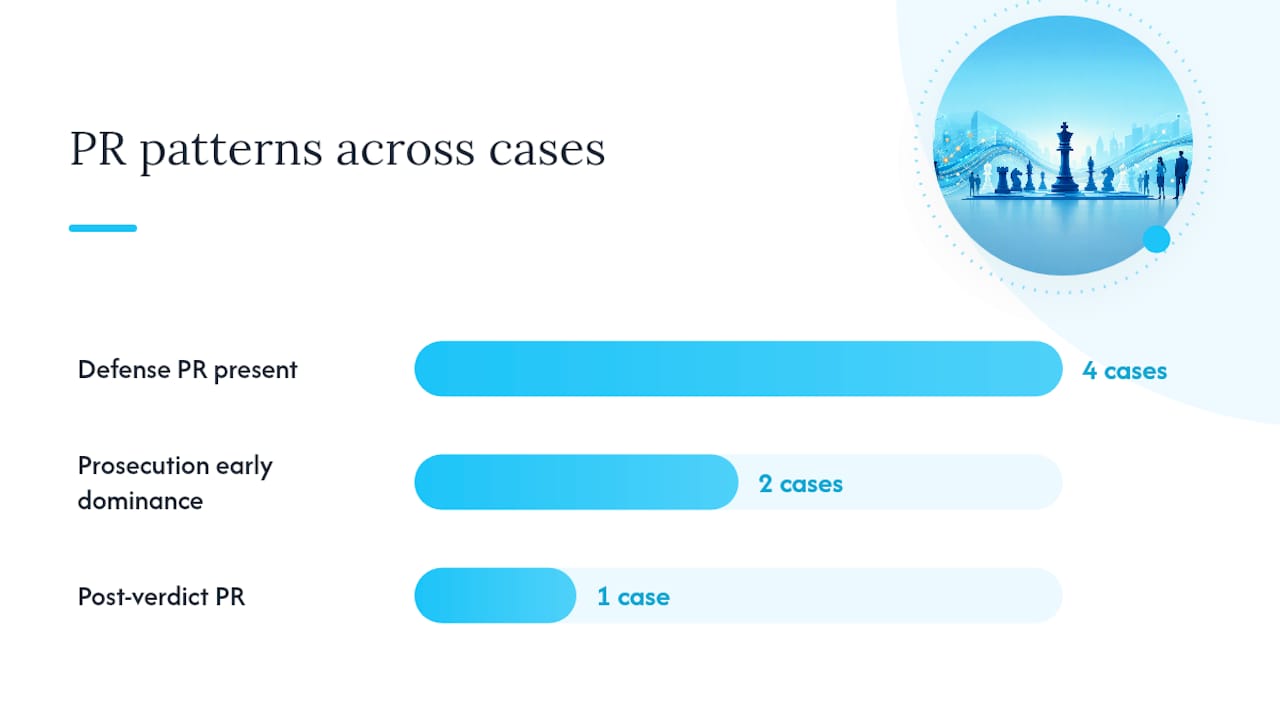
Michael Jackson (2005). Defense counsel retained a communications team that placed favorable profiles and corrective statements throughout the trial. Jurors later cited the complexity of the evidence, but the defense’s consistent “presumption of innocence” framing in public statements reinforced that standard.
Three lessons:
- First-mover advantage in narrative framing is real and measurable.
- Documented media exposure can support legal remedies that change the venue or pool.
- Post-verdict PR is not optional when the public narrative outlasts the verdict.
What ethical pitfalls should defense teams avoid?
The behaviors below create professional responsibility exposure and can prejudice the case:
- Speculating publicly about witness credibility or anticipated testimony.
- Releasing or describing confidential evidence or privileged communications.
- Using inflammatory language about alleged victims or co-defendants.
- Coaching third-party advocates on what to say in ways that effectively circumvent Rule 3.6.
- Allowing client family members to speak without media training and counsel approval.
Internal approval template: Before any public statement is released, the file should contain: (1) the draft statement, (2) the name of the approving attorney, (3) the date and time of approval, (4) confirmation that the statement was reviewed against the applicable district rule.
Emergency escalation process: If a statement has already been released and counsel identifies a potential ethics violation, immediately: (1) preserve the statement as released, (2) notify supervising counsel, (3) consult the applicable state bar’s ethics hotline, (4) document the consultation.
Pro Tip: Never let a PR firm release a statement without attorney sign-off. The firm’s job is to draft and distribute; the attorney’s job is to approve. That division of authority protects both the client and the license.
How do you select the right legal PR firm for a defense matter?
Not every PR firm understands gag orders, Rule 3.6, or what “court-ready documentation” means. Ask these questions before signing:
Vendor interview questions:
- Have you worked on matters subject to a gag order or local criminal rule restrictions?
- Can you provide timestamped, archived monitoring reports suitable for exhibit preparation?
- Do you have litigation communications case studies you can share under NDA?
- Who approves outgoing statements, and what is your sign-off protocol with counsel?
- What is your process when coverage contains a factual error that requires correction?
Expected engagement deliverables:
- Press counsel available on-call during active proceedings.
- Daily monitoring reports with tone analysis and reach data.
- Approved holding statement templates, reviewed against applicable rules.
- Media training sessions for lead counsel and the client.
- Filings-as-press-releases drafting support.
Goldman McCormick PR has specialized in legal PR since at least 2014, when the New York Observer named it one of the top five public relations agencies in that category. Forbes recognized it as one of America’s Best PR Firms for 2021, and the firm earned a Bulldog Reporter Gold Award in 2016. For defense counsel who need a firm that understands both the media landscape and the ethical constraints of criminal litigation, that track record is a meaningful differentiator.
How does acquittal-related PR affect public trust and victim families?
An acquittal verdict does not close the public conversation. For victim families, a not-guilty verdict can feel like institutional failure, and media coverage that amplifies that reaction can undermine public confidence in the justice system. Defense PR teams have a responsibility to communicate the verdict’s legal meaning, specifically that acquittal reflects the prosecution’s failure to meet its burden of proof, without dismissing the human cost of the underlying allegations.

Measured, factual post-verdict statements that acknowledge the gravity of the case while affirming the defendant’s legal vindication tend to reduce the secondary media cycle that otherwise fills the vacuum. Inflammatory victory statements do the opposite.
How do social media narratives shape public opinion after acquittal?
Social platforms extend the trial’s public life indefinitely. A verdict that closes in court reopens on X, Reddit, and TikTok within hours. Defense teams that have no post-verdict social strategy will watch the prosecution’s narrative recirculate through user-generated content, often stripped of legal context.
Effective post-acquittal social strategy involves monitoring keyword clusters around the defendant’s name, preparing platform-specific corrective content, and identifying credible third-party voices who can contextualize the verdict. The litigation news cycle rarely ends at the courthouse steps, and social media is where the long-term reputation battle is fought.
What ethical obligations apply to PR communications after an acquittal?
Post-acquittal PR is not exempt from professional responsibility rules. Counsel remains bound by Rule 3.6 and its state equivalents even after the verdict. Statements that prejudice a potential retrial, a civil proceeding, or a co-defendant’s pending matter carry the same risk as pretrial statements.
Specific obligations post-acquittal:
- Avoid statements that could prejudice any related civil litigation.
- Do not characterize prosecution witnesses or investigators in ways that could constitute defamation.
- Confirm whether any protective order or gag order survives the verdict before speaking publicly.
- Coordinate with the client on personal social media activity, which remains attributable.
How should legal counsel and PR professionals coordinate during the acquittal phase?
The acquittal phase requires the tightest coordination of the entire engagement. Counsel and the PR team should agree on the post-verdict statement before the verdict is read, not after. That means drafting two versions: one for acquittal, one for conviction, and having both approved in advance.
Immediately after the verdict, the sequence is: (1) counsel makes a brief courtroom statement for the press pool, (2) the pre-approved written statement is distributed simultaneously, (3) no further comment is made for at least 24 hours while the media cycle is assessed, (4) a follow-up statement addresses any factual errors in initial coverage.
Practitioners recommend that defense teams draft filings and public statements with public narrative implications in mind throughout the case, so the post-verdict moment is the culmination of a coherent strategy, not an improvised response.
What the conventional wisdom on trial PR gets wrong
Most commentary on PR in criminal defense focuses on the pre-indictment window as the critical period. That framing is too narrow. The narrative battle is continuous, and the post-acquittal phase is where defense teams most often surrender ground they spent months winning.
A verdict of not guilty is a legal conclusion, not a public one. Jurors acquit; the public deliberates indefinitely. Defense counsel who treat the verdict as the finish line will watch their client’s reputation erode through the secondary media cycle, civil litigation coverage, and social media recirculation. The PR work that begins at intake should have a post-verdict chapter built in from the start.
The other underappreciated point: silence is a strategy, not a default. Practitioners are clear that reflexive rebuttals create soundbites that outlast the correction. But silence chosen without a plan is just absence. The difference between disciplined silence and passive silence is documentation: you should be able to explain, in writing, why you chose not to respond to a specific piece of coverage and what you monitored in the interim.
Goldman McCormick PR supports defense teams from intake through verdict
Goldman McCormick PR offers criminal defense counsel a discreet, litigation-aware communications service built around the constraints that govern high-profile matters.
Named by Forbes as one of America’s Best PR Firms for 2021 and recognized with a Bulldog Reporter Gold Award, the firm has been cited as a top legal PR agency since 2014. Services available to defense teams include press counsel on-call, daily media monitoring with court-ready archives, holding statement drafting and approval protocols, media training for counsel and clients, and filing-as-press-release support.
For counsel who need immediate intake, contact Goldman McCormick PR directly through the firm’s landing page to discuss the matter under a confidentiality agreement before any public statement is made.
Sources
The sources below were used in preparing this article. Counsel should preserve these links in the litigation folder and cite the relevant ones in motions where appropriate.
- Chapter on juror story model (DOI reference)
- It’s personal: strategic communications takeaways for white-collar criminal representations
- Five Ways to Manage PR In High-Profile Litigation (NYLJ excerpt, Zuckerman)
- NYLS Law Review article on media coverage, jury bias, and professional conduct rules
- Research on courtroom media coverage and psychological effects (AJFP)
- Experimental test of an educational video to reduce pretrial publicity bias (SAGE)
- Court of Public Opinion: The Litigation Communications Playbook for High-Stakes Matters (PR News / Everything-PR)
- IADC guidance on changing the narrative in difficult cases
This article is general information, not a substitute for advice from a qualified lawyer. Consult a qualified legal professional about your own circumstances before acting on anything here.