
Mental health media relations is defined as the practice of managing communications about mental health through media channels using evidence-based methods, ethical storytelling, and legal compliance to shape public understanding and build organizational trust. In 2026, this field sits at the intersection of public health advocacy and earned media strategy, shaped by AI-driven search behavior, trauma-informed messaging frameworks like MindFrame, and federal regulations including 42 CFR Part 2. PR professionals and mental health advocates who understand these forces will run campaigns that reduce stigma, reach the right audiences, and hold up under legal scrutiny.
What is mental health media relations in 2026?
Mental health media relations is the specialized branch of public relations focused on communicating mental health information through earned, broadcast, and digital media. The industry term is “mental health public relations,” and it covers everything from pitching a psychiatrist to a national news outlet to managing a crisis response after a public mental health incident.
The field has changed significantly. Three forces now define best practice: AI integration in how audiences find mental health information, compliance requirements that go beyond standard HIPAA rules, and a shift toward what researchers call “emotional stewardship.” Emotional stewardship means PR professionals treat audience emotional responses as a core responsibility, not a side effect of messaging. This concept, grounded in affective neuroscience and organizational listening, reframes the PR role from message delivery to audience emotional care.

The PRSA and MindFrame both publish guidelines that shape how practitioners approach this work. Ignoring those standards produces campaigns that can harm vulnerable audiences and expose organizations to legal risk.
How does influencer training improve mental health communication?
Training social media content creators in evidence-based mental health communication improves audience mental health knowledge by 4%, according to a Harvard T.H. Chan School of Public Health study that analyzed 188,169 user comments from 1,882 videos by 49 trained creators. A 4% shift across millions of viewers represents a measurable public health outcome, not a marginal gain.
Youth audiences are the primary beneficiaries. Adolescents consume mental health content through social media at rates that far exceed traditional media consumption. When creators receive structured training in accurate terminology, safe messaging, and emotional support competencies, their audiences absorb that accuracy. The comments in the Harvard study showed increased empathy, reduced stigma language, and more accurate descriptions of mental health conditions.
For PR professionals, the practical implication is clear: influencer partnerships in mental health campaigns require a training component, not just a content brief. Sending a creator a set of talking points is not enough. Structured training programs, ideally developed with clinical advisors, produce measurably better outcomes. Mental health insights shared through podcast formats follow the same principle: the medium only works when the messenger is properly prepared.
Pro Tip: Before signing an influencer agreement for a mental health campaign, require the creator to complete a safe messaging training module developed with a licensed clinician. Document completion as part of your compliance record.
- Build creator training around three competencies: accurate terminology, safe messaging standards, and emotional support language.
- Partner with clinical advisors to review all training materials before distribution.
- Track comment sentiment before and after creator training to measure knowledge shifts.
- Include youth-specific messaging modules when campaigns target audiences under 25.
How is AI reshaping mental health media relations?
Nearly 50% of consumers now use AI platforms to research behavioral health providers, with that figure doubling in the past year. That single data point changes the entire logic of mental health PR strategy. If half your potential audience finds providers through ChatGPT or Google AI Overviews rather than a Google search, then earned media is no longer just a credibility signal. It is the primary mechanism by which AI platforms verify that a provider or organization is trustworthy.
Answer engine optimization (AEO) is the practice of structuring earned media and content so that AI platforms surface it in response to user queries. For mental health organizations, this means:
- Secure third-party media coverage in outlets with high editorial standards, since AI platforms weight credible sources heavily.
- Publish thought leadership content that answers specific patient questions directly and accurately.
- Maintain consistent messaging across TV, radio, and print placements so AI systems recognize a coherent, authoritative voice.
- Monitor AI-generated answers about your organization and correct factual errors through proactive media outreach.
- Treat earned media coverage as infrastructure, not a campaign deliverable.
Goldman McCormick PR, named by Forbes Magazine as one of America’s Best PR Firms for 2021, specializes in exactly this kind of multi-platform earned media work, placing clients on TV, radio, and in print to build the coverage record that AI platforms use to verify expertise.
How do compliance and safe storytelling work together?
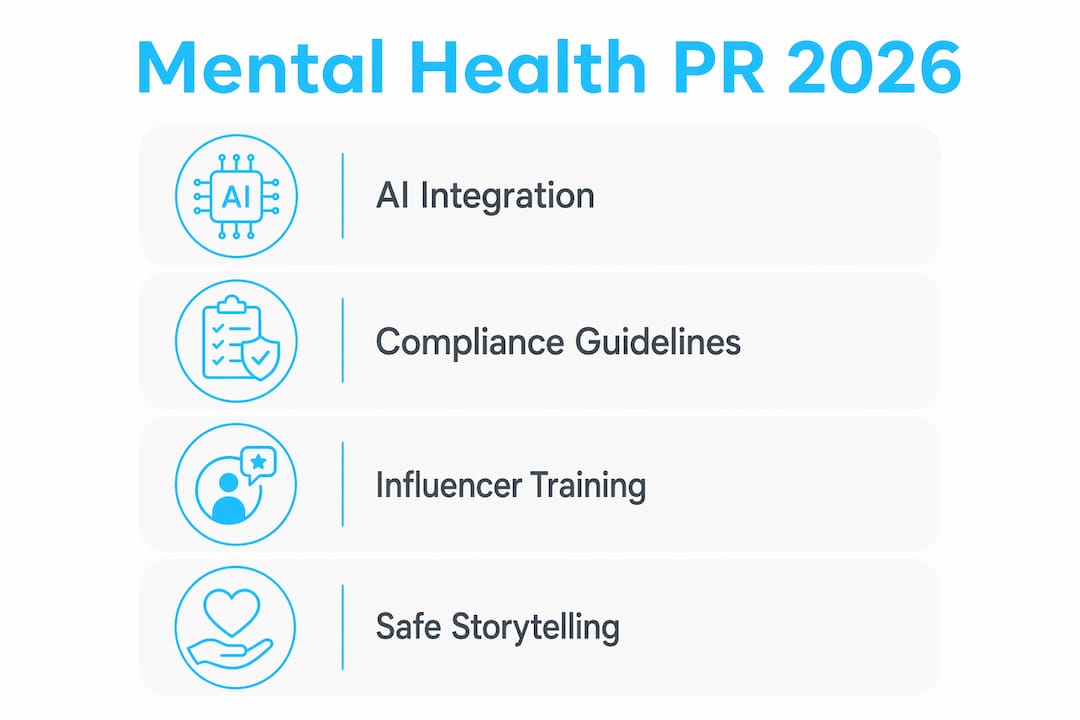
42 CFR Part 2 regulations require explicit written authorization before any patient information can be disclosed to media, a stricter standard than HIPAA. Treatment centers and mental health organizations must establish compliance protocols with legal officers before pitching any story that involves patient data or personal narratives. Violating 42 CFR Part 2 is not a minor procedural error. It exposes organizations to federal liability and destroys the public trust that mental health PR depends on.
Trauma-informed communication frameworks like MindFrame provide evidence-based guidelines for ensuring that media stories empower rather than traumatize audiences. MindFrame is particularly effective for adolescent audiences, where poorly managed narratives can trigger emotional harm rather than support.
The table below shows how pitchable and non-pitchable story types differ under these frameworks:
| Story type | Pitchable | Reason |
|---|---|---|
| Clinician discussing treatment approaches | Yes | No patient data involved; expert perspective only |
| Anonymous recovery narrative with written consent | Yes | Meets 42 CFR Part 2 authorization requirements |
| Named patient story without written authorization | No | Violates 42 CFR Part 2 regardless of patient verbal agreement |
| Crisis intervention case study with identifiable details | No | High trauma risk; fails MindFrame safety standards |
| Community mental health event coverage | Yes | Public-facing, no protected health information involved |
Effective mental health PR blends brand reputation with public-interest focus, emphasizing transparency and safety over polished marketing messages. That means avoiding sales slogans in media pitches and instead building narratives that mirror how community members actually talk about mental health.
Pro Tip: Involve your compliance officer in the story selection process before any media pitch goes out. Create a one-page internal checklist that maps each story type against 42 CFR Part 2 requirements and MindFrame guidelines.
What do winning mental health campaigns look like?
The PRSA Anvil Award-winning “Start the Conversation” campaign demonstrates what multi-channel mental health outreach looks like at its best. The campaign combined influencer partnerships, community events, PSAs, and high-school partnerships to reach youth audiences with targeted messaging. It won because it treated every channel as a distinct audience touchpoint, not a copy-paste of the same message.
Effective 2026 mental health outreach campaigns share a consistent set of characteristics:
- They target specific demographics with tailored messaging rather than broadcasting a single message to everyone.
- They integrate social media, broadcast, community events, and partnerships into a single coherent narrative.
- They measure success through stigma reduction metrics and community engagement rates, not just impressions.
- They involve community leaders as co-creators of messaging, which builds credibility that paid advertising cannot replicate.
- They use podcast content with proper moderation standards to reach audiences who distrust traditional media.
The role of media in mental health advocacy is not just to inform. It is to shift the emotional and social context in which people make decisions about seeking help. Campaigns that understand this distinction produce measurably better outcomes than those focused purely on awareness.
Key Takeaways
Mental health media relations in 2026 succeeds when evidence-based communication, AI-driven earned media strategy, and trauma-informed compliance protocols work together as a single integrated practice.
| Point | Details |
|---|---|
| Influencer training drives real outcomes | Creator training improves audience mental health knowledge, making it a required campaign element, not optional. |
| AI demands earned media investment | Nearly 50% of patients use AI to find providers, so credible third-party coverage directly affects visibility. |
| 42 CFR Part 2 governs media pitching | Written patient authorization is required before any personal narrative reaches a journalist. |
| MindFrame guides safe storytelling | Evidence-based frameworks protect vulnerable audiences and keep campaigns legally and ethically sound. |
| Multi-channel campaigns win awards and trust | Combining social media, events, PSAs, and community partnerships produces measurable stigma reduction. |
The emotional stewardship shift no one talks about enough
The phrase “emotional stewardship” sounds like academic language, but it describes something I see every day in mental health PR work. Most campaigns still treat the audience as a passive recipient of information. The message goes out, the impressions get counted, and the campaign is declared a success. That model is broken.
What actually builds trust in mental health communications is organizational listening. It means reading the emotional temperature of your audience before you pitch a story, not after. It means understanding that a well-intentioned campaign about suicide prevention can cause harm if the messaging does not follow safe storytelling standards. Transparency and accountability matter more than polish. A rough, honest story from a community member carries more weight than a produced video with a celebrity spokesperson who has no lived connection to the issue.
The AI shift makes this even more urgent. When half your audience finds you through an AI platform, the quality and credibility of your earned media record is your reputation. You cannot buy your way into an AI-generated answer. You earn it through consistent, credible, third-party coverage over time. That is the work Goldman McCormick PR does, and it is the work that mental health advocates need to prioritize right now.
— Ryan McCormick
Goldman McCormick PR and mental health media relations
Mental health PR requires a firm that understands both the media landscape and the compliance requirements that govern it.
Goldman McCormick PR has built its practice on earned media placement across TV, radio, and print since 2010. Forbes Magazine named Goldman McCormick PR one of America’s Best PR Firms for 2021, and the firm earned a Gold Award in the “Best Cause/Advocacy Campaign” category at Bulldog Reporter’s CSR Awards in 2016. For mental health advocates and organizations that need credible, compliant media coverage that AI platforms will recognize and surface, Goldman McCormick PR offers the expertise and media relationships to make that happen. Review the firm’s PR insights to understand how earned media strategy translates into measurable public trust.
FAQ
What is mental health media relations?
Mental health media relations is the practice of managing communications about mental health through earned, broadcast, and digital media using evidence-based methods and ethical storytelling to build public trust and reduce stigma.
How does AI affect mental health PR in 2026?
Nearly 50% of consumers use AI platforms to research behavioral health providers, making earned media coverage the primary way organizations establish credibility in AI-generated search results.
What is 42 CFR Part 2 and why does it matter for PR?
42 CFR Part 2 requires explicit written patient authorization before any personal health information is disclosed to media, a stricter standard than HIPAA that directly governs how mental health stories can be pitched.
What is the MindFrame framework?
MindFrame is an evidence-based set of guidelines for media portrayals of mental health that helps PR professionals craft stories that empower rather than traumatize audiences, particularly adolescents.
How do you measure success in mental health advocacy campaigns?
Effective campaigns measure stigma reduction, community engagement rates, and earned media reach rather than impressions alone, with award-winning programs like “Start the Conversation” using multi-channel metrics to track real behavioral shifts.