
A psychologist book publicity strategy is an organized plan combining audience building, media appearances, and authority-driven campaigns to maximize your book’s reach in the mental health community. Research shows that starting 10–12 weeks before publication with a core mailing list and advance reader reviews is critical to sustained visibility. The goal is not a single sales spike at launch. The goal is compounding momentum that builds your reputation, fills your speaking calendar, and keeps your book selling long after launch week ends.
What is a psychologist book publicity strategy and why does it matter?
A psychologist book publicity strategy differs from generic author marketing strategies because your credentials are the campaign. Your clinical background, research framing, and behavioral insights are what separate your book from self-help titles written by non-clinicians. That distinction belongs at the center of every media pitch, ad, and email you send.
The mental health publishing space is crowded. Narrowing your audience to a specific condition, population, or clinical challenge is not limiting. It is the most efficient use of your marketing resources. A book on adolescent anxiety disorder reaches a sharper, more engaged audience than a book pitched broadly to “anyone dealing with stress.”

Publicity for psychologists works best when it runs on a coordinated timeline. Build your audience before launch. Secure media appearances before the book ships. Let momentum carry sales forward for months, not days.
How to build an email list before your psychology book launch
Email lists convert better than virtually any other marketing channel because you own them completely. Social media algorithms shift without warning. An email list does not. Every subscriber you build before launch is a guaranteed reader on day one.
Start building your list 60–90 days before publication. The fastest way to grow it is with a reader magnet: a free chapter, a clinical resource guide, a self-assessment tool, or a short video series tied directly to your book’s core topic. Readers trade their email address for something genuinely useful.
Practical steps to build your pre-launch list:
- Create a dedicated landing page with a single opt-in offer tied to your book’s theme
- Promote the magnet across your existing professional networks, LinkedIn profile, and practice website
- Send a welcome sequence of 3–5 emails that introduce you, your credentials, and the book’s core argument
- Aim for 300–1,000 subscribers before launch day; that base drives early reviews and word-of-mouth
- Segment your list by interest (clinicians vs. general readers) and tailor your messaging accordingly
Pro Tip: Set up your email sequence before you start promoting the magnet. Subscribers who receive nothing after signing up will forget you within a week.
Why podcast guesting is the highest-return channel for psychologist-authors
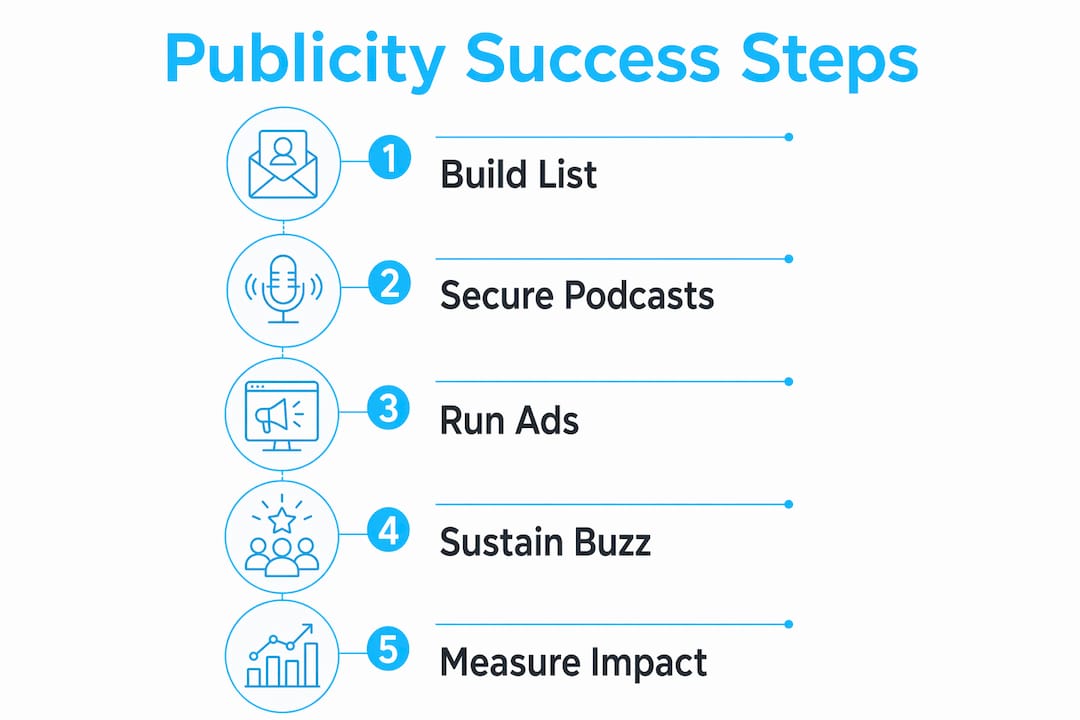
Podcast guesting builds authority in a way that paid ads cannot replicate. A 45-minute conversation about your clinical research positions you as a trusted expert. That trust transfers directly to book sales. One practitioner appeared on 50+ podcasts in 2025 to promote a 2026 book launch. That volume of appearances creates a media presence that no single ad campaign can match.
The key is starting early. Begin pitching podcasts six months before your publication date. Podcast hosts are flexible: episodes can be recorded months in advance and scheduled to air near your launch window for maximum exposure. That flexibility lets you build a pipeline of appearances that hits simultaneously when your book goes live.
Follow this sequence for effective podcast outreach:
- Identify 20–30 podcasts whose audiences match your book’s specific niche, not just “mental health” broadly
- Listen to two or three episodes of each show before pitching; reference specific episodes in your outreach
- Write a personalized pitch of 150 words or fewer that leads with your credentials and one concrete talking point
- Offer two or three episode angle options so the host can choose what fits their audience
- After recording, repurpose each episode into short video clips for LinkedIn, Instagram Reels, and YouTube Shorts
Pro Tip: One strong podcast appearance on a well-aligned show outperforms ten appearances on shows with mismatched audiences. Quality of fit matters more than raw episode count.
How to run authority-driven paid advertising for your psychology book
Paid advertising for psychology book promotion works when the creative leads with authority, not hype. Your clinical credentials, research citations, and behavioral insights are your ad copy. Readers searching for mental health guidance trust a licensed psychologist far more than a motivational tagline.
The most effective paid channels for psychologist-authors in 2026 are Google Search, Meta (Facebook and Instagram), Amazon Sponsored Products, and TikTok or Instagram Reels. Each channel serves a different stage of the buyer journey. Authority-driven ad creative combining credentials and research framing consistently outperforms generic book promotion copy on these platforms.
Key principles for running paid campaigns:
- Target high-intent search queries on Google, such as “books on OCD treatment” or “psychologist anxiety book,” rather than broad interest categories
- Use your book cover, a short credential statement, and one specific outcome the reader will gain as your core ad elements
- On Meta, build a lookalike audience from your existing email list to reach readers similar to your most engaged subscribers
- On Amazon, bid on competitor book titles in your niche and on relevant clinical search terms
- Integrate paid ads with your email list: retarget website visitors who did not subscribe and convert them with a lead magnet offer
| Channel | Best use case | Creative anchor |
|---|---|---|
| Google Search | High-intent buyers searching by topic | Credential statement plus book outcome |
| Meta (Facebook/Instagram) | Audience building and retargeting | Author photo, clinical framing, social proof |
| Amazon Sponsored Products | Direct purchase intent | Book cover, subtitle, reader benefit |
| TikTok/Instagram Reels | Younger audience, awareness stage | Short clinical insight clips from the book |
Combining paid social and search channels with your organic media presence creates a compounding effect. Each channel reinforces the others.
How to sustain visibility long after your book launch
The momentum model treats book promotion as an ongoing professional activity, not a one-time event. Sustained visibility through multiple media appearances and audience engagement over time leads to broader professional opportunities, including consulting contracts, speaking engagements, and workshop invitations. A short launch spike rarely produces those outcomes.
Map your post-launch activities across a 12-month calendar:
- Monthly email newsletter sharing new research, clinical insights, or reader questions tied to your book’s themes
- Quarterly podcast appearances on new shows to reach fresh audiences
- Speaking engagements at professional conferences, community organizations, and corporate wellness programs
- Social media content repurposed from podcast clips, reader testimonials, and media coverage
- Annual review of your paid ad performance to reallocate budget toward the highest-converting channels
“Book marketing is not a sprint. It is a professional practice. The psychologists who treat visibility as a clinical skill, something to develop and maintain, are the ones whose books keep selling two years after launch.”
Balancing promotion with clinical work requires structure. Block two to three hours per week for marketing activities. Treat those hours as non-negotiable appointments.
Key takeaways
A psychologist book publicity strategy built on email list building, podcast guesting, authority-driven paid ads, and sustained momentum produces far greater long-term impact than any single launch tactic.
| Point | Details |
|---|---|
| Start early | Begin marketing 10–12 weeks before publication to build your list and secure media appearances. |
| Own your channel | Build an email list of 300–1,000 subscribers before launch; it converts better than any social platform. |
| Podcast guesting scales authority | Appearing on 50+ aligned podcasts builds trust that paid ads alone cannot replicate. |
| Lead ads with credentials | Clinical framing and research-backed copy outperform hype-driven creative on every paid channel. |
| Sustain momentum | Treat book promotion as a 12-month professional practice, not a one-week launch event. |
What I have learned about book publicity for psychologists
The biggest mistake I see psychologist-authors make is waiting until the book is published to start promoting it. By then, you have lost the most valuable window: the pre-launch period when media interest is highest and audiences are easiest to build.
The second mistake is pitching too broadly. Personalized, targeted outreach to a small group of well-aligned podcasts and outlets consistently outperforms mass email campaigns. A pitch that references a specific episode and explains exactly why your clinical expertise fits that audience gets responses. A generic pitch does not.
What I have also seen is that psychologists underestimate how much their credentials do the heavy lifting. You do not need a celebrity platform to sell a psychology book. You need a clear argument, a specific audience, and the discipline to show up consistently in the right media channels over time. The keynote and media circuit that follows a well-executed book launch is often worth more professionally than the book royalties themselves.
Pace yourself. Burnout during a launch phase is real. Build a schedule you can sustain for 12 months, not just 12 days.
— Ryan McCormick
Goldman McCormick PR and your book publicity plan
Goldman McCormick PR has worked with authors and professionals across media since 2010, placing clients on television, radio, and in major print outlets nationwide.
Named by Forbes Magazine as one of America’s Best PR Firms for 2021, Goldman McCormick PR brings a media-insider perspective to every campaign. For psychologist-authors, that means pitching your credentials and clinical insights to the outlets that reach your readers, not just any outlet. The firm also produces podcasts and nationally syndicated radio programs on the Genesis Communications Network and Starcom Radio Network, giving author clients direct access to broadcast audiences. If you are ready to build a publicity campaign that extends well beyond launch week, contact Goldman McCormick PR to discuss your book and your goals.
FAQ
When should a psychologist start promoting their book?
Start at least 10–12 weeks before publication, building your email list and securing advance reader reviews during that window.
How many email subscribers do I need before launch?
Aim for 300–1,000 subscribers before your publication date. That base drives early reviews, word-of-mouth, and first-week sales.
Is podcast guesting worth the time investment for a psychology book?
Yes. Podcast appearances build the kind of clinical authority that paid ads cannot replicate, and episodes recorded months in advance can be timed to air exactly at launch.
What paid advertising channels work best for psychology books?
Google Search, Meta, Amazon Sponsored Products, and TikTok or Instagram Reels each serve a different stage of the buyer journey. Authority-driven creative anchored in your credentials outperforms generic copy on all four.
How do I keep selling books after the launch week ends?
Follow a momentum model: monthly email content, quarterly podcast appearances, speaking engagements, and consistent social media repurposing sustain long-term visibility and generate professional opportunities beyond book sales.