
Mental health organizations produce dozens of press releases every year that never get picked up. The reason is rarely a lack of important work. It’s the writing. Knowing how to write a mental health press release, technically called a news release, that actually earns journalist attention requires a specific combination of clear structure, genuine newsworthiness, and messaging that respects both the subject matter and the reader. Mental health news coverage depends on releases that answer critical questions immediately and lead with impact. This guide walks you through every step.
Table of Contents
- Key Takeaways
- How to write a mental health press release: preparation first
- Crafting each section of your release
- Common mistakes that kill media interest
- Measuring what your release actually accomplished
- My honest take on what actually works
- How Goldman McCormick PR can help your organization get heard
- FAQ
Key Takeaways
| Point | Details |
|---|---|
| Start with one clear angle | Each release should announce a single, newsworthy event to keep journalist interest focused. |
| Lead paragraph answers the 5 Ws | Who, What, When, Where, and Why must all appear in the first sentences of your release. |
| Data builds credibility fast | Include measurable program outcomes or community impact numbers to substantiate your message. |
| Quotes add human perspective | Authentic quotes from organizational leaders or advocates make releases feel real, not corporate. |
| Track results after distribution | Measure media pickup, mentions, and community engagement to refine future releases. |
How to write a mental health press release: preparation first
Before you type a single word, you need a clear answer to one question: what is the single most newsworthy thing you are announcing? Not two things. Not a general update on your organization. One specific event, program launch, finding, or milestone.
Mental health announcements that earn coverage almost always attach to a defined moment. A peer support training program with a registration deadline and specific program value gives journalists something concrete to report. Vague “awareness” releases do not.
Once you know your angle, research which media outlets actually cover mental health stories in your region or sector. Health reporters at local news stations, mental health trade publications, and advocacy-focused digital outlets are far more likely to pick up your release than a general assignment reporter. Matching your story to the outlet’s existing coverage patterns matters more than most people realize.
Here is what to prepare before you write:
- A clear, singular news angle tied to a specific date or event
- At least one measurable outcome or data point from your program
- Two to three media outlets or journalists you are targeting specifically
- A quote from a senior organizational figure, ready to approve
- Your distribution timeline, including embargo date if applicable
Pro Tip: Review three to five press release examples from mental health organizations you respect before writing yours. Notice how the best ones lead with impact numbers and avoid vague language about “raising awareness.”
The table below compares preparation approaches that typically succeed versus those that fall flat:
| Preparation approach | Likely outcome |
|---|---|
| Single newsworthy event with data | Strong media pickup potential |
| General organizational update | Low journalist interest |
| Timed to awareness month or policy shift | Higher relevance and pickup rate |
| No defined media targets | Broad distribution, poor results |
Crafting each section of your release
Journalists use the inverted pyramid format: the most critical information first, supporting context in the middle, and background at the bottom. Your release needs to follow this structure without exception.
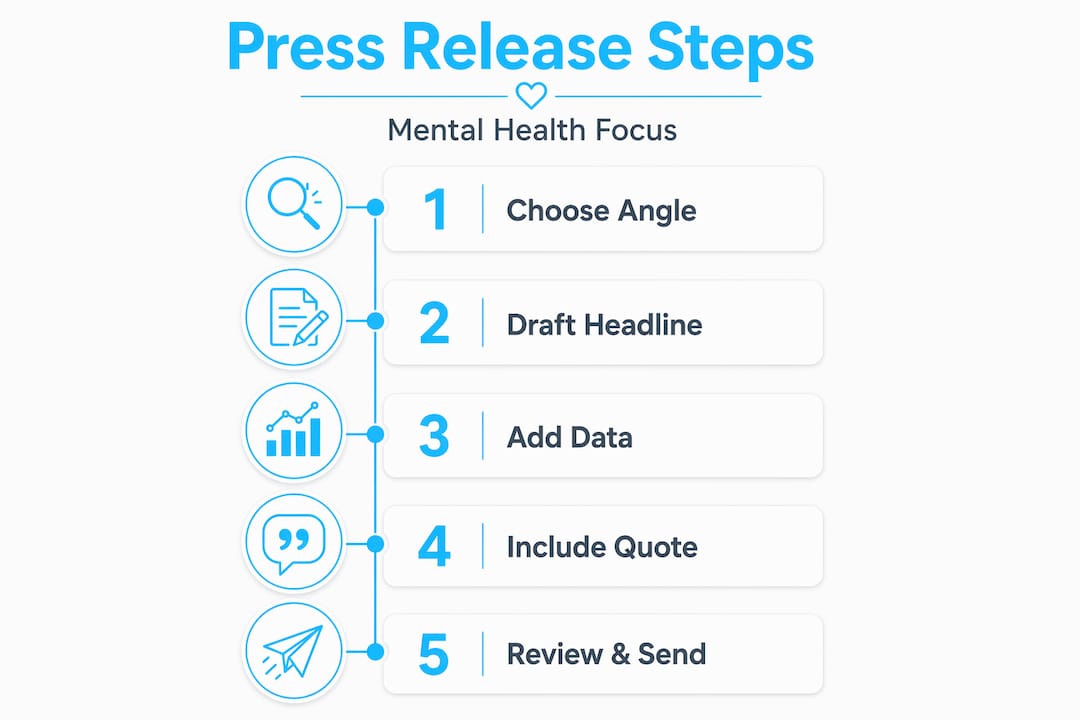
Follow these steps when writing your mental health news release:
-
Write the headline last. Once you know exactly what your release says, write a headline of 10 to 15 words that uses an active verb, includes your core news, and avoids hype. “Headlines that include key data” perform measurably better with journalists than vague subject lines.
-
Open with the lead paragraph. This single paragraph must answer all five Ws without delay. A journalist who reads only the first paragraph should understand the full story.
-
Build the body with context and data. Use paragraphs two and three to provide supporting details, program outcomes, community impact, and why this matters right now. Contextual framing of “why now” helps media understand the public health significance of your announcement.
-
Include an authentic quote. The quote should offer genuine insight or perspective from a leader or advocate. Quotes that reflect emotion and expertise get used. Quotes that sound like brochure copy get cut. Keep them to two to three sentences.
-
Write a tight boilerplate. Your boilerplate is a short paragraph at the end of every release that explains who your organization is, what it does, and its mission. Keep it under 75 words.
-
List complete contact information. Name, title, email address, and phone number for the person ready to respond to press inquiries. Missing or outdated contact details are one of the fastest ways to lose a media opportunity.
Pro Tip: Position your most compelling data point in the first sentence of the body, not buried in paragraph four. Journalists scan, they do not read.
| Release section | Purpose | Length |
|---|---|---|
| Headline | Capture attention, signal news value | 10 to 15 words |
| Lead paragraph | Answer the 5 Ws | 40 to 60 words |
| Body paragraphs | Context, data, and impact | 150 to 250 words |
| Quote | Human perspective and authority | 2 to 3 sentences |
| Boilerplate | Organizational background | Under 75 words |
| Contact info | Media follow-up | Name, title, email, phone |
Common mistakes that kill media interest
Writing health press announcements for mental health organizations carries a particular risk: the subject matter feels so important that writers overdo the urgency and end up producing something that reads like a fundraising appeal instead of news.
Releases perceived as promotional are discarded by journalists. That is not a guideline. It is a newsroom reality. Here are the mistakes that most often undermine a mental health awareness release:
- Multiple announcements in one release. Combining a new program launch with a donation appeal and a staff hire in a single release fragments your story and confuses journalists. Pick one.
- Jargon and clinical language. Words like “psychoeducational interventions” or “comorbid presentations” belong in clinical documentation, not press releases. Write clearly for a general reader.
- Missing quotes. A release without a human voice feels institutional. Always include at least one quote.
- Poor timing. Releasing on a Friday afternoon or during a major news cycle significantly reduces pickup rates. Tuesday through Thursday mornings tend to perform better.
- No follow-up plan. Sending and forgetting is not a strategy. Plan a polite follow-up email three to five business days after distribution.
Pro Tip: Read your release out loud before sending it. If you stumble over a sentence, a journalist will too. Simplify anything that does not flow naturally.
Positioning your organization as a thought leader through education and substance, rather than promotion, consistently builds more media trust over time.
Measuring what your release actually accomplished
Distributing a release is not the end of the process. It is the beginning of a feedback loop that makes your next release stronger. After distribution, track these indicators:
- Direct media pickups. How many outlets ran the story? Which types covered it?
- Online mentions. Search your organization name and announcement keywords in the days following distribution.
- Website traffic spikes. A well-covered release will often drive measurable traffic to your site within 48 to 72 hours.
- Community or partner response. Did advocates share the story? Did partner organizations reach out?
- Journalist inquiries. Any reporter who contacts you for more information represents a relationship worth maintaining.
High-impact campaigns that earn national recognition share one consistent characteristic: they measure outcomes and adjust. Do not treat each release as a standalone effort. Build on what works, cut what does not, and keep refining your mental health communication strategy with real data.
My honest take on what actually works

I have worked with mental health organizations across multiple campaigns, and the single biggest shift I have seen is when they stop writing to impress and start writing to inform. The most effective mental health announcements I have reviewed are the ones that treat journalists like intelligent people who need a clear, specific story with real numbers attached.
What I have learned is that authenticity beats polish every time. A quote from a counselor describing what a new program meant to a patient in plain language will outperform a polished executive statement written by a committee. Mental health is a topic where simplifying core messaging and trusting the human story creates more traction than any amount of PR spin.
If you take one thing from my experience: write for the journalist first, the community second, and your organization third. That order matters.
— Ryan McCormick
How Goldman McCormick PR can help your organization get heard
Goldman McCormick PR has spent over a decade helping organizations get their stories in front of the right journalists, on television, radio, and in print. Named by Forbes Magazine as one of America’s Best PR Firms for 2021, the team at Goldman McCormick PR brings real media experience to every mental health campaign they support. From crafting a precise news release to distributing it through the right channels, the firm handles the work that most organizations struggle to execute on their own. If your mental health initiative deserves coverage, the place to start is with a PR partner who already has the media relationships and the messaging expertise to make it happen.
FAQ
What makes a mental health press release newsworthy?
A mental health press release earns coverage when it announces a singular, specific event backed by measurable impact. Program launches, research findings, awareness milestones tied to dates, and community outcomes all qualify.
How long should a mental health news release be?
Most effective releases run between 400 and 600 words. Long enough to include all key details, short enough that a journalist can read it in under two minutes.
What should a mental health press release headline include?
A strong headline uses an active verb, includes the core news or a specific data point, and stays under 15 words. Avoid hype words like “groundbreaking” or “revolutionary.”
When is the best time to distribute a mental health press release?
Tuesday through Thursday mornings between 9 a.m. and 11 a.m. local time tend to produce the strongest pickup rates. Avoid Fridays, Mondays, and any day when a major news event dominates coverage.
Do you need quotes in a mental health press release?
Yes. Authentic quotes from organizational leaders or advocates add human perspective and authority. A release without a quote reads as institutional and is less likely to earn placement.