
Most people assume crisis communication is about protecting reputations. In mental health contexts, that assumption gets people hurt. Understanding what is crisis communication mental health means grasping something more urgent: it is the structured, empathetic exchange of information designed to reduce harm, build trust, and stabilize individuals and communities during acute psychological distress. The first 24 hours of any crisis are the most critical window for response. What you say, how you say it, and when you say it can determine whether someone reaches safety or spirals further into crisis.
Table of Contents
- Key takeaways
- What is crisis communication in mental health
- Types of crisis communication in mental health
- Evidence-based crisis communication strategies
- Challenges and ethical considerations
- How to implement crisis communication in practice
- My perspective on where crisis communication is heading
- How Goldmanmccormick can support your crisis communication needs
- FAQ
Key takeaways
| Point | Details |
|---|---|
| Timing shapes outcomes | Rapid, transparent communication in the first 24 hours reduces escalation and builds trust. |
| Collaboration beats control | Collaboration-based language lowers crisis escalation risk far more effectively than control-based approaches. |
| One voice, one message | A single designated spokesperson prevents contradictory messaging that can deepen harm during a mental health crisis. |
| Privacy is non-negotiable | HIPAA compliance and confidentiality must guide every communication decision in mental health emergencies. |
| Trauma-informed language matters | Validating emotions and avoiding control-based language transforms crisis interactions into trust-building exchanges. |
What is crisis communication in mental health
Crisis communication in mental health is not a subset of general public relations. It is a specialized discipline that combines psychological awareness, ethical responsibility, and strategic messaging to support individuals experiencing acute mental health episodes and to guide organizations responding to those situations.
The core objectives are specific and measurable:
- Reduce emotional intensity before it escalates into physical danger
- Prevent misinformation from spreading through communities or media channels
- Build enough trust that the person in crisis feels heard rather than managed
- Protect the dignity of individuals while maintaining safety for everyone involved
What separates mental health crisis communication from standard messaging is the recognition that facts alone rarely stabilize a person in distress. Effective crisis communication requires understanding emotional layers, not only focusing on facts. This distinction is what most organizations miss when they default to press release mode during a mental health emergency.
The 2026 standard, shaped by growing consensus among behavioral health organizations and communication professionals, is radical transparency over delay. Delayed or deflective communication increases reputational damage and erodes the trust that crisis resolution depends on. Organizations must acknowledge a crisis clearly and honestly, even when they do not have complete information yet.
Pro Tip: Draft pre-approved holding statements before a crisis ever occurs. When the 24-hour window opens, you want words ready, not a committee meeting.
Types of crisis communication in mental health
Not every crisis communication interaction looks the same. The form it takes depends on the setting, the audience, and the severity of the situation. Understanding the types of crisis communication mental health professionals encounter helps you match the right approach to the right moment.
| Communication Type | Purpose | Best Practice |
|---|---|---|
| Direct individual communication | Stabilize a person experiencing acute distress | Use calm, validation-first language; avoid commands |
| Organizational public statements | Inform stakeholders and media | Single spokesperson, factual, empathetic tone |
| Community-level messaging | Address widespread fear or misinformation | Clear, accessible language; repeated across channels |
| Two-way communication | Empower individuals and communities to respond | Create feedback channels and active listening structures |
| Proactive communication | Prevent crises before they escalate | Ongoing education, visible leadership, open-door culture |
The contrast between reactive and proactive communication deserves attention. Reactive communication responds after a crisis has already broken. Proactive communication reduces the frequency and severity of crises by establishing trust before any emergency arrives.
Equally significant is the contrast between trauma-informed language and traditional control-based language. Trauma-informed communication validates emotions, acknowledges that every behavior has a story, and refuses to treat a person in crisis as a problem to be managed. Control-based language, by contrast, prioritizes compliance and order, which typically escalates rather than resolves mental health emergencies.
Evidence-based crisis communication strategies
When someone is in acute psychological distress, your communication strategy is not theoretical. It is happening in real time, with real stakes. These strategies reflect both research consensus and frontline experience.
-
Practice active listening. Give the person your full attention. Reflect back what you hear without judgment. Active listening and empathy shift the interaction toward trust, collaboration, and stability far more effectively than any script.
-
Use calm, clear language. Panic in your voice transfers directly to the person in crisis. Slow your speech. Use short sentences. Avoid clinical jargon that creates distance.
-
Validate before you problem-solve. Saying “that sounds incredibly painful” before offering any solution communicates that the person’s experience is real and respected. Validation reduces defensiveness and opens the door to collaboration.
-
Set boundaries without issuing commands. There is a meaningful difference between “you need to calm down” and “I want to make sure we both stay safe here.” One triggers resistance. The other invites cooperation.
-
Move toward collaboration-based language. Collaboration over control reduces crisis escalation risks significantly. Ask what the person needs. Offer choices where possible. Position yourself as someone working with them, not on them.
-
Apply trauma-informed care principles throughout. Recognize that past trauma shapes how people receive communication. Avoid language that replicates power imbalances, and never assume you know the full context of what someone is experiencing.
Pro Tip: Nonverbal cues communicate as much as your words. Maintain an open posture, steady eye contact, and physical distance that feels safe, not threatening, to the person you are supporting.
Challenges and ethical considerations
Communicating effectively during a mental health crisis means navigating obligations that sometimes feel like they pull in opposite directions.

The most significant tension is between transparency and privacy. HIPAA compliance and confidentiality override the desire for public transparency in sensitive cases. An organization cannot share patient details to demonstrate accountability. The legal risk is real, and so is the human cost of getting this wrong.
Other common challenges include:
- Contradictory messaging across spokespeople. A single designated spokesperson prevents inconsistency that confuses the public and undermines trust in the organization’s response.
- Misinformation filling communication gaps. When organizations go silent, speculation rushes in. Communities create narratives. Those narratives are almost always more damaging than a transparent, incomplete acknowledgment would have been.
- Protecting reputation at the expense of patient dignity. This is a documented failure pattern. Prioritizing how an organization looks over how a patient is treated erodes trust in ways that take years to rebuild.
“The public does not expect perfection. They expect accountability, empathy, and honesty. Organizations that deliver those three things during a mental health crisis consistently recover faster and with stronger stakeholder loyalty.” (Crisis PR in 2026)
Ongoing training is not optional in this field. Communication norms, legal standards, and community expectations shift. Professionals who stop learning create the conditions for ethical failures.
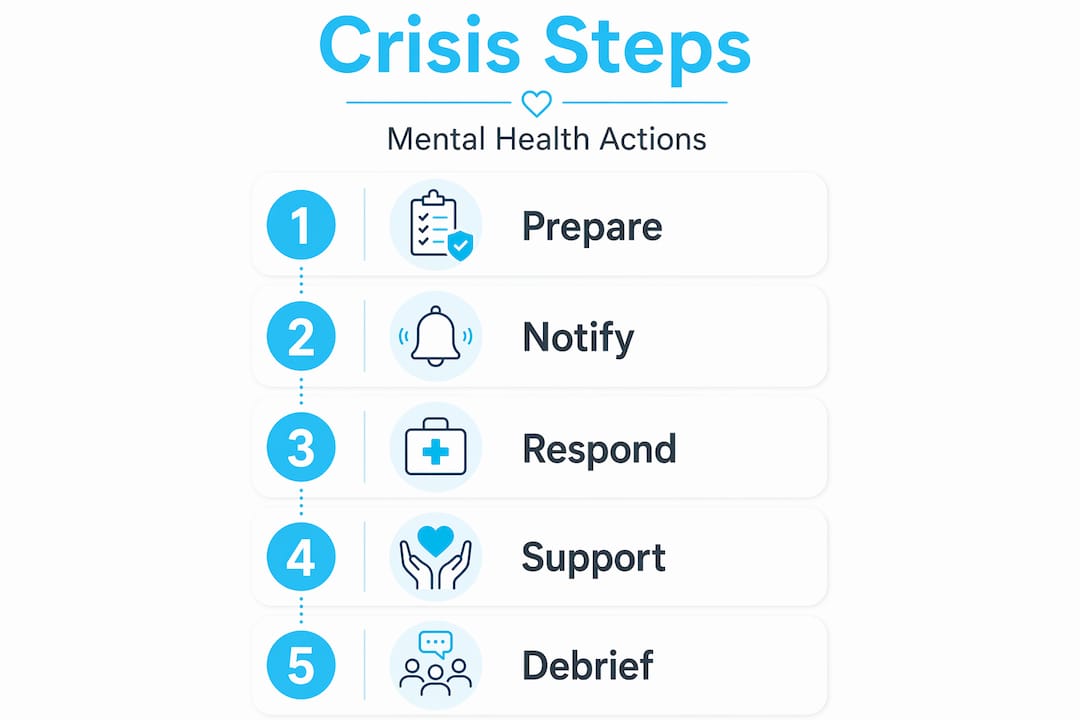
How to implement crisis communication in practice
Knowing the theory is not enough. The following steps help mental health professionals and crisis teams build communication capacity before they need it.
-
Establish a rapid response framework. Develop pre-approved messaging templates, identify your spokesperson in advance, and create a decision tree for different crisis scenarios. Organizations that communicate early and honestly recover reputations faster and retain stakeholder trust.
-
Create stakeholder-specific communication plans. What you say to a family member differs from what you say to the media, which differs from what you say to a patient. Each audience needs its own messaging track.
-
Train your team on trauma-informed communication. Role-play crisis scenarios. Practice active listening and de-escalation language. Include mental health and crisis team members in realistic simulations.
-
Leverage community resources and mobile crisis teams. North Carolina’s investment in behavioral health infrastructure produced a 100% increase in 988 lifeline calls, with over 1,000 calls monthly now referred to mobile crisis teams. That is a model for how real-world infrastructure supports communication at scale.
-
Monitor and adapt messages in real time. Crises evolve. Your communication must evolve with them. Build in regular check-ins to assess whether your messaging is landing as intended.
| Implementation Step | Timeline | Key Owner |
|---|---|---|
| Draft response framework | Before any crisis | Leadership and PR team |
| Stakeholder messaging tracks | 30 days before deployment | Communications lead |
| Team training sessions | Quarterly | Clinical and crisis leads |
| Real-time message monitoring | During active crisis | Designated communications team |
Pro Tip: Crisis communicators experience secondary trauma. Build in structured debriefs and mental health support for your own team. Communicators who are running on empty cannot support anyone else.
My perspective on where crisis communication is heading
I have watched organizations operate under the old secrecy model long after the evidence told them to stop. The instinct to protect information, to wait until everything is certain before speaking, consistently produces worse outcomes for the people involved and for the organizations themselves.
What I find genuinely promising in 2026 is the growing adoption of collaboration-based language at the organizational level, not just in direct clinical interactions. When an organization treats its community the way a skilled frontline worker treats a person in crisis, the results are measurably different. Trust builds. People stay engaged rather than fleeing or fighting.
The hardest part is the privacy-transparency balance. There is no clean formula for it. I think the answer lives in consistent training, clear legal guidance, and a culture that treats patient dignity as the non-negotiable baseline, not an afterthought. Mental health professionals who commit to that standard are doing the most important communication work in any field right now.
— Jack
How Goldmanmccormick can support your crisis communication needs
When a mental health crisis becomes a media event, the stakes for your organization’s communication rise sharply. Goldmanmccormick has spent more than 15 years helping clients navigate exactly these moments, from managing crisis messaging strategy to placing expert voices on television, radio, and in print at the speed a crisis demands.

Named by Forbes Magazine as one of America’s Best PR Firms for 2021, Goldmanmccormick brings media relationships and communication infrastructure that most organizations cannot build internally. If your team needs a customized crisis communication plan that meets 2026 transparency standards and protects the dignity of the individuals you serve, reach out to Goldmanmccormick directly. Professional guidance is the difference between a crisis that erodes trust and one that actually builds it.
FAQ
What is crisis communication in mental health?
Crisis communication in mental health is the structured, empathetic exchange of information designed to reduce harm, stabilize individuals in distress, and guide organizations through acute mental health events. It combines trauma-informed care principles with strategic messaging to protect both people and trust.
What are the main types of crisis communication in mental health?
The primary types include direct individual communication, organizational public statements, community-level messaging, two-way communication, and proactive communication. Each serves a different audience and purpose depending on the nature and scale of the crisis.
Why is the first 24 hours so critical in crisis communication?
The first 24 hours set the public and personal narrative for the entire crisis. Rapid, transparent communication during this window reduces escalation, limits misinformation, and signals accountability to all stakeholders involved.
How does trauma-informed communication differ from traditional crisis communication?
Trauma-informed communication prioritizes emotional validation, collaboration, and recognizing the full context of a person’s distress. Traditional control-based communication prioritizes compliance and order, which often escalates mental health crises rather than resolving them.
How do mental health organizations balance privacy with transparency during a crisis?
Organizations must prioritize HIPAA compliance and patient confidentiality even when facing public pressure to share details. Transparent communication about process, values, and general response steps can maintain trust without violating individual privacy protections.