
Crisis communications law has moved far beyond spin control and press releases. As of 2025, crisis communication shifted from discretionary PR to a mandatory legal obligation under frameworks like the EU NIS2 Directive and DORA, complete with hard reporting deadlines and penalties that reach into the millions. For legal professionals and corporate communications managers, understanding what is crisis communications law is no longer a nice-to-have. It is a prerequisite for protecting your organization and yourself.
Table of Contents
- The regulatory framework defining crisis communications law
- Core principles and legal risks in crisis communications
- Protecting legal privilege during crisis responses
- Preparing and practicing crisis communications under legal constraints
- Reframing crisis communications: Beyond compliance to strategic resilience
- How Goldman McCormick supports your crisis communications law needs
- Frequently asked questions
Key Takeaways
| Point | Details |
|---|---|
| Legal obligation | Crisis communication is now a mandatory legal duty with strict reporting deadlines and penalties. |
| Individual liability | Executives and public officers face personal criminal risks for dishonest crisis communications. |
| Transparency strategy | Transparency is essential, as public expects honest and timely responses over silence. |
| Privilege protection | Maintaining attorney-client privilege requires counsel-directed, separate investigations. |
| Preparedness drills | Regular tabletop exercises are critical to align legal and PR teams and test crisis plans. |
The regulatory framework defining crisis communications law
What is crisis communications law at its core? It is the body of regulations, reporting obligations, and liability standards that govern how organizations must communicate during a crisis. This is not about messaging preferences. It is about legal deadlines, verified facts, and accountability.
The EU NIS2 Directive and the Digital Operational Resilience Act (DORA) set the current benchmark. Under these frameworks, EU NIS2 requires 24-hour early warnings to authorities, while DORA mandates incident reporting within 4 to 24 hours, depending on severity. Non-compliance carries potential million-dollar penalties. These are not aspirational guidelines. They are enforceable law.
Here is what the crisis management legal guidelines demand of organizations today:
- Issue early notifications to regulators within legally defined windows (4 to 72 hours depending on the framework and incident type).
- Follow up with detailed incident reports documenting the scope, impact, and remediation steps taken.
- Communicate truthfully and completely to both authorities and affected parties.
- Coordinate legal counsel involvement from the first moments of response.
The individual liability dimension is the part most communicators have not fully absorbed. Executives and Public Information Officers may face personal criminal liability for misleading statements or material omissions, including management bans for gross negligence. A spokesperson who soft-pedals a data breach to protect the company’s stock price is no longer just making a bad PR call. They may be committing a crime.
The legal aspects of crisis communication now extend to individuals, not just organizations. The era of institutional shields absorbing all personal liability is over.
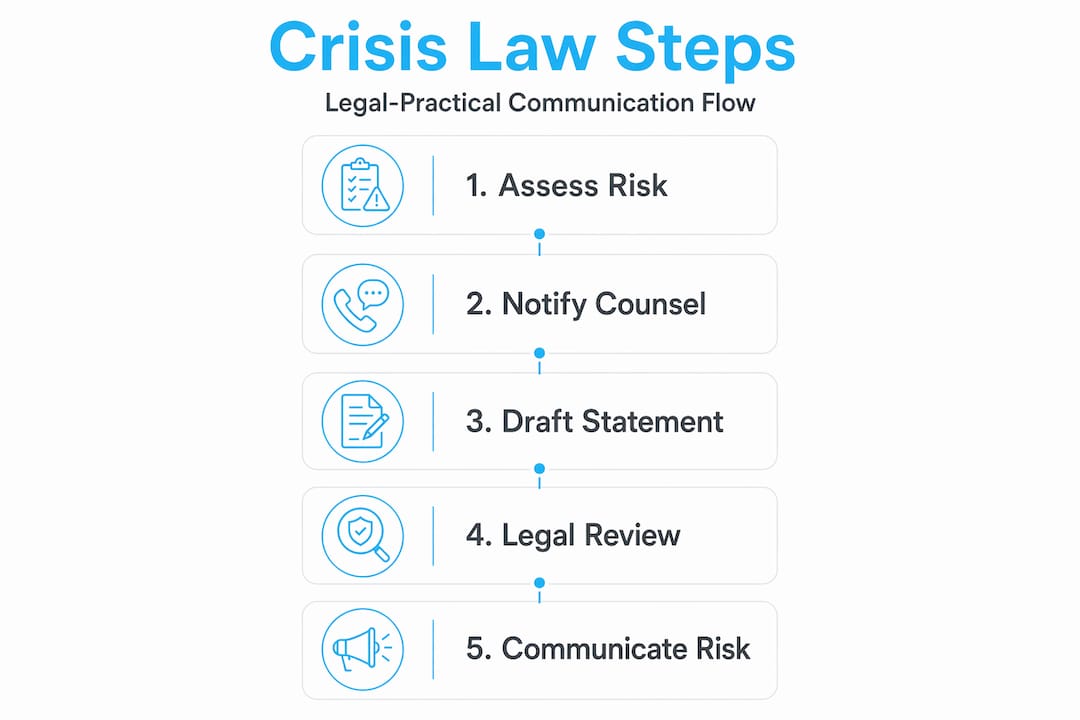
Working closely with legal counsel from the first hour of a crisis is not optional under these frameworks. Crisis communication legal strategies must be built before the incident occurs, because there is no time to design them during one.
Core principles and legal risks in crisis communications
Understanding communications law means recognizing that legal risk and reputational risk are now inseparable. The core principles governing compliant crisis communication include transparency, proportionality, and coordination. None of them exist in isolation.

Transparency is the only viable crisis strategy today because public and regulatory expectations have shifted. People no longer judge organizations on whether they handled a crisis perfectly. They judge them on whether they were honest and responsive. That alignment between public expectation and legal obligation is not coincidental. Regulators read the room too.
The legal risks that arise without proper oversight are concrete and serious:
- Defamation exposure from inaccurate public statements, especially in fast-moving situations where facts are still unclear.
- Confidentiality breaches when spokespeople, under pressure, disclose information covered by trade secrets or pending litigation.
- Regulatory penalties for failing to report incidents on time or for submitting incomplete information.
- Securities law violations when public communications conflict with material disclosure obligations for publicly traded companies.
Legal oversight in crisis communication mitigates these risks by establishing message approval workflows, defining who speaks and when, and creating pre-approved holding statements that are both accurate and legally defensible.
What is crisis management law asking of communications teams practically? It demands documented policies before the crisis hits. Those policies must address social media use, third-party vendor statements, and message clearance chains. Online reputation management during crises compounds these considerations because a single employee tweet can create as much legal exposure as a formal press release.
Pro Tip: Draft three pre-approved holding statements with legal counsel before any crisis materializes. One for data incidents, one for personnel issues, and one for operational failures. These statements buy you legally safe communication time while the full picture develops.
Protecting legal privilege during crisis responses
Legal privilege is one of the most misunderstood assets in crisis response planning. Many organizations assume that because their legal team is involved, all communications and investigation findings are automatically protected. Courts do not agree.
Maintaining privilege requires that outside counsel direct the scope and nature of the investigation, and that the work performed is substantively different from the organization’s ordinary cybersecurity or compliance activities. If your incident response vendor does the same work they would do under a standard retainer, a court may strip the privilege protection entirely.
Practical steps to protect privilege during a crisis:
- Engage outside counsel before the investigation begins, not after, and have counsel formally retain any forensic or communications vendors.
- Maintain a strict dual-track structure: one track for the legal investigation (privileged), and a separate track for business remediation (not privileged).
- Limit distribution of investigation findings and legal memoranda to those with a genuine need to know.
- Ensure invoices for vendor work flow through outside counsel, not directly to the company’s accounts payable.
Pro Tip: Label all counsel-directed investigation documents with “Prepared at the Direction of Counsel for the Purpose of Legal Advice” from the start. Courts use this kind of documented intent as evidence of privilege, but it only works when it reflects reality. Do not apply this label retroactively or indiscriminately.
Crisis legal privilege protection collapses when privilege is treated as an afterthought. The dual-track separation needs to be built into your crisis plan, not improvised under pressure.
Preparing and practicing crisis communications under legal constraints
The most technically sound crisis communication plan fails if no one has practiced it. The role of law in crisis communications extends to preparation: knowing the legal risks in advance, rehearsing responses under pressure, and confirming that your team understands both what to say and what never to say.
Successful crisis management relies on pre-defined playbooks, clear command chains, and regular tabletop exercises. A playbook that sits unread in a shared drive offers no protection. An annual tabletop that tests realistic scenarios, including the unexpected ones, builds the muscle memory that holds up when a real crisis hits at 11 p.m. on a Friday.
Build your crisis communication plan in this sequence:
- Identify the crisis scenarios most likely to affect your organization based on your industry, regulatory environment, and past incidents.
- Assign clear roles: who declares the crisis, who contacts legal counsel, who is the authorized spokesperson, and who monitors regulatory deadlines.
- Develop a message approval chain that is fast enough to meet legal reporting windows without bypassing legal review.
- Schedule tabletop exercises at least twice a year, and include curveballs like simultaneous media inquiries, regulator calls, and social media escalations.
- Conduct a post-exercise debrief with legal counsel to identify statements or decisions that created potential liability.
Not all crises require immediate public responses. Deliberate, counsel-aligned communications prevent long-term liability far better than reactive statements made to fill a silence. This is counterintuitive for many communications professionals trained on the “get ahead of the story” instinct.
Pro Tip: Include a “pause and assess” step as a formal part of your crisis protocol. Before any statement goes out, your plan should require a 30-minute legal check, even under media pressure. That window is worth protecting.
The key elements of a legally sound crisis communication plan include:
- Written spokesperson designation with backup contacts.
- Regulatory reporting deadlines listed by scenario type.
- Pre-approved language for common incident categories.
- A social media freeze protocol for the first two hours of any declared crisis.
- Documented legal sign-off requirements before any public statement.
Crisis communication planning and practice is not a one-time event. Plans must be updated when regulations change, when leadership changes, and when a near-miss reveals a gap.
Reframing crisis communications: Beyond compliance to strategic resilience
Here is the uncomfortable truth about how most organizations approach understanding communications law: they treat it as a liability minimization exercise. Legal signs off, PR sends the statement, and everyone hopes the regulators are satisfied. That is a defensive posture, and in 2026, it is not enough.
The organizations that handle crises well are not the ones that just met their reporting deadlines. They are the ones that communicated with enough clarity, speed, and honesty that stakeholders extended them trust during uncertainty. Transparency has become a core operational requirement, with public and regulators judging organizations on responsiveness rather than perfection.
There is also a real tension worth acknowledging. Regulatory enforcement requirements can clash with free speech considerations and with litigation strategy, where saying too much publicly can damage a defense position in court. This is not a theoretical problem. Free speech and regulatory tensions in communications are active, live conflicts that organizations navigate in real time. The answer is not silence, and it is not disclosure of everything. It is a calibrated, legally reviewed response that treats transparency as a floor rather than a ceiling.
Strategic crisis communications perspective requires treating every crisis as an opportunity to demonstrate that your organization can be trusted under pressure. That trust is a long-term asset. The organizations that build it outperform those that manage only for the next news cycle.
How Goldman McCormick supports your crisis communications law needs
Navigating the legal aspects of crisis communication requires more than a PR firm and a lawyer working in separate lanes. It requires a team that understands both disciplines simultaneously.

Goldman McCormick Public Relations, named by Forbes Magazine as one of America’s best PR firms, has spent over a decade at the intersection of legal PR and crisis communications. Named by the New York Observer as one of the top five agencies specializing in legal PR, the firm brings real-world experience to Goldman McCormick crisis communications expertise where compliance and messaging strategy must move together. From advising on regulatory reporting language to preparing spokespeople for media pressure during active investigations, Goldman McCormick helps legal and communications teams move with confidence when the stakes are highest.
Frequently asked questions
What is crisis communications law?
Crisis communications law refers to the regulations and legal obligations requiring organizations to communicate promptly, transparently, and truthfully during crises, often under strict reporting deadlines to avoid penalties. As regulators have shifted from discretionary PR to mandatory legal frameworks like EU NIS2 and DORA, it now carries enforceable consequences.
Who can be held personally liable under crisis communications laws?
Public information officers and executives may face personal criminal liability, including management bans, for misleading statements or material omissions during a crisis. Legislation extends liability to individual professionals, not just the organizations they represent.
How can legal privilege be protected in crisis communications?
Privilege is protected when outside counsel directs the investigation, the work is distinct from ordinary business activities, distribution is tightly controlled, and separate tracks exist for legal and business response. Courts scrutinize whether incident response work was genuinely counsel-directed before granting protection.
Why is transparency now critical in crisis communication strategies?
Transparency meets modern regulatory and public expectations by demonstrating responsiveness and honesty, which builds trust and reduces reputational damage. Transparency has become the only viable crisis strategy as the public prioritizes response quality over flawlessness.
What role do tabletop exercises play in legal crisis communication preparation?
Tabletop exercises simulate realistic crisis scenarios to test plans, align legal and PR teams, and identify gaps before a real incident occurs, minimizing both legal and reputational risk. Tabletop exercises help test all crisis response aspects in low-pressure environments where course corrections can actually be made.