
Media visibility for psychologists means earned public exposure, television segments, radio interviews, podcasts, bylined op-eds, and press interviews, secured through public relations work, media training, and reputation management rather than paid advertising. The American Psychological Association tracks this closely, recommending psychologists prepare three key take-home points before any interview and offering a Media Referral Service that connects journalists with vetted expert sources. The British Psychological Society echoes this: preparation beats charisma every time.
If you’re evaluating this for your practice, do three things this week:
- Audit your core message. Can you explain your specialty in one sentence a stranger would understand?
- Ask any PR firm you’re considering for three sample placements in mental health or adjacent fields.
- Request a short intro call or audit before signing anything longer than a 90-day trial.
Key Takeaways
Media visibility for psychologists comes from earned coverage secured through PR strategy and media training, not paid placement, and it pays off through referrals and authority, not overnight virality.
| Point | Details |
|---|---|
| Definition matters | Media visibility means earned coverage, TV, radio, podcasts, op-eds, not paid advertising or self-promotion. |
| Match channel to goal | Podcasts and local press tend to drive referrals; op-eds and trade press build policy influence. |
| Measure real outcomes | Track placements, referral conversions, and inquiry quality, not just raw reach numbers. |
| Protect ethical boundaries | Use media training and approval workflows to avoid misquotes and confidentiality risks. |
| Expect a real timeline | First placements typically land six to ten weeks in; referral signal builds over three to six months. |
| Vet firms rigorously | Goldman McCormick PR offers sector relevant proof points, including Forbes recognition and a Bulldog Reporter Gold Award, worth using as a benchmark when comparing firms. |
Table of Contents
- What Counts as Media Visibility for Psychologists?
- Why Does Media Visibility Matter for a Psychology Practice?
- Earned vs. Paid Media, and Where the Ethical Risks Sit
- What Does a PR Firm Actually Do for Psychologists?
- How Do You Choose the Right PR Partner?
- How Long Does It Take to See Results?
- Ready to Build Real Media Visibility?
- Frequently Asked Questions
- Sources
What Counts as Media Visibility for Psychologists?
Not all coverage delivers the same thing, and treating a podcast guest spot like a national TV hit will lead to disappointment. Here’s how the major channels break down:
- TV segments — broad public reach, strong for name recognition, weak for referral tracking.
- Radio interviews — mid-size reach, builds local authority, especially useful for private practitioners.
- Podcasts — smaller audiences but high engagement, often the best referral pipeline of any channel.
- National and trade press — credibility with peers, referral sources, and potential speaking bureaus.
- Op-eds and bylines — positions you as a thought leader on a specific issue, useful for policy influence.
- Expert quotes and syndicated pieces — cumulative SEO and reputation value over time.
- LinkedIn thought leadership and webinar panels — steady, low-risk visibility that compounds.
Private practitioners tend to get the most mileage from podcasts, local press, and LinkedIn, where referral intent is high. Academic and organizational psychologists often benefit more from op-eds and trade press that shape policy conversations rather than drive appointment bookings.
Pro Tip: Rank your target channels by what you actually need. If your goal is client intake, chase podcasts and local press before national TV.

Why Does Media Visibility Matter for a Psychology Practice?
The payoff isn’t abstract. It shows up in specific, trackable ways:
- Authority and credibility — a byline in a respected outlet does more for referral trust than a paid ad ever will.
- Referral growth — colleagues and physicians refer more readily to psychologists they’ve seen quoted as experts.
- Higher-quality inquiries — media coverage tends to pre-qualify clients who already understand your specialty.
- Speaking and invite pipeline — one solid placement often leads to conference or panel invitations.
- Policy influence — op-eds and press interviews let you shape public conversation on issues you specialize in.
When you hire a PR firm, ask for reporting on placements secured, targeted reach (not just raw numbers), referral conversions, inquiry quality, backlink or SEO signal, and speaking invitations generated. Set expectations early: most practices see incremental referral movement three to six months after sustained coverage begins, not overnight.
Pro Tip: Ask your PR firm to tag inbound inquiries by source for 90 days. It’s the cheapest way to see if coverage is actually converting.
Earned vs. Paid Media, and Where the Ethical Risks Sit
Earned media, a journalist deciding your expertise is worth covering, carries far more credibility than paid placement because the audience knows no one bought that endorsement. Paid media gives you control over message and timing but reads as advertising, which matters when trust is the entire product you sell. Most psychologists need a mix: earned coverage for authority, and owned channels like a podcast or newsletter to keep the relationship going between placements.
The real risk isn’t obscurity. It’s mishandled exposure. Watch for:
- Misquotes that oversimplify a nuanced clinical point.
- Confidentiality breaches when a case example gets too specific.
- Public diagnosing, which crosses ethical lines fast.
- Sensationalized framing that a journalist wants but you shouldn’t give.
Howden Group’s guidance for talking therapists is blunt on this point: effective PR for regulated professionals runs on clarity and usefulness, not sensationalism.
Pro Tip: If a producer pushes you toward a dramatic personal story, offer a plain-language explanation of the pattern instead. It’s a better interview and it protects your license.
What Does a PR Firm Actually Do for Psychologists?
A firm earns its fee by handling the parts you don’t have time to master. That typically includes:
- Media outreach and pitching to relevant journalists and producers.
- Media training so you stop getting misquoted.
- Press materials and professional bios that make you pitch-ready.
- Op-ed and byline development for policy or thought-leadership plays.
- Podcast production and promotion for long-form referral building.
- Crisis communications when something goes sideways publicly.
- Awards and recognition management to build third-party credibility.
- Measurement and reporting so you know what’s working.
Each service maps to an outcome. Media training reduces misquotes. A well-placed op-ed builds influence on policy conversations. Podcast production builds the slow-burn referral pipeline that keeps paying off long after the episode airs.
Goldman McCormick PR has built its practice around exactly this kind of work, earning recognition from Forbes as one of America’s best PR firms, a Bulldog Reporter Gold Award for its cause and advocacy campaign work, and a mention from the New York Observer as a leading agency in its specialty area.
The value of a placement isn’t the segment itself. It’s what a journalist’s endorsement does for every referral conversation that happens afterward.
How Do You Choose the Right PR Partner?
Evaluate any firm against a short list before you sign anything:
- Sector experience — have they placed healthcare or mental health professionals specifically, not just general business clients?
- Media relationships — can they name outlets and producers they work with regularly?
- Evidence of placements — will they show three to five real, verifiable samples?
- Measurement approach — do they report placements, reach, and referral conversion, or just impressions?
- Senior involvement — will an experienced strategist run your account, or does it get handed to a junior?
- Contract clarity — is pricing, scope, and cancellation spelled out plainly?
Bring these questions to a discovery call:
- What should I expect in months one through six?
- Who leads my account day to day?
- Can you show sample placements in psychology or healthcare?
- What KPIs will you report, and how often?
- Have you handled a crisis communications situation before?
- What does your media training session actually cover?
No Strings Public Relations recommends pressing hard on positioning and reporting cadence specifically, since vague answers here predict vague results later.
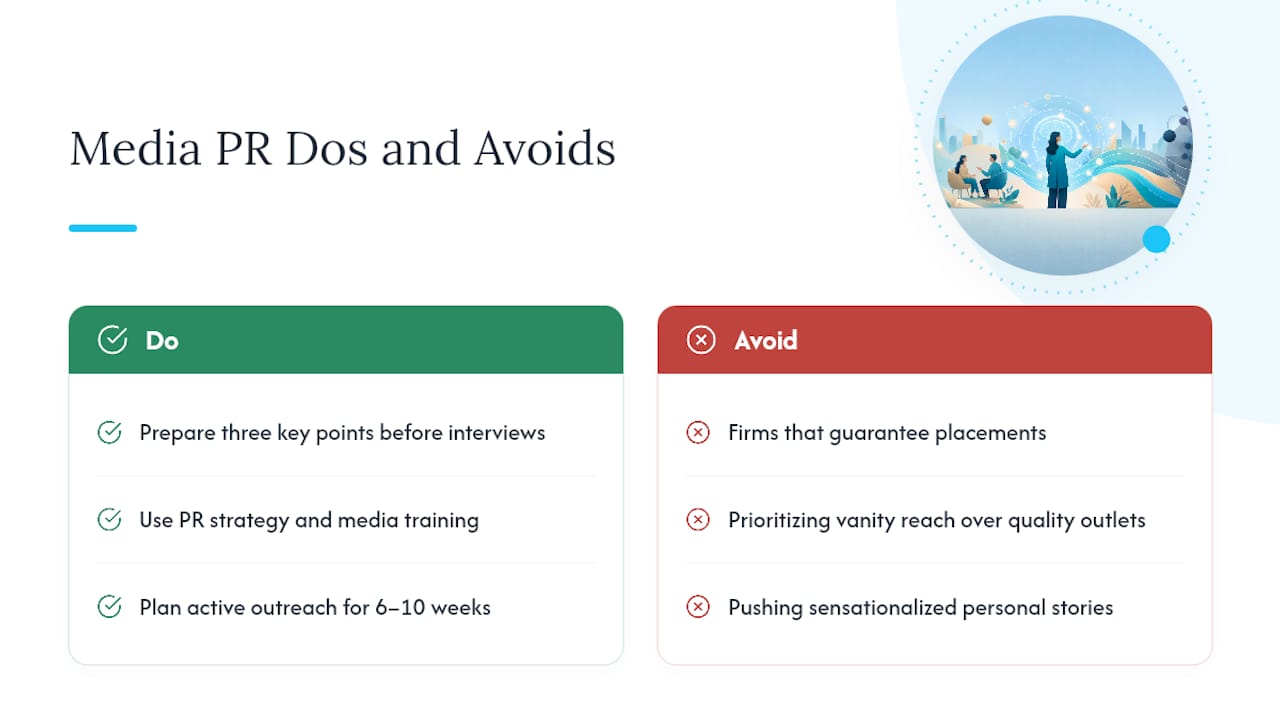
Red flags to walk away from: guaranteed placements (no ethical firm promises editorial outcomes, since journalists make that call), a pitch heavy on vanity reach numbers instead of outlet quality, pressure to share sensational client stories for a better angle, opaque reporting, or a senior team member you never actually get access to after signing.
Pro Tip: Ask what happens in month two if outreach hasn’t landed a placement yet. A firm with a real process has an answer ready.
How Long Does It Take to See Results?
Realistic timelines matter more than most proposals let on. Expect roughly this arc:
- Discovery and positioning (weeks one to three): the firm learns your specialty, audience, and message.
- Media kit and training (weeks two to four, often overlapping): bios, press materials, and interview prep get built.
- Active outreach (ongoing from week four): pitching begins, often producing first placements by week six to ten.
- Follow-up and amplification (ongoing): placements get repurposed across LinkedIn, your site, and future pitches.
Pricing usually falls into three models:
- Project fees for a single campaign or launch.
- Monthly retainers for ongoing outreach and relationship building, the most common model for sustained visibility.
- Success-linked fees tied to speaking engagements or award submissions.
Expect modest activity in months one through three (positioning and early placements) and clearer referral signal by months three through six. Ask for monthly reporting so you’re not guessing.
An Agency Note on Working With Psychologists
Psychologists come to us worried about two things: getting misquoted and looking like they’re chasing attention instead of serving patients. Both concerns are fair, and both are solvable with real media training and outcome-focused reporting rather than vanity metrics. If you specialize in a clinical area with public relevance, sector experience and production capability, like in-house podcast work, close that gap faster than a generalist agency can. A short audit call costs you nothing and tells you quickly whether a firm actually understands your field.
Ready to Build Real Media Visibility?
Goldman McCormick PR handles the parts of visibility most psychologists don’t have bandwidth for: pitching your expertise to producers and editors, training you to give a clean, quotable interview, producing podcast content that builds a referral pipeline over months instead of days, and managing your reputation when a story doesn’t go the way you expected.
Founded by former members of the media, the firm was named by Forbes as one of America’s best PR firms, earned a Bulldog Reporter Gold Award for advocacy campaign work, and was recognized by the New York Observer for its agency specialization. Those aren’t abstract accolades. They reflect a team that has spent years learning what journalists actually want from expert sources, which is exactly the gap most psychologists struggle to close alone.
If you’re ready to see what media visibility could look like for your practice, request an audit from Goldman McCormick PR and get a straight answer on what’s realistic for your specialty before you commit to anything.
Frequently Asked Questions
What is media visibility for psychologists?
It’s earned public exposure, TV, radio, podcasts, bylines, and interviews, gained through PR strategy, media training, and reputation management rather than paid advertising.
How long does it take to get media placements?
Most practices see initial placements within six to ten weeks of active outreach, with measurable referral impact building over three to six months.
Do I need media training before doing interviews?
Yes. The APA recommends preparing three key points before any interview to avoid misquotes and stay on message under pressure.
What’s the difference between earned and paid media for psychologists?
Earned media comes from a journalist choosing to cover you, which carries more credibility. Paid media gives you control but reads as advertising, which can undercut trust.
How much does hiring a PR firm typically cost?
Pricing usually runs as monthly retainers, project fees for a specific campaign, or success fees tied to speaking or awards, and it varies by scope and firm.
What red flags should I watch for when hiring a PR firm?
Avoid firms that guarantee placements, emphasize vanity reach over outlet quality, or push you toward sensationalized personal stories for a better pitch angle.