
A press release is a strategic communication tool that psychologists use to share credible, expert-driven information that shapes public understanding and client relationships. Research shows consumers trust editorial coverage 3.2 times more than paid advertising, which makes the press release one of the most cost-effective credibility tools available to mental health professionals. The formal industry term is “media release,” though “press release” remains the standard working term across newsrooms and PR firms alike. Organizations like the American Psychological Association (APA) and the British Psychological Society (BPS) rely on this format to communicate research findings, professional surveys, and public health guidance to journalists and the broader public.
What does a press release do for psychologists?
A press release positions a psychologist as a credible expert source, giving journalists a structured, factual entry point to cover mental health topics accurately. This matters because public perception of psychology is shaped largely by media coverage, and that coverage is only as accurate as the source material journalists receive.
The psychological mechanisms at work are worth understanding. Emotional appeals, including empathy, urgency, and familiarity, activate reader engagement before any logical processing occurs. A well-structured press release leads with a human-relevant finding, follows with expert commentary, and closes with context. That sequence mirrors how the brain processes new information, moving from emotional resonance to analytical evaluation.
“Earned expert media coverage is more trusted than paid ads or social media posts, making press releases a critical tool if used ethically.” — Leeds Beckett University trust research
Credibility is the central variable. External expert trust consistently outperforms general PR communications in public trust surveys, meaning a psychologist quoted in a news story carries more weight than a branded social media post from the same professional. Press releases are the mechanism that gets psychologists into those news stories.
Press releases also serve a counter-misinformation function. When a misleading mental health claim circulates online, a well-timed release from a credentialed psychologist can reframe the narrative before it hardens into public belief. Understanding how news goes viral helps psychologists time and frame their releases for maximum corrective impact.

Best practices for psychologists writing press releases
The first decision is whether a press release is the right vehicle at all. NOAA’s communications toolkit frames this clearly: choose the right channel based on your audience, your timeline, and the nature of your announcement. A new research finding warrants a press release. A routine service update does not.
When a press release is appropriate, follow these principles:
- Lead with evidence, not promotion. State the finding or announcement in the first sentence. Avoid language that sounds like advertising copy.
- Include concrete data. Numbers give journalists something to anchor their story. Vague claims get cut.
- Name your credentials explicitly. Your title, institutional affiliation, and area of specialization belong in the first paragraph.
- Add a clear call to action. Tell journalists exactly how to reach you for comment or interview.
- Balance benefits and risks. Press releases that present balanced benefit and risk data improve public understanding and reduce the sensationalism that distorts mental health coverage.
Ethical considerations are non-negotiable. BPS guidelines place duty of care and risk management at the center of any psychologist’s media engagement. That means screening the context your commentary will appear in, not just the content of the release itself.
Pro Tip: Avoid language that reads as self-promotional. Research shows 61% of readers assume press releases are paid content, which reduces their credibility. Write like a scientist reporting findings, not a marketer selling services.
How psychologists use press releases to address current issues
The APA’s December 2025 press release on AI tool usage among psychologists is a textbook example of the format done right. The release reported that 56% of psychologists used AI tools, while 92% expressed concerns. It broke those concerns into specific categories: data breaches at 67% and algorithmic bias at 63%. That level of specificity gave journalists a ready-made story with multiple angles.
What made that release effective was its structure. It combined survey data with expert interpretation, presented both adoption rates and concern levels, and avoided advocacy language. The result was coverage that informed rather than alarmed.
A second strong example comes from UTHealth Houston, where a psychologist made themselves available to discuss the Surgeon General’s advisory on children’s screen time. That release connected expert commentary on screen time to a high-profile public health moment, giving journalists a credentialed voice at exactly the moment they needed one.
Both examples share a common structure:
- A timely hook tied to a current event or survey
- Named expert with clear credentials
- Specific data points, not general claims
- A direct offer for media follow-up
Psychologists who connect their releases to active news cycles get picked up. Those who issue releases in a vacuum rarely do.
How do press releases compare to other media tools for psychologists?
| Media tool | Trust level | Best use case |
|---|---|---|
| Press release (earned media) | High, 3.2x vs. paid ads | Research findings, expert commentary, public health announcements |
| Paid advertising | Lower, perceived as promotional | Brand awareness, service promotion |
| Social media posts | Variable, platform-dependent | Community engagement, real-time updates |
| Direct media pitch | High, relationship-dependent | Exclusive stories, broadcast appearances |
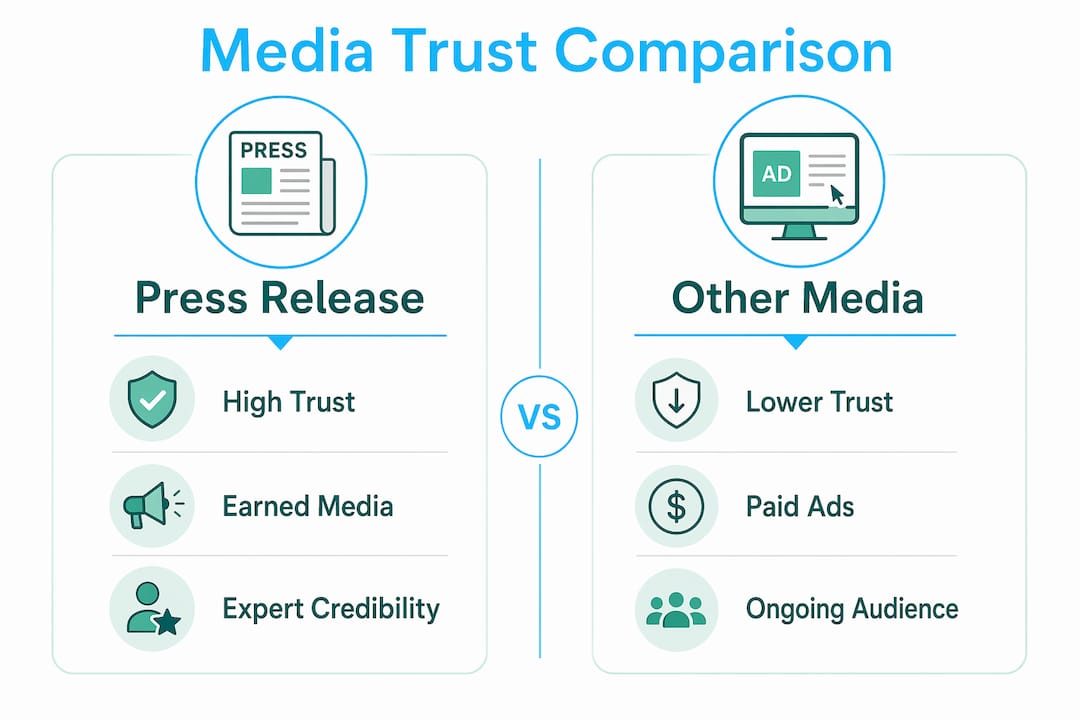
Press releases occupy a specific niche. They are not the right tool for building an ongoing audience, which social media handles better. They are not the right tool for guaranteed placement, which paid advertising provides. They are the right tool when you need a journalist to treat your announcement as news rather than promotion.
Pro Tip: Pair a press release with a direct pitch call to the journalist most likely to cover your topic. The release provides the facts; the pitch call provides the relationship. Together, they optimize media coverage in ways neither achieves alone.
Key takeaways
A press release gives psychologists their single most credible pathway into earned media coverage, and that credibility depends entirely on transparent, evidence-based messaging.
| Point | Details |
|---|---|
| Trust multiplier | Editorial coverage generates 3.2x more consumer trust than paid advertising. |
| Ethical obligation | BPS guidelines require duty of care and risk screening in all media appearances. |
| Data specificity wins | APA’s AI survey release succeeded because it named exact percentages, not general trends. |
| Perceived paid content | 61% of readers assume press releases are paid, so transparency in tone is non-negotiable. |
| Right tool, right moment | Press releases work best for research findings and expert commentary tied to current news cycles. |
Why most psychologists underestimate what a press release actually does
I have worked with professionals across industries for over a decade, and psychologists consistently make the same mistake: they treat a press release as a marketing document rather than a journalism tool. That framing kills the release before it reaches a single editor.
The psychologists who get consistent media coverage think like reporters. They ask what a journalist needs, not what they want to say. They lead with data. They offer access. They frame their expertise as a service to the story, not the story itself.
The credibility gap between earned media and paid content is not closing. If anything, audiences are growing more skeptical of promotional content and more receptive to expert voices in editorial contexts. That creates a real opportunity for psychologists willing to invest in the craft of public communication.
My honest advice: do not issue a press release until you have something genuinely newsworthy to say. One strong release tied to a real finding or a timely public health moment will do more for your professional reputation than a dozen generic announcements. Quality and timing are everything.
— Ryan McCormick
How Goldman McCormick PR helps psychologists get media coverage
Goldman McCormick PR has spent over a decade placing mental health professionals in front of the audiences that matter, from national television to syndicated radio programs on the Genesis Communications Network and Starcom Radio Network. Named by Forbes Magazine as one of America’s Best PR Firms for 2021, the firm understands the difference between a press release that gets filed and one that gets covered.
For psychologists ready to build a credible public profile, Goldman McCormick PR crafts releases that lead with evidence, position expertise accurately, and reach the journalists most likely to act on them. The firm’s track record in mental health media placement reflects a direct, results-focused approach that respects both the professional standards of psychology and the practical demands of newsrooms. If your research or practice deserves public attention, this is where that process starts.
FAQ
What is the main purpose of a press release for psychologists?
A press release gives psychologists a structured, credible way to share research findings, expert commentary, or public health guidance with journalists. Its primary function is to generate earned media coverage, which carries significantly more public trust than paid advertising.
How do psychologists use press releases ethically?
BPS guidelines require psychologists to screen the context of their media appearances and manage risk to public welfare. Ethical press releases present balanced data, avoid promotional language, and clearly identify the expert’s credentials and institutional affiliation.
Are press releases more effective than social media for mental health professionals?
Press releases generate higher trust when they result in editorial coverage, earning 3.2 times more consumer trust than paid content. Social media is better suited for ongoing audience engagement, while press releases serve specific announcements tied to research or current events.
What makes a psychology press release credible?
Credibility comes from named expert credentials, specific data points, balanced reporting of both benefits and risks, and transparent language that reads as journalism rather than promotion. The APA’s 2025 AI survey release is a strong model of this approach.
When should a psychologist not use a press release?
A press release is the wrong tool for routine service updates, general brand awareness, or announcements without a newsworthy data point or expert finding. NOAA’s communications guidance recommends choosing the channel that matches both the audience and the nature of the announcement.