
Understanding what is PR strategy for law firms means recognizing it goes far beyond sending press releases or announcing case wins. Effective PR planning aligns communications with strategic business goals, shapes how clients, courts, and the public perceive your firm, and positions your attorneys as credible authorities before a crisis ever forces your hand. Done right, law firm public relations builds the kind of trust that no advertising budget can buy. This article breaks down exactly how to build that foundation.
Table of Contents
- Key Takeaways
- What a PR strategy for law firms actually means
- Building thought leadership that actually gets read
- Ethical and confidentiality limits in legal PR
- Media relations and channel strategy
- Crisis preparedness and PR during high-stakes matters
- My take on where law firm PR actually goes wrong
- How Goldman McCormick PR helps law firms build real visibility
- FAQ
Key Takeaways
| Point | Details |
|---|---|
| Align PR with firm strategy | Map every PR activity to a business priority like sector leadership or national profile growth. |
| Thought leadership requires distribution | Publishing without promotion limits reach. Repurpose content across LinkedIn and podcasts to engage audiences. |
| Ethical boundaries shape PR | Lawyer ethics restrict what can be shared publicly during litigation, affecting how you work with media consultants. |
| Crisis plans need regular audits | Confirm spokesperson roles, digital capabilities, and messaging protocols before a crisis hits, not during one. |
| Measure impact, not activity | Track earned media, social engagement, and business development outcomes rather than just press release counts. |
What a PR strategy for law firms actually means
A PR strategy is not a list of press releases. The recognized industry term is public relations strategy, and for law firms it refers to a structured plan that governs how the firm communicates with clients, media, regulators, prospective hires, and the public to advance specific business objectives. It covers everything from how a partner speaks at a conference to how the firm responds when a client matter lands on the front page of the Wall Street Journal.
Starting with strategic goals is the first and most skipped step. That means pulling out the firm’s 2026 business plan before you open a media list. What practices are growing? Which sectors are you targeting? Is the firm trying to raise its national profile or deepen relationships in a specific vertical? Your PR activities should map directly to those answers.
Bring business development leaders and practice group chairs into the planning process early. They hold the intelligence you need: which clients are expanding, which competitors are gaining ground, and which legal issues are emerging in your priority sectors. When you have that context, you can plan to lead conversations in the market rather than scramble to react when a competitor gets the byline you should have had.
Pro Tip: Build a simple grid that maps each PR activity (bylined article, podcast appearance, media pitch) to a specific firm priority. If an activity does not connect to a priority, cut it from the plan.
Here is what a well-mapped PR plan typically covers:
- Sector leadership positioning across target industries
- Client relationship deepening through visibility in relevant trade press
- National or regional profile building for key partners
- Recruiting and retention support through culture-focused storytelling
- Crisis readiness and spokesperson preparation
Building thought leadership that actually gets read
Thought leadership is the cornerstone of law firm marketing strategies, but most firms confuse production with distribution. Writing a 2,000-word client alert and posting it to the firm website is not a thought leadership program. It is a document archive.

Real thought leadership maps content to specific audience needs and practice strengths, then distributes that content through channels where your clients and referral sources actually spend time. Repurposing into LinkedIn posts with targeted discussion prompts generates meaningful interactions that can lead directly to referrals. A podcast appearance by a regulatory partner reaches an audience who will never read a law review article.
Here is a four-step content amplification process that works:
- Identify the insight. What does your firm know about a trending legal issue that clients and prospects do not already know? That gap is your content.
- Write the long form. A bylined article, client alert, or white paper establishes depth and credibility.
- Repurpose for each channel. Pull three key takeaways for LinkedIn. Record a short audio clip for a podcast. Pitch the angle to a trade journalist as an expert source.
- Measure social signals. Track which themes generate comments, shares, and inquiries. Refine future content based on what actually resonates.
Pro Tip: Social engagement signals are your real-time focus group. If a post on a particular regulatory topic sparks conversation, that topic deserves a deeper content investment.
Ethical and confidentiality limits in legal PR
This is where law firm public relations gets genuinely complicated, and where most general PR advice breaks down. Lawyers operate under professional conduct rules that restrict extrajudicial statements in litigation-related matters. Lawyer ethics restrict what confidential information can be shared with communication consultants, which means your media strategy during an active matter has hard boundaries baked in.
Attorney-client privilege does not automatically extend to a PR consultant unless that consultant is functioning in a role directly supporting the legal strategy, similar to how jury consultants are treated. The scope of the engagement matters enormously. Privilege depends on consultant role, not simply on the fact that the attorney hired them.
Practical implications for your PR plan:
- Define clearly in writing what the media consultant’s role is and how it supports legal strategy
- Brief consultants only on information they need to execute their role
- Require counsel to approve all public statements before release during active litigation
- Establish a single spokesperson to prevent conflicting messages
“Effective crisis communications must be led by counsel who manage communications consultants to align messaging with legal strategy.” — Keller Anderle Scolnick
Media relations and channel strategy
Identifying key journalists, podcasters, and editors in your priority sectors is not a one-time exercise. It is an ongoing relationship-building effort that pays off when a reporter needs an expert source on a breaking legal development and calls your partner instead of a competitor.
Here is a comparison of communication channels and their primary PR value for law firms:
| Channel | Primary PR value |
|---|---|
| Trade press bylines | Credibility with industry decision-makers |
| Broadcast media appearances | Broad public visibility and brand recognition |
| LinkedIn thought leadership | Direct engagement with clients and referral sources |
| Podcasts and webinars | Deep-topic authority and audience building |
| Sponsorships and conferences | Culture showcasing and relationship development |
Sponsorships and webinars also create natural opportunities to showcase firm culture alongside legal expertise. When you sponsor an industry event featuring media access, you are not just buying visibility. You are creating a context where journalists, prospects, and clients see your attorneys in action.
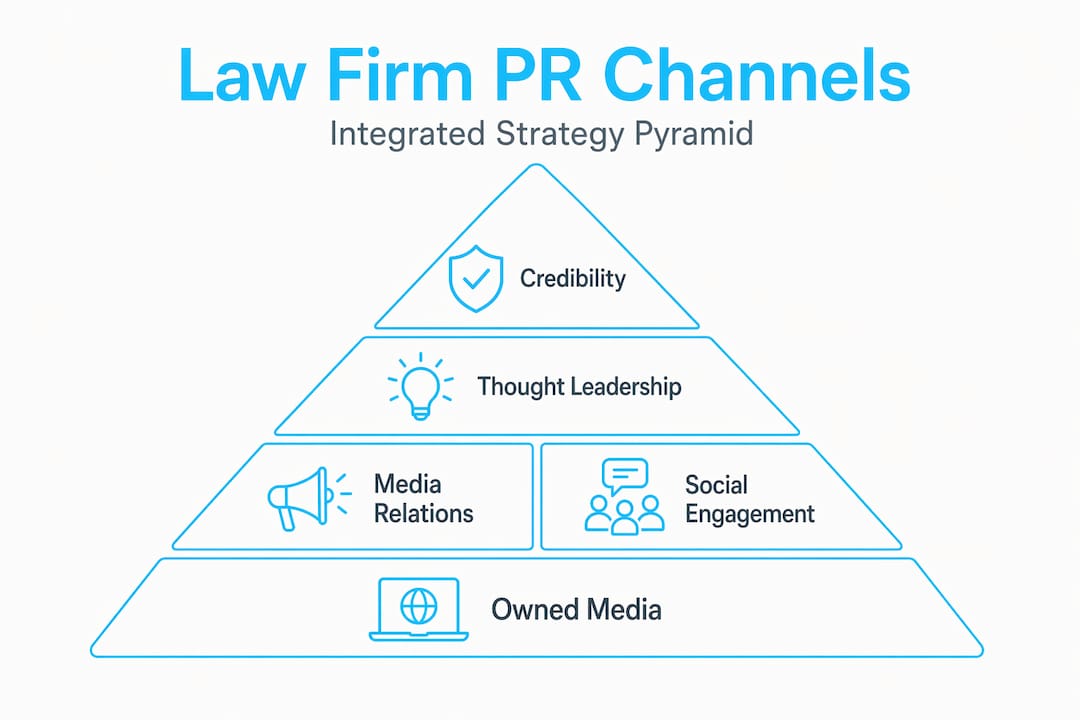
Integrating owned, earned, and social media into a coordinated strategy creates credibility that no single channel achieves alone. A blog post becomes a news release. The news release earns a trade publication pickup. The trade piece gets shared on LinkedIn. Each amplifies the others.
Crisis preparedness and PR during high-stakes matters
A crisis communication plan that has not been reviewed in two years is not a plan. It is a liability. Refreshing crisis protocols and confirming digital capabilities for rapid communications should happen at least annually, not after a client matter goes sideways.
Coordinated messaging between PR and legal teams is not optional during high-profile litigation or regulatory events. Public statements made without counsel review can waive privilege, undermine trial strategy, or create inconsistencies that opposing counsel will exploit.
Best practices for crisis readiness in legal PR:
- Assign and train a primary spokesperson and a backup before any crisis occurs
- Create pre-approved holding statements for common scenarios (regulatory investigation, client lawsuit, partner departure)
- Run a tabletop exercise annually to pressure-test your response protocol
- Confirm that your digital publishing capabilities can handle a rapid response within two hours of a story breaking
Pro Tip: The goal in a crisis is not to say everything. It is to say the right thing once, clearly, without creating new legal exposure. Less is almost always more.
My take on where law firm PR actually goes wrong
I have worked with legal clients long enough to know that the firms with the most sophisticated attorneys often have the most reactive PR programs. Everyone understands the strategy at a whiteboard level. Then the fiscal year starts, the billable hours take over, and the communications function gets reduced to writing announcements about lateral hires.
The firms that build lasting reputations do one thing differently. They treat what is law firm branding as a living, ongoing investment rather than a project to complete. They have a partner who champions the PR program internally and holds business development accountable to the content calendar.
I have also watched firms blow a winnable crisis response because no one had defined the consultant’s role properly before the phone rang. The ethical nuances around confidentiality and privilege are not abstract. They are operational. You need to sort them out before you need them.
And here is the thing most PR agencies will not tell you: proactive media relationships built in quiet times are worth ten times more than frantic outreach when a story breaks. Journalists remember who was useful to them on a slow news day.
— Ryan McCormick
How Goldman McCormick PR helps law firms build real visibility

Goldman McCormick PR has been named by Forbes Magazine as one of America’s Best PR Firms and was cited by the New York Observer as one of the top five agencies specializing in legal PR services. Since 2010, our team has helped law firms and legal professionals build credible media profiles across TV, radio, and national print outlets. We also produce podcasts and syndicated radio programming that gives your attorneys a platform no press release can replicate. If your firm is ready to build a PR strategy that ties directly to your business goals and holds up under pressure, explore our PR insights for law firms or contact Goldman McCormick PR directly to get started.
FAQ
What is a PR strategy for a law firm?
A PR strategy for a law firm is a structured communications plan that aligns public-facing messaging with the firm’s business goals, covering thought leadership, media relations, crisis readiness, and ethical compliance across all channels.
How is law firm PR different from general PR?
Law firm PR operates under professional conduct rules that restrict extrajudicial statements and limit what can be shared with media consultants, particularly during active litigation, making ethical compliance a core part of every communication decision.
What are the most effective PR tactics for law firms?
Effective PR tactics include bylined thought leadership in trade publications, proactive media relationship building, social amplification of content, spokesperson training, and integrated crisis communication protocols that are reviewed annually.
How do law firms measure PR success?
PR success should be measured through earned media placements, social engagement quality, content performance, and business development outcomes like new client inquiries. Tracking activity alone, such as press releases sent, does not reflect actual impact.
When should a law firm hire a PR firm?
A law firm should engage a PR firm before a crisis occurs, ideally when building its annual communications plan, so the agency has time to establish media relationships and develop messaging frameworks grounded in the firm’s actual strategic priorities.