
Editorial coverage generates 3.2 times more trust than paid advertising, and 91% of decision-makers cite earned media as their top trusted information source. For law firm partners, that gap between what advertising delivers and what editorial coverage achieves represents a significant competitive exposure. Understanding why law firms need PR agencies is no longer a theoretical exercise. It is a question with measurable answers, clear timelines, and real consequences for client acquisition in 2026.
Table of Contents
- Key Takeaways
- Why referrals alone no longer protect your firm
- How PR agencies build the visibility AI and clients trust
- Reputation management and crisis readiness
- Practical benefits of collaborating with a specialized PR agency
- My perspective on why waiting is the wrong call
- How Goldmanmccormick can build your firm’s presence
- FAQ
Key Takeaways
| Point | Details |
|---|---|
| Editorial trust outperforms ads | Earned media builds 3.2x more consumer trust than paid advertising, directly affecting client decisions. |
| PR drives non-referral inquiries | Law firms with active PR strategies see measurable increases in non-referral client inquiries within 90 days. |
| AI visibility is now a PR function | Structured editorial content is how AI-driven search tools discover and recommend your firm to prospective clients. |
| Early movers dominate citation authority | AI citation authority costs are rising 50 to 80% annually, rewarding firms that invest in PR sooner. |
| Crisis readiness requires proactive PR | Consistent reputation-building before a crisis is what preserves client trust when scrutiny arrives. |
Why referrals alone no longer protect your firm
Law firms have operated on referral networks for generations, and those networks still matter. But they are no longer sufficient protection against the shifts happening in client behavior right now.
Prospective clients do not simply call the name a colleague mentioned. They search. They read. They ask AI assistants for recommendations, and those assistants pull from editorial sources, structured content, and authoritative publications. A firm with strong referral relationships but weak public visibility hands clients to competitors the moment someone types a query into ChatGPT, Perplexity, or Google’s AI overview. Law firms without editorial visibility lose potential clients at that research stage, often without ever knowing those clients were considering them.
Consider the practical risk. If a senior partner retires, relocates, or reduces their caseload, the referral stream they maintained for 20 years does not transfer. Firms with no earned media presence have no safety net. Those with established editorial authority continue attracting inquiries regardless of personnel changes.
Here is what the shift in client behavior demands from law firms today:
- Consistent editorial presence across publications your prospective clients actually read
- AI-readable content that structured platforms can extract and cite in responses to client queries
- Proactive thought leadership from named attorneys, published in credible outlets, not just firm blogs
- Measurable visibility metrics that track where the firm appears and how that drives inquiries
Pro Tip: Map your current non-referral inquiry sources for the last 12 months. If you cannot name three distinct channels that bring in prospective clients independently of referrals, your firm has a visibility gap that PR can address.
How PR agencies build the visibility AI and clients trust
This is where the mechanics matter, and where many law firms misunderstand what a specialized PR agency actually does.
Earned media is not press releases sent into a void. A skilled PR agency places named attorneys as expert sources in national publications, secures bylined articles in legal trade outlets, and builds a documented record of expertise that both human readers and AI systems recognize as authoritative. AI citation authority is now a genuine PR function, not a side effect of traditional media work.
The reason this matters technically: AI engines cannot extract useful claims from rhetorical or promotional text. A firm website that says “we are passionate advocates for our clients” is invisible to an AI assistant recommending attorneys in a specific practice area. A published piece in a recognized outlet where an attorney explains a legal precedent, cites facts, and offers structured analysis is exactly what AI pulls from when answering client queries. Law firm websites without structured, factual content are losing search prominence to firms that have this content published externally through PR.
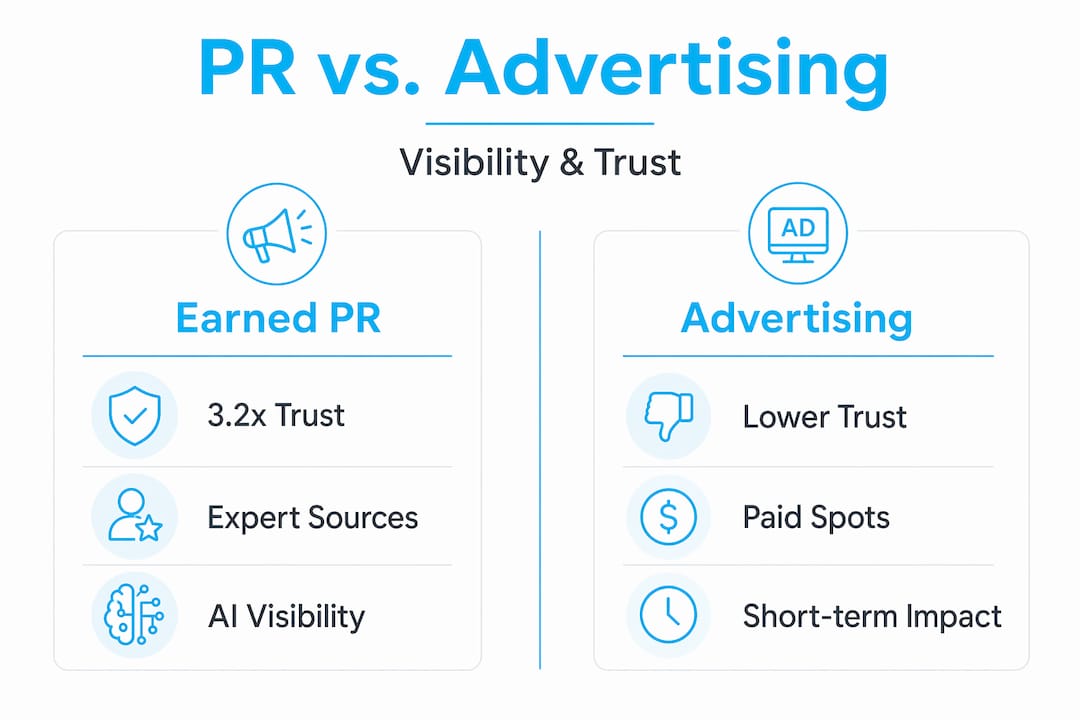
Here is how earned editorial authority compares to paid advertising for law firms:
| Factor | Earned PR coverage | Paid advertising |
|---|---|---|
| Trust level | 3.2x higher consumer trust | Lower trust, recognized as promotional |
| AI citation eligibility | High: structured, credible sources preferred | None: AI does not cite ads |
| Shelf life | Persistent: articles remain indexed indefinitely | Limited to campaign duration |
| Cost trajectory | Stable with relationship-building | Increasing with market competition |
| Client conversion influence | 82% of exposed consumers consider acting | 39% without editorial exposure |
Advanced PR agencies now combine traditional earned media with technical SEO, schema markup, and LinkedIn citation strategies to influence how AI platforms discover and recommend legal expertise. This is not optional optimization. It is the core of how client discovery works in 2026.
Pro Tip: Ask any PR agency you evaluate whether they have a specific process for AI citation authority. If they do not know what that means, keep looking.
Reputation management and crisis readiness
Law firms face reputational threats that would have been manageable 15 years ago but are genuinely dangerous today. A single negative story, a disgruntled former client’s social media post, or an AI-generated misattribution can circulate faster than any communications team can respond reactively.

Social media and AI-driven misinformation accelerate reputational threats in ways that demand proactive monitoring and ethical response protocols, not improvised reactions. The firms that survive these situations with their client relationships intact are the ones that had already established a credible public profile before the crisis occurred.
This is what law firm reputation management actually requires:
- Ongoing media monitoring to catch emerging narratives before they compound
- Pre-written response frameworks approved by both communications and legal counsel
- Named spokespeople with existing media relationships who can respond credibly on short notice
- Consistent thought leadership that creates a reservoir of positive coverage to counterbalance negative attention
- Ethical communication protocols aligned with bar association standards, so responses protect rather than create additional liability
A firm’s ability to respond credibly during a crisis depends directly on the reputation-building work that happened before the crisis. Firms that cultivate a consistent, credible public profile maintain client trust through serious situations far more effectively than those who engage PR only when something goes wrong.
Practical benefits of collaborating with a specialized PR agency
The law firm PR benefits that matter most to partners are concrete, not conceptual. Here is what working with a specialized agency actually delivers:
-
Access to legal media relationships. National and AI-focused PR outreach requires professional agency expertise and established contacts. A specialized agency has those relationships with legal trade publications, national business press, and broadcast producers. Your attorneys do not need to cold-pitch producers.
-
Strategic message development. PR professionals translate complex legal expertise into language that attracts high-value clients without compromising professional standards. This is a skill set distinct from legal writing, and most law firms do not have it internally.
-
AI visibility integration. The role of PR in legal marketing now includes technical work: structuring content for AI discoverability, building schema-marked pages, and securing citations in authoritative publications that AI tools reference. This requires specialists.
-
Measurement and refinement. Law firms that implement PR strategies see measurable increases in non-referral inquiries within 90 days, with revenue impact materializing between three and six months. A professional agency tracks these metrics and adjusts.
-
Resource efficiency. Your partners bill hundreds of dollars per hour. The time they spend attempting to manage media relationships or draft thought leadership is time not spent on client work. An agency handles this at a fraction of the opportunity cost.
Pro Tip: When evaluating the importance of PR for law firms in your budget discussions, calculate what one new retained client is worth over three years. Then compare that to annual PR spend. The math typically resolves the hesitation.
My perspective on why waiting is the wrong call
I’ve watched law firms lose clients they never knew they were losing because another firm showed up in the right editorial outlets and they did not. The prospective client did their research, found one firm quoted as an authority in a trusted publication, and never called anyone else.
What concerns me most in 2026 is the cost curve. AI citation authority costs are rising 50 to 80% annually, and by 2028, that authority will cost three to five times more to secure than it does today. Firms that invest now are buying an asset. Firms that wait are paying a penalty.
The law firms I’ve seen struggle most with PR are the ones that treat it as a cost rather than a position. PR spend is not discretionary marketing. It is the infrastructure that makes everything else, referrals, advertising, and business development, work better. Do it reactively and you are always catching up. Do it consistently and you control how your firm is perceived before anyone asks.
— Jack
How Goldmanmccormick can build your firm’s presence
Goldmanmccormick has specialized in legal PR placement since 2014, when the New York Observer recognized the firm as one of the top five public relations agencies for legal practices. Named by Forbes Magazine as one of America’s Best PR Firms for 2021, Goldmanmccormick places clients on television, radio, and in print and digital publications that matter to your prospective clients.
For law firms specifically, Goldmanmccormick combines earned editorial placements with AI visibility strategies, crisis communication preparation, and nationally syndicated broadcast opportunities through the Genesis Communications Network and Starcom Radio Network. If your firm is not appearing where prospective clients are looking, that is a solvable problem. The first step is understanding exactly where your visibility gaps are.
FAQ
Why do law firms need PR agencies instead of handling PR in-house?
Specialized PR agencies bring established media relationships, AI citation expertise, and crisis communication frameworks that take years to build internally. Most law firms lack the time and specialist knowledge to compete for editorial placements at scale.
How quickly do law firms see results from PR strategies?
Law firms typically see measurable increases in non-referral inquiries within 90 days of implementing a PR strategy, with revenue impact materializing between three and six months.
What is AI citation authority and why does it matter for law firms?
AI citation authority refers to how frequently and prominently AI-driven search tools reference a firm’s attorneys and expertise when answering client queries. Law firms without structured editorial content are invisible to these tools, which are increasingly where clients begin their search.
How does PR help with law firm reputation management during a crisis?
Firms with consistent public profiles and pre-established media relationships respond to crises far more credibly than those engaging PR reactively. Proactive reputation-building creates a reservoir of trust that holds when scrutiny arrives.
Is PR a good investment compared to advertising for law firms?
Editorial coverage generates 3.2 times more consumer trust than paid advertising, and unlike ads, earned media remains indexed and discoverable indefinitely, making it a more durable investment for client acquisition.